✨ New Arrivals Just Dropped!Explore
Till Death Us Do Part by Edmund Blair Leighton
Edmund Blair Leighton
1852-1922 | British
Till Death Us Do Part
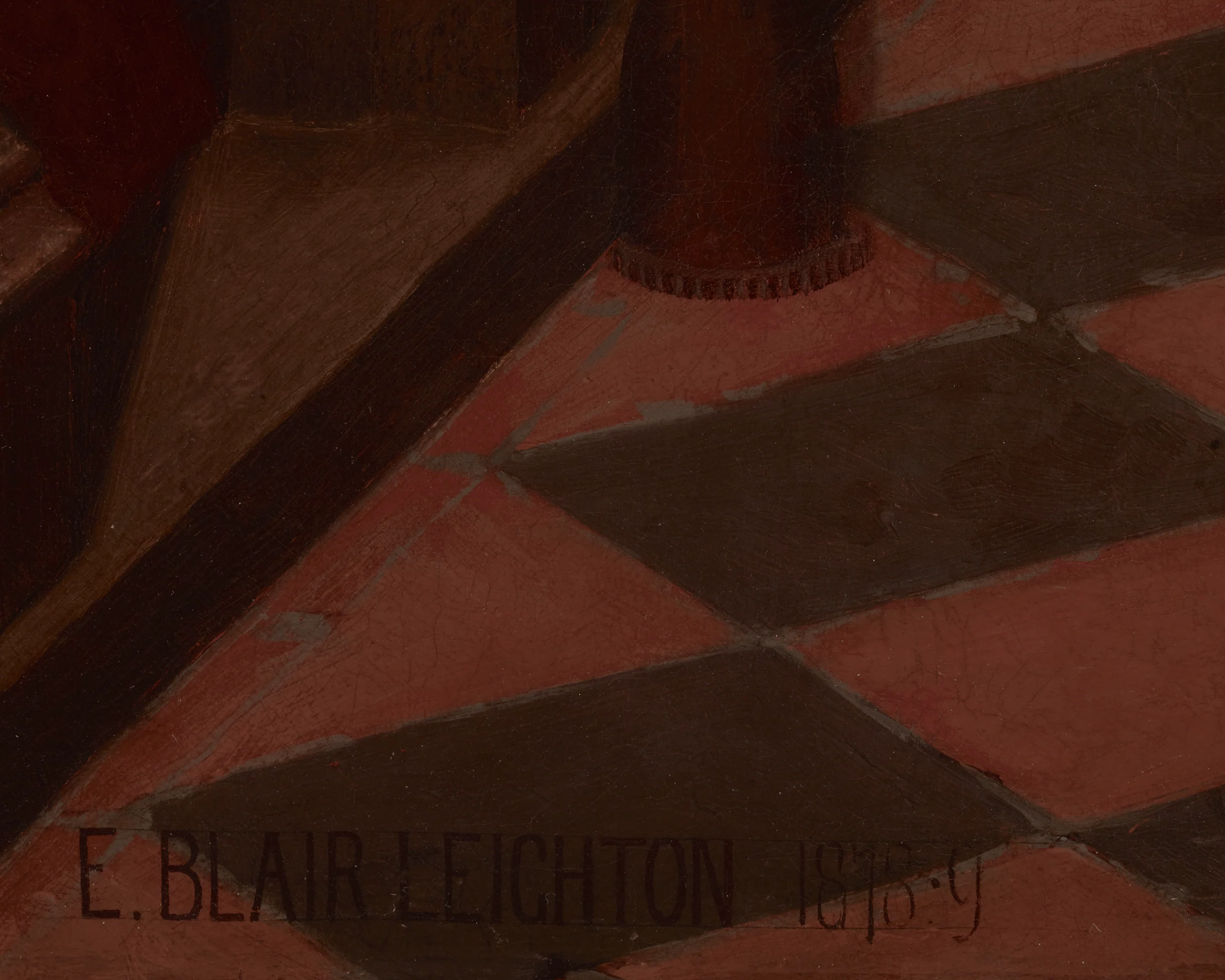
Signed and dated "E. Blair Leighton 1878-9" (lower left)
Oil on canvas
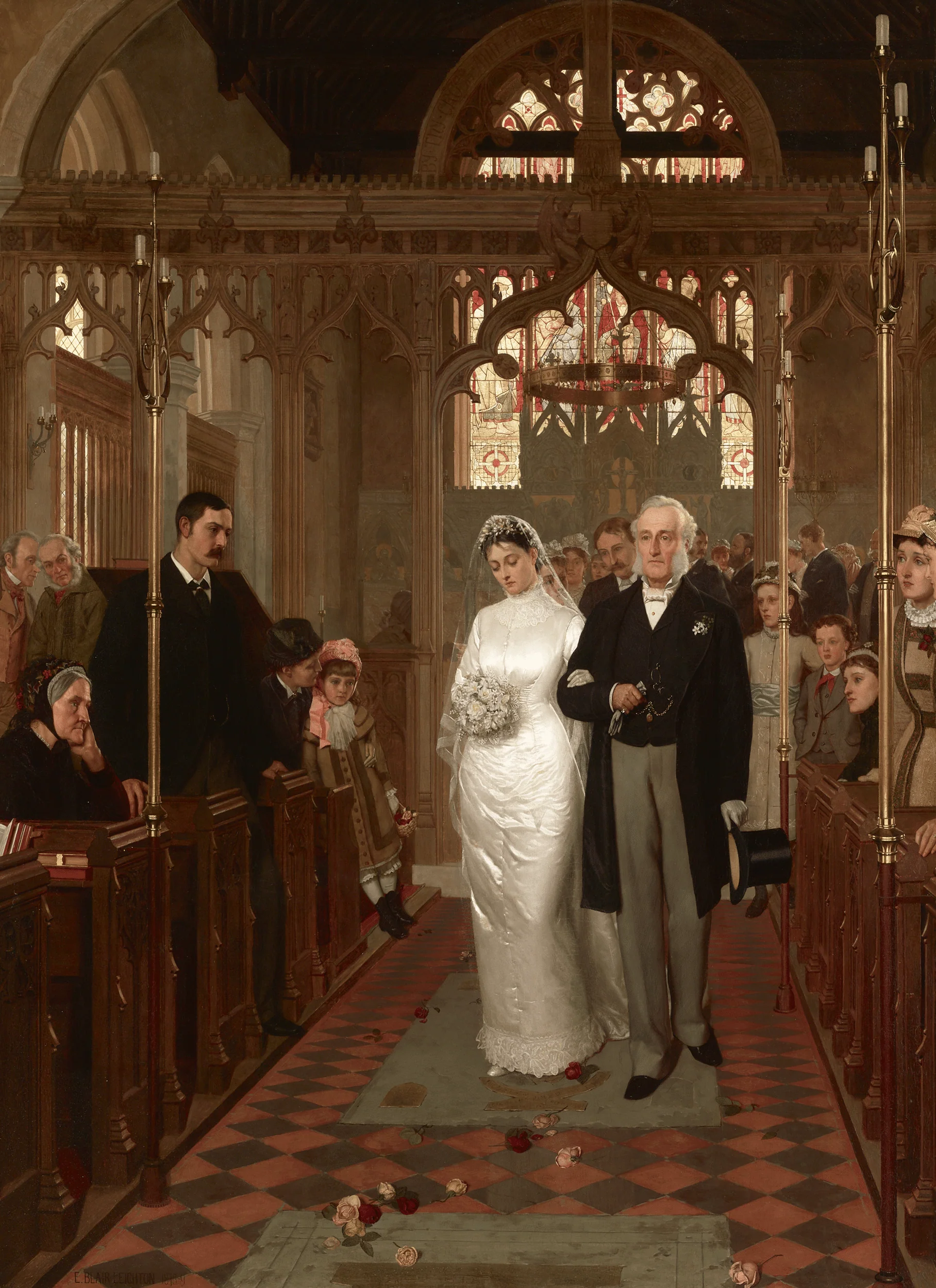
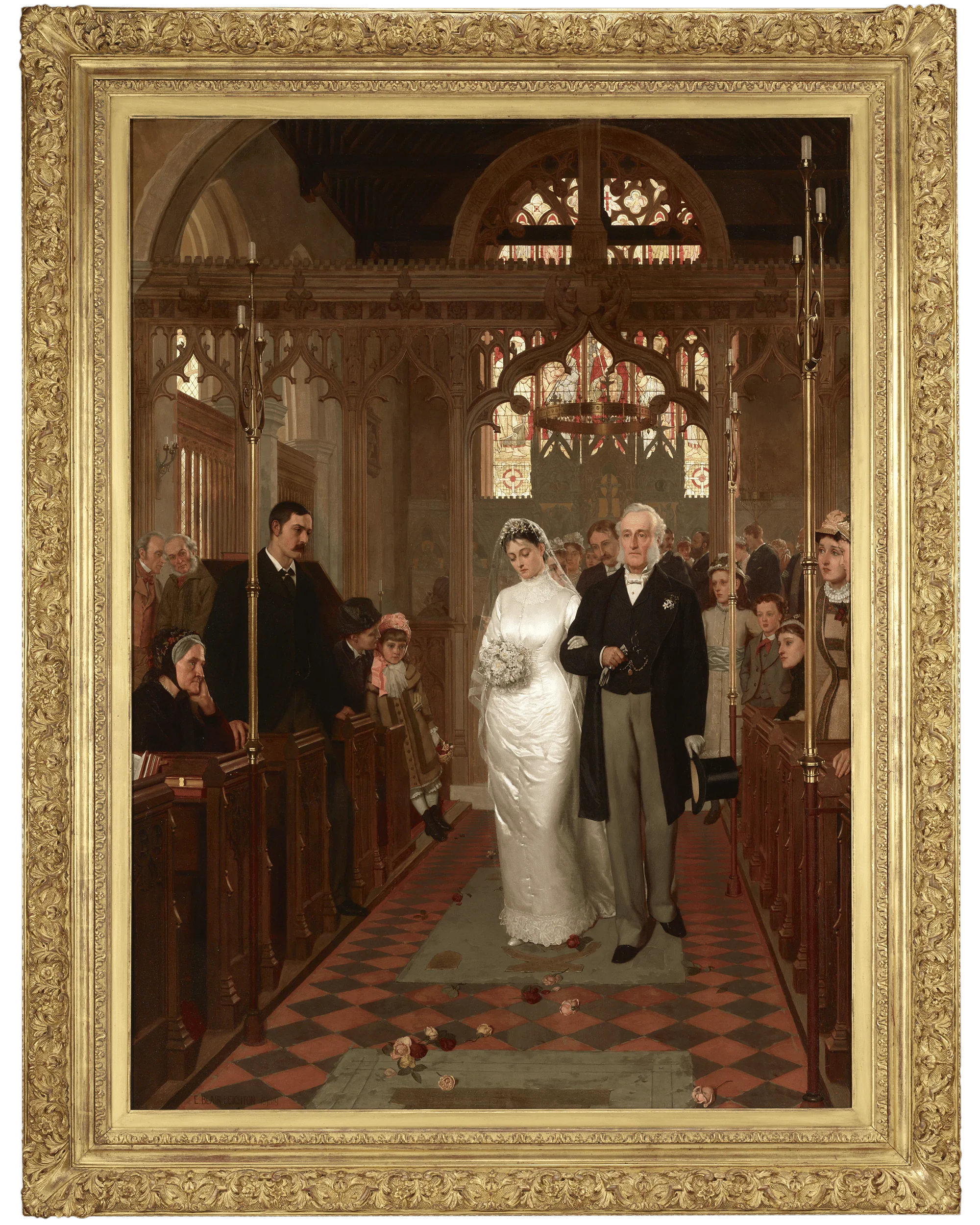
This delightful oil on canvas was composed by the great Regency painter Edmund Blair Leighton. Like many of Leighton’s genre scenes, Till Death Us Do Part is a humorous portrayal of male-female interaction. Walking down the aisle of their wedding ceremony, a beautiful young woman in period dress links arms with her new husband, a gentleman several years her senior. The artist exhibited this work at the Royal Academy in 1879, and when he first sent it to the Academy, he gave it the incisively sarcastic title “L.S.D.“ standing for the Latin phrase ”librae, solidi, denarii.“ The phrase translates to ”pounds, shillings, pence,“ suggesting the woman is marrying for money rather than affection.
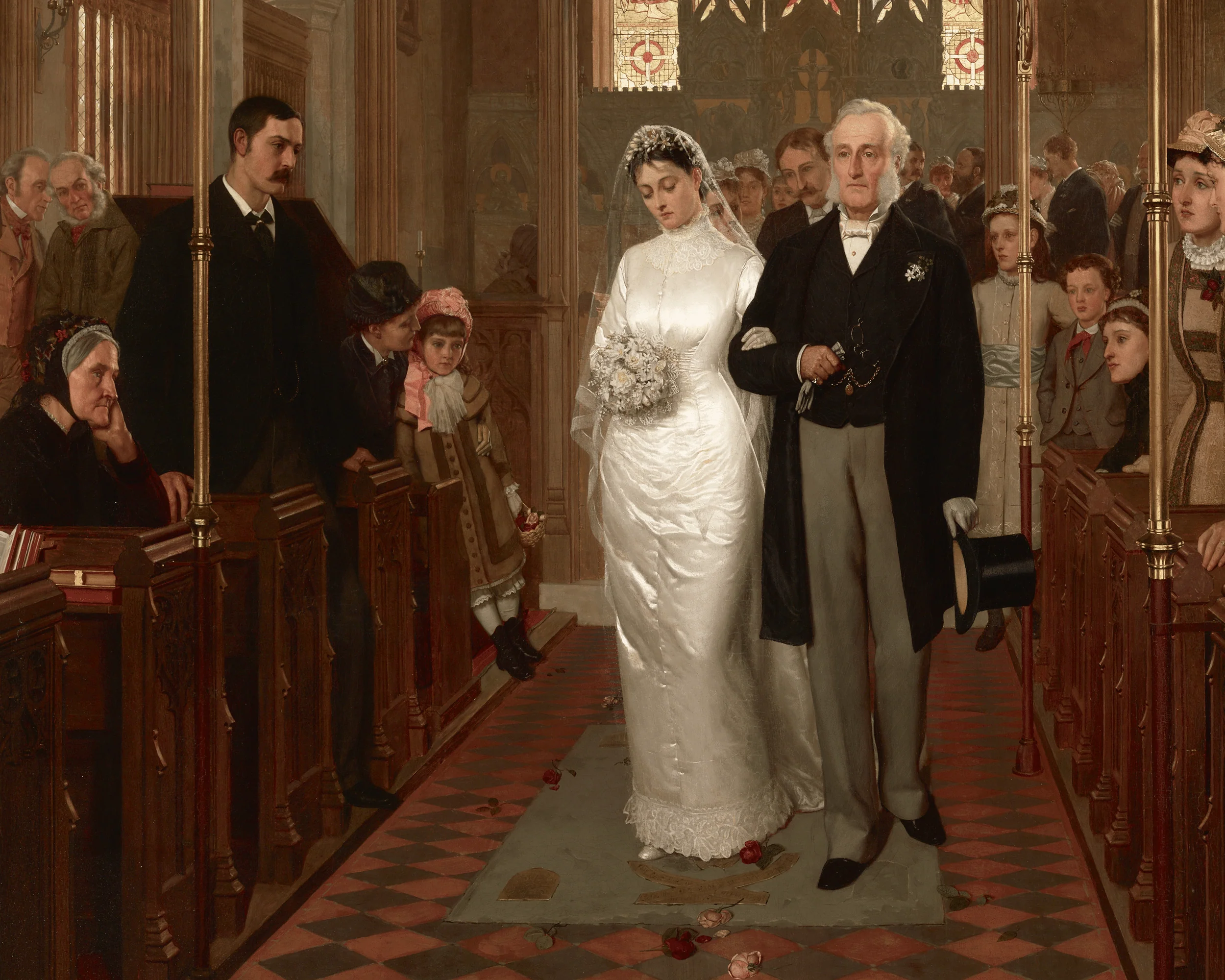
Elaborately detailed, the canvas is filled with wedding guests who whisper and flash disapproving looks, wearing comical expressions ranging from worry to dazed confusion. The bride casts her eyes downward as the “well-wishers” look on, avoiding the gaze of a young man to her right, implying perhaps that they were once to be married instead. The old groom (humorously painted as a self-portrait of the artist) stares ahead, his face blank, oblivious to their connection. Although no one looks happy on this occasion, Leighton is able to infuse the work with the rich narrative detail and his trademark sense of humor that make his canvases an absolute pleasure to view.
This painting once belonged in the collection of Malcolm Forbes, one of the most prolific fine and decorative art collectors of the 20th century. All told, his collection filled six residences across three continents and was internationally renowned for its importance and eclectic nature. At one point, Forbes owned more of the famed Fabergé eggs than were in the country of Russia. He had a particular inclination towards Victorian narrative painters, including the great Edmund Leighton.
Edmund Blair Leighton was the son of Charles Blair Leighton (1823–1855), a portrait and historical painter who showed at the Royal Academy and who died when his son was only three years old. At twelve years of age, he began his studies at the University College School in London, completing his schooling in 1867 at age fifteen. For some time thereafter, he worked for a tea merchant, and after earning a sufficient income to determine his own path in life, Leighton chose to pursue a career as an artist. For six years, he took evening classes in art, both at the South Kensington School of Art and at Heatherley’s School of Art, one of the most venerable private art schools in the United Kingdom. In 1874, Leighton enrolled at the prestigious Royal Academy schools for full-time instruction, and he studied there for another five years, supporting himself financially by producing illustrations for such publications as Cassel & Co. and Harper’s Bazaar.
Leighton first exhibited at the Royal Academy in 1878, beginning a period of over four decades in which he was represented by over sixty artworks at the Royal Academy’s summer annuals. Like many of Heatherley’s most famous students, who include Edward Burne Jones, Dante Gabriel Rossetti and Sir Frederic Leighton, Leighton was a figure painter first and foremost who specialized in historical scenes. Enjoying medieval subjects, he also frequently painted scenes set in Britain’s Regency era, such as the present canvas.
Dated 1878-9
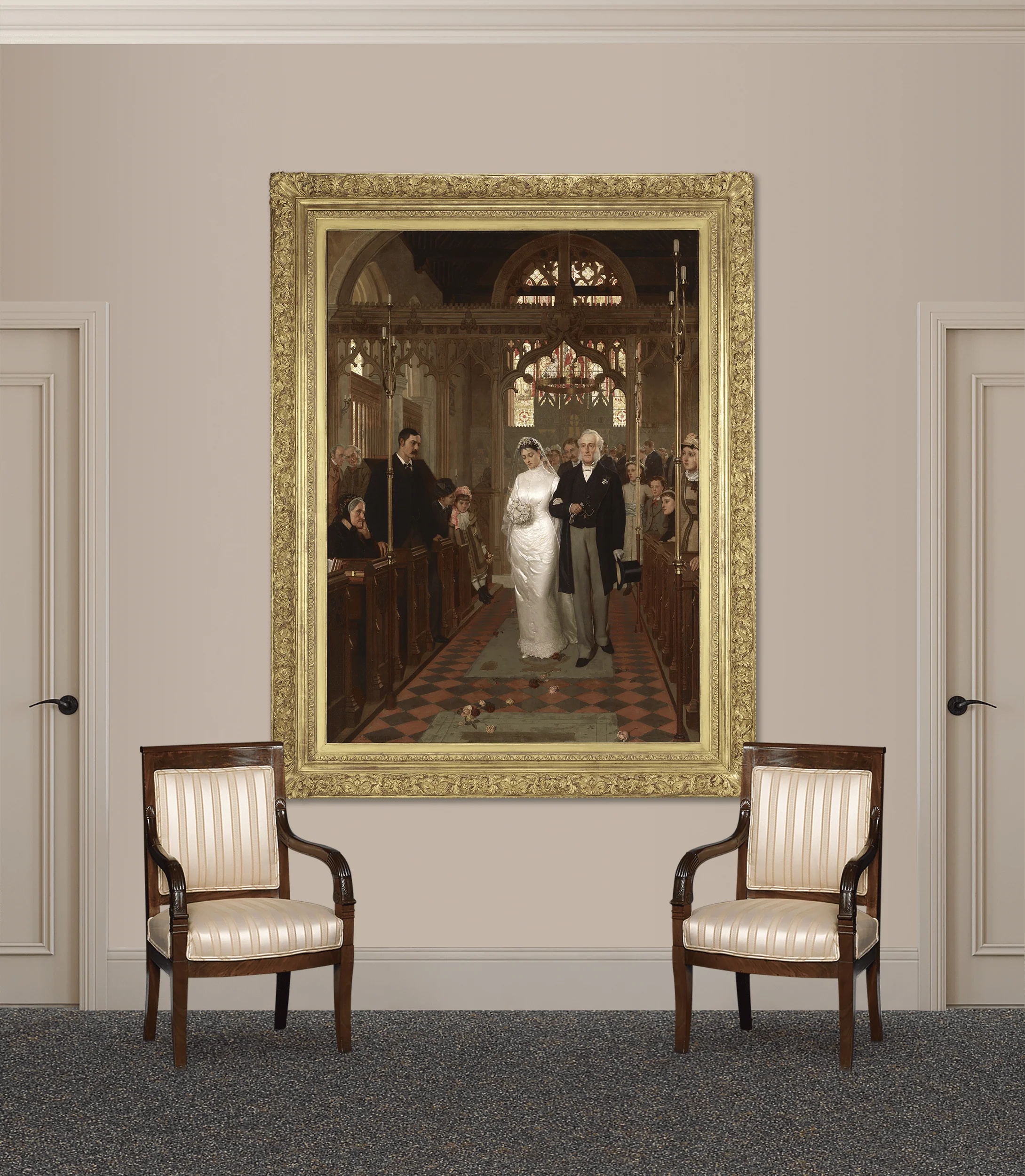
Canvas: 61" high x 44" wide
Frame: 72" high x 56" wide
Exhibited:
London, Royal Academy, 1879, no. 599
Provenance:
Mr. Bromwick, Rugby
Anonymous sale, Miss Cecil Lucas: Sotheby’s, London, 25 October 1977
Forbes Magazine Collection, acquired from the above
The Forbes Collection, Christie’s, London, 19 February 2003
Private collection, acquired from the above
1852-1922 | British
Till Death Us Do Part
Signed and dated "E. Blair Leighton 1878-9" (lower left)
Oil on canvas
This delightful oil on canvas was composed by the great Regency painter Edmund Blair Leighton. Like many of Leighton’s genre scenes, Till Death Us Do Part is a humorous portrayal of male-female interaction. Walking down the aisle of their wedding ceremony, a beautiful young woman in period dress links arms with her new husband, a gentleman several years her senior. The artist exhibited this work at the Royal Academy in 1879, and when he first sent it to the Academy, he gave it the incisively sarcastic title “L.S.D.“ standing for the Latin phrase ”librae, solidi, denarii.“ The phrase translates to ”pounds, shillings, pence,“ suggesting the woman is marrying for money rather than affection.
Elaborately detailed, the canvas is filled with wedding guests who whisper and flash disapproving looks, wearing comical expressions ranging from worry to dazed confusion. The bride casts her eyes downward as the “well-wishers” look on, avoiding the gaze of a young man to her right, implying perhaps that they were once to be married instead. The old groom (humorously painted as a self-portrait of the artist) stares ahead, his face blank, oblivious to their connection. Although no one looks happy on this occasion, Leighton is able to infuse the work with the rich narrative detail and his trademark sense of humor that make his canvases an absolute pleasure to view.
This painting once belonged in the collection of Malcolm Forbes, one of the most prolific fine and decorative art collectors of the 20th century. All told, his collection filled six residences across three continents and was internationally renowned for its importance and eclectic nature. At one point, Forbes owned more of the famed Fabergé eggs than were in the country of Russia. He had a particular inclination towards Victorian narrative painters, including the great Edmund Leighton.
Edmund Blair Leighton was the son of Charles Blair Leighton (1823–1855), a portrait and historical painter who showed at the Royal Academy and who died when his son was only three years old. At twelve years of age, he began his studies at the University College School in London, completing his schooling in 1867 at age fifteen. For some time thereafter, he worked for a tea merchant, and after earning a sufficient income to determine his own path in life, Leighton chose to pursue a career as an artist. For six years, he took evening classes in art, both at the South Kensington School of Art and at Heatherley’s School of Art, one of the most venerable private art schools in the United Kingdom. In 1874, Leighton enrolled at the prestigious Royal Academy schools for full-time instruction, and he studied there for another five years, supporting himself financially by producing illustrations for such publications as Cassel & Co. and Harper’s Bazaar.
Leighton first exhibited at the Royal Academy in 1878, beginning a period of over four decades in which he was represented by over sixty artworks at the Royal Academy’s summer annuals. Like many of Heatherley’s most famous students, who include Edward Burne Jones, Dante Gabriel Rossetti and Sir Frederic Leighton, Leighton was a figure painter first and foremost who specialized in historical scenes. Enjoying medieval subjects, he also frequently painted scenes set in Britain’s Regency era, such as the present canvas.
Dated 1878-9
Canvas: 61" high x 44" wide
Frame: 72" high x 56" wide
Exhibited:
London, Royal Academy, 1879, no. 599
Provenance:
Mr. Bromwick, Rugby
Anonymous sale, Miss Cecil Lucas: Sotheby’s, London, 25 October 1977
Forbes Magazine Collection, acquired from the above
The Forbes Collection, Christie’s, London, 19 February 2003
Private collection, acquired from the above
$104,475.00
Original: $298,500.00
-65%Till Death Us Do Part by Edmund Blair Leighton—
$298,500.00
$104,475.00More Images
Till Death Us Do Part by Edmund Blair Leighton
Edmund Blair Leighton
1852-1922 | British
Till Death Us Do Part
Signed and dated "E. Blair Leighton 1878-9" (lower left)
Oil on canvas
This delightful oil on canvas was composed by the great Regency painter Edmund Blair Leighton. Like many of Leighton’s genre scenes, Till Death Us Do Part is a humorous portrayal of male-female interaction. Walking down the aisle of their wedding ceremony, a beautiful young woman in period dress links arms with her new husband, a gentleman several years her senior. The artist exhibited this work at the Royal Academy in 1879, and when he first sent it to the Academy, he gave it the incisively sarcastic title “L.S.D.“ standing for the Latin phrase ”librae, solidi, denarii.“ The phrase translates to ”pounds, shillings, pence,“ suggesting the woman is marrying for money rather than affection.
Elaborately detailed, the canvas is filled with wedding guests who whisper and flash disapproving looks, wearing comical expressions ranging from worry to dazed confusion. The bride casts her eyes downward as the “well-wishers” look on, avoiding the gaze of a young man to her right, implying perhaps that they were once to be married instead. The old groom (humorously painted as a self-portrait of the artist) stares ahead, his face blank, oblivious to their connection. Although no one looks happy on this occasion, Leighton is able to infuse the work with the rich narrative detail and his trademark sense of humor that make his canvases an absolute pleasure to view.
This painting once belonged in the collection of Malcolm Forbes, one of the most prolific fine and decorative art collectors of the 20th century. All told, his collection filled six residences across three continents and was internationally renowned for its importance and eclectic nature. At one point, Forbes owned more of the famed Fabergé eggs than were in the country of Russia. He had a particular inclination towards Victorian narrative painters, including the great Edmund Leighton.
Edmund Blair Leighton was the son of Charles Blair Leighton (1823–1855), a portrait and historical painter who showed at the Royal Academy and who died when his son was only three years old. At twelve years of age, he began his studies at the University College School in London, completing his schooling in 1867 at age fifteen. For some time thereafter, he worked for a tea merchant, and after earning a sufficient income to determine his own path in life, Leighton chose to pursue a career as an artist. For six years, he took evening classes in art, both at the South Kensington School of Art and at Heatherley’s School of Art, one of the most venerable private art schools in the United Kingdom. In 1874, Leighton enrolled at the prestigious Royal Academy schools for full-time instruction, and he studied there for another five years, supporting himself financially by producing illustrations for such publications as Cassel & Co. and Harper’s Bazaar.
Leighton first exhibited at the Royal Academy in 1878, beginning a period of over four decades in which he was represented by over sixty artworks at the Royal Academy’s summer annuals. Like many of Heatherley’s most famous students, who include Edward Burne Jones, Dante Gabriel Rossetti and Sir Frederic Leighton, Leighton was a figure painter first and foremost who specialized in historical scenes. Enjoying medieval subjects, he also frequently painted scenes set in Britain’s Regency era, such as the present canvas.
Dated 1878-9
Canvas: 61" high x 44" wide
Frame: 72" high x 56" wide
Exhibited:
London, Royal Academy, 1879, no. 599
Provenance:
Mr. Bromwick, Rugby
Anonymous sale, Miss Cecil Lucas: Sotheby’s, London, 25 October 1977
Forbes Magazine Collection, acquired from the above
The Forbes Collection, Christie’s, London, 19 February 2003
Private collection, acquired from the above
1852-1922 | British
Till Death Us Do Part
Signed and dated "E. Blair Leighton 1878-9" (lower left)
Oil on canvas
This delightful oil on canvas was composed by the great Regency painter Edmund Blair Leighton. Like many of Leighton’s genre scenes, Till Death Us Do Part is a humorous portrayal of male-female interaction. Walking down the aisle of their wedding ceremony, a beautiful young woman in period dress links arms with her new husband, a gentleman several years her senior. The artist exhibited this work at the Royal Academy in 1879, and when he first sent it to the Academy, he gave it the incisively sarcastic title “L.S.D.“ standing for the Latin phrase ”librae, solidi, denarii.“ The phrase translates to ”pounds, shillings, pence,“ suggesting the woman is marrying for money rather than affection.
Elaborately detailed, the canvas is filled with wedding guests who whisper and flash disapproving looks, wearing comical expressions ranging from worry to dazed confusion. The bride casts her eyes downward as the “well-wishers” look on, avoiding the gaze of a young man to her right, implying perhaps that they were once to be married instead. The old groom (humorously painted as a self-portrait of the artist) stares ahead, his face blank, oblivious to their connection. Although no one looks happy on this occasion, Leighton is able to infuse the work with the rich narrative detail and his trademark sense of humor that make his canvases an absolute pleasure to view.
This painting once belonged in the collection of Malcolm Forbes, one of the most prolific fine and decorative art collectors of the 20th century. All told, his collection filled six residences across three continents and was internationally renowned for its importance and eclectic nature. At one point, Forbes owned more of the famed Fabergé eggs than were in the country of Russia. He had a particular inclination towards Victorian narrative painters, including the great Edmund Leighton.
Edmund Blair Leighton was the son of Charles Blair Leighton (1823–1855), a portrait and historical painter who showed at the Royal Academy and who died when his son was only three years old. At twelve years of age, he began his studies at the University College School in London, completing his schooling in 1867 at age fifteen. For some time thereafter, he worked for a tea merchant, and after earning a sufficient income to determine his own path in life, Leighton chose to pursue a career as an artist. For six years, he took evening classes in art, both at the South Kensington School of Art and at Heatherley’s School of Art, one of the most venerable private art schools in the United Kingdom. In 1874, Leighton enrolled at the prestigious Royal Academy schools for full-time instruction, and he studied there for another five years, supporting himself financially by producing illustrations for such publications as Cassel & Co. and Harper’s Bazaar.
Leighton first exhibited at the Royal Academy in 1878, beginning a period of over four decades in which he was represented by over sixty artworks at the Royal Academy’s summer annuals. Like many of Heatherley’s most famous students, who include Edward Burne Jones, Dante Gabriel Rossetti and Sir Frederic Leighton, Leighton was a figure painter first and foremost who specialized in historical scenes. Enjoying medieval subjects, he also frequently painted scenes set in Britain’s Regency era, such as the present canvas.
Dated 1878-9
Canvas: 61" high x 44" wide
Frame: 72" high x 56" wide
Exhibited:
London, Royal Academy, 1879, no. 599
Provenance:
Mr. Bromwick, Rugby
Anonymous sale, Miss Cecil Lucas: Sotheby’s, London, 25 October 1977
Forbes Magazine Collection, acquired from the above
The Forbes Collection, Christie’s, London, 19 February 2003
Private collection, acquired from the above
Product Information
Product Information
Shipping & Returns
Shipping & Returns
Description
Edmund Blair Leighton
1852-1922 | British
Till Death Us Do Part
Signed and dated "E. Blair Leighton 1878-9" (lower left)
Oil on canvas
This delightful oil on canvas was composed by the great Regency painter Edmund Blair Leighton. Like many of Leighton’s genre scenes, Till Death Us Do Part is a humorous portrayal of male-female interaction. Walking down the aisle of their wedding ceremony, a beautiful young woman in period dress links arms with her new husband, a gentleman several years her senior. The artist exhibited this work at the Royal Academy in 1879, and when he first sent it to the Academy, he gave it the incisively sarcastic title “L.S.D.“ standing for the Latin phrase ”librae, solidi, denarii.“ The phrase translates to ”pounds, shillings, pence,“ suggesting the woman is marrying for money rather than affection.
Elaborately detailed, the canvas is filled with wedding guests who whisper and flash disapproving looks, wearing comical expressions ranging from worry to dazed confusion. The bride casts her eyes downward as the “well-wishers” look on, avoiding the gaze of a young man to her right, implying perhaps that they were once to be married instead. The old groom (humorously painted as a self-portrait of the artist) stares ahead, his face blank, oblivious to their connection. Although no one looks happy on this occasion, Leighton is able to infuse the work with the rich narrative detail and his trademark sense of humor that make his canvases an absolute pleasure to view.
This painting once belonged in the collection of Malcolm Forbes, one of the most prolific fine and decorative art collectors of the 20th century. All told, his collection filled six residences across three continents and was internationally renowned for its importance and eclectic nature. At one point, Forbes owned more of the famed Fabergé eggs than were in the country of Russia. He had a particular inclination towards Victorian narrative painters, including the great Edmund Leighton.
Edmund Blair Leighton was the son of Charles Blair Leighton (1823–1855), a portrait and historical painter who showed at the Royal Academy and who died when his son was only three years old. At twelve years of age, he began his studies at the University College School in London, completing his schooling in 1867 at age fifteen. For some time thereafter, he worked for a tea merchant, and after earning a sufficient income to determine his own path in life, Leighton chose to pursue a career as an artist. For six years, he took evening classes in art, both at the South Kensington School of Art and at Heatherley’s School of Art, one of the most venerable private art schools in the United Kingdom. In 1874, Leighton enrolled at the prestigious Royal Academy schools for full-time instruction, and he studied there for another five years, supporting himself financially by producing illustrations for such publications as Cassel & Co. and Harper’s Bazaar.
Leighton first exhibited at the Royal Academy in 1878, beginning a period of over four decades in which he was represented by over sixty artworks at the Royal Academy’s summer annuals. Like many of Heatherley’s most famous students, who include Edward Burne Jones, Dante Gabriel Rossetti and Sir Frederic Leighton, Leighton was a figure painter first and foremost who specialized in historical scenes. Enjoying medieval subjects, he also frequently painted scenes set in Britain’s Regency era, such as the present canvas.
Dated 1878-9
Canvas: 61" high x 44" wide
Frame: 72" high x 56" wide
Exhibited:
London, Royal Academy, 1879, no. 599
Provenance:
Mr. Bromwick, Rugby
Anonymous sale, Miss Cecil Lucas: Sotheby’s, London, 25 October 1977
Forbes Magazine Collection, acquired from the above
The Forbes Collection, Christie’s, London, 19 February 2003
Private collection, acquired from the above
1852-1922 | British
Till Death Us Do Part
Signed and dated "E. Blair Leighton 1878-9" (lower left)
Oil on canvas
This delightful oil on canvas was composed by the great Regency painter Edmund Blair Leighton. Like many of Leighton’s genre scenes, Till Death Us Do Part is a humorous portrayal of male-female interaction. Walking down the aisle of their wedding ceremony, a beautiful young woman in period dress links arms with her new husband, a gentleman several years her senior. The artist exhibited this work at the Royal Academy in 1879, and when he first sent it to the Academy, he gave it the incisively sarcastic title “L.S.D.“ standing for the Latin phrase ”librae, solidi, denarii.“ The phrase translates to ”pounds, shillings, pence,“ suggesting the woman is marrying for money rather than affection.
Elaborately detailed, the canvas is filled with wedding guests who whisper and flash disapproving looks, wearing comical expressions ranging from worry to dazed confusion. The bride casts her eyes downward as the “well-wishers” look on, avoiding the gaze of a young man to her right, implying perhaps that they were once to be married instead. The old groom (humorously painted as a self-portrait of the artist) stares ahead, his face blank, oblivious to their connection. Although no one looks happy on this occasion, Leighton is able to infuse the work with the rich narrative detail and his trademark sense of humor that make his canvases an absolute pleasure to view.
This painting once belonged in the collection of Malcolm Forbes, one of the most prolific fine and decorative art collectors of the 20th century. All told, his collection filled six residences across three continents and was internationally renowned for its importance and eclectic nature. At one point, Forbes owned more of the famed Fabergé eggs than were in the country of Russia. He had a particular inclination towards Victorian narrative painters, including the great Edmund Leighton.
Edmund Blair Leighton was the son of Charles Blair Leighton (1823–1855), a portrait and historical painter who showed at the Royal Academy and who died when his son was only three years old. At twelve years of age, he began his studies at the University College School in London, completing his schooling in 1867 at age fifteen. For some time thereafter, he worked for a tea merchant, and after earning a sufficient income to determine his own path in life, Leighton chose to pursue a career as an artist. For six years, he took evening classes in art, both at the South Kensington School of Art and at Heatherley’s School of Art, one of the most venerable private art schools in the United Kingdom. In 1874, Leighton enrolled at the prestigious Royal Academy schools for full-time instruction, and he studied there for another five years, supporting himself financially by producing illustrations for such publications as Cassel & Co. and Harper’s Bazaar.
Leighton first exhibited at the Royal Academy in 1878, beginning a period of over four decades in which he was represented by over sixty artworks at the Royal Academy’s summer annuals. Like many of Heatherley’s most famous students, who include Edward Burne Jones, Dante Gabriel Rossetti and Sir Frederic Leighton, Leighton was a figure painter first and foremost who specialized in historical scenes. Enjoying medieval subjects, he also frequently painted scenes set in Britain’s Regency era, such as the present canvas.
Dated 1878-9
Canvas: 61" high x 44" wide
Frame: 72" high x 56" wide
Exhibited:
London, Royal Academy, 1879, no. 599
Provenance:
Mr. Bromwick, Rugby
Anonymous sale, Miss Cecil Lucas: Sotheby’s, London, 25 October 1977
Forbes Magazine Collection, acquired from the above
The Forbes Collection, Christie’s, London, 19 February 2003
Private collection, acquired from the above