✨ New Arrivals Just Dropped!Explore
Rotterdam, Scène de Port by Maximilien Luce
Maximilien Luce
1858-1941 | French
Rotterdam, Scène de Port
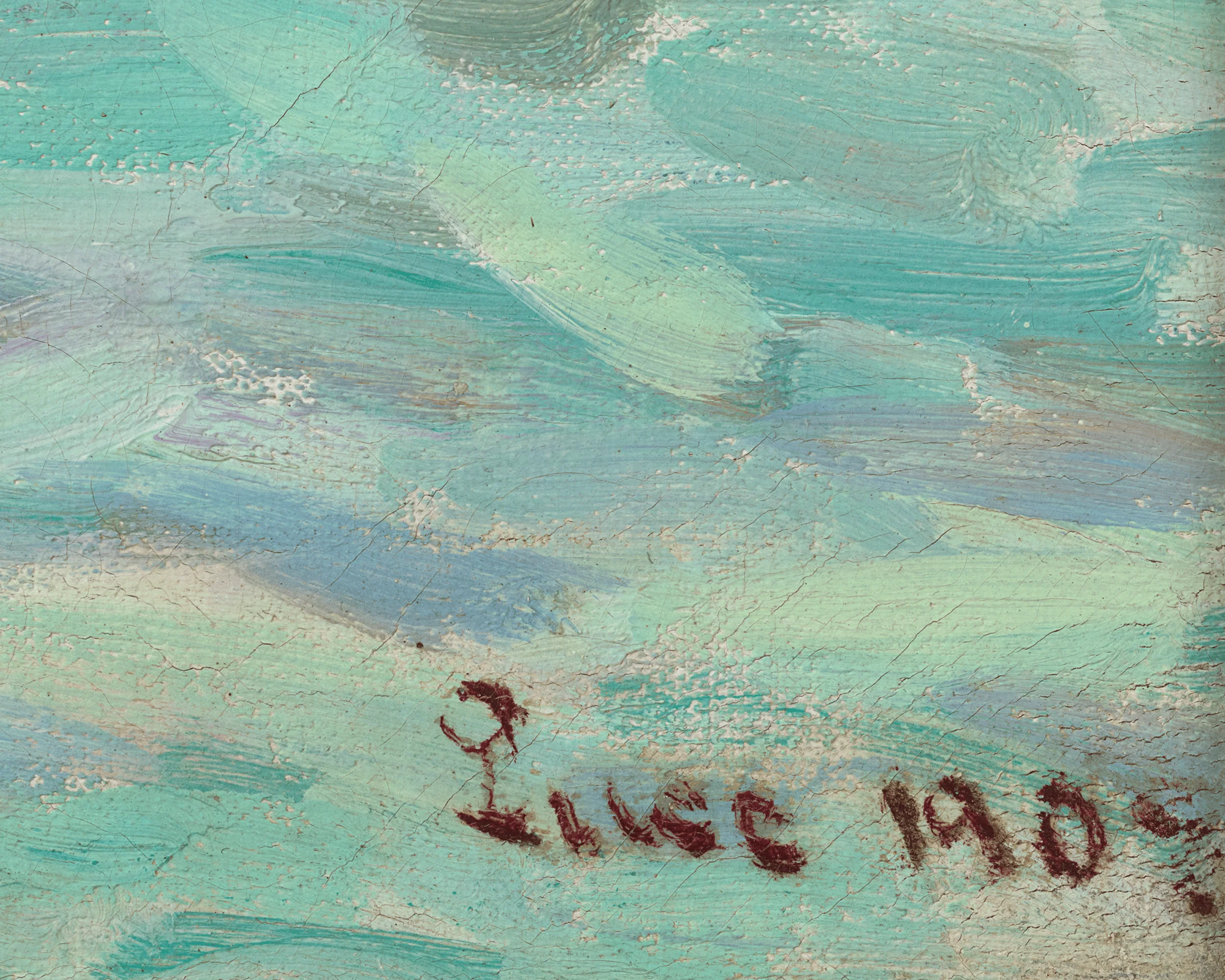
Signed and dated “Luce 1907” (lower right)
Oil on canvas
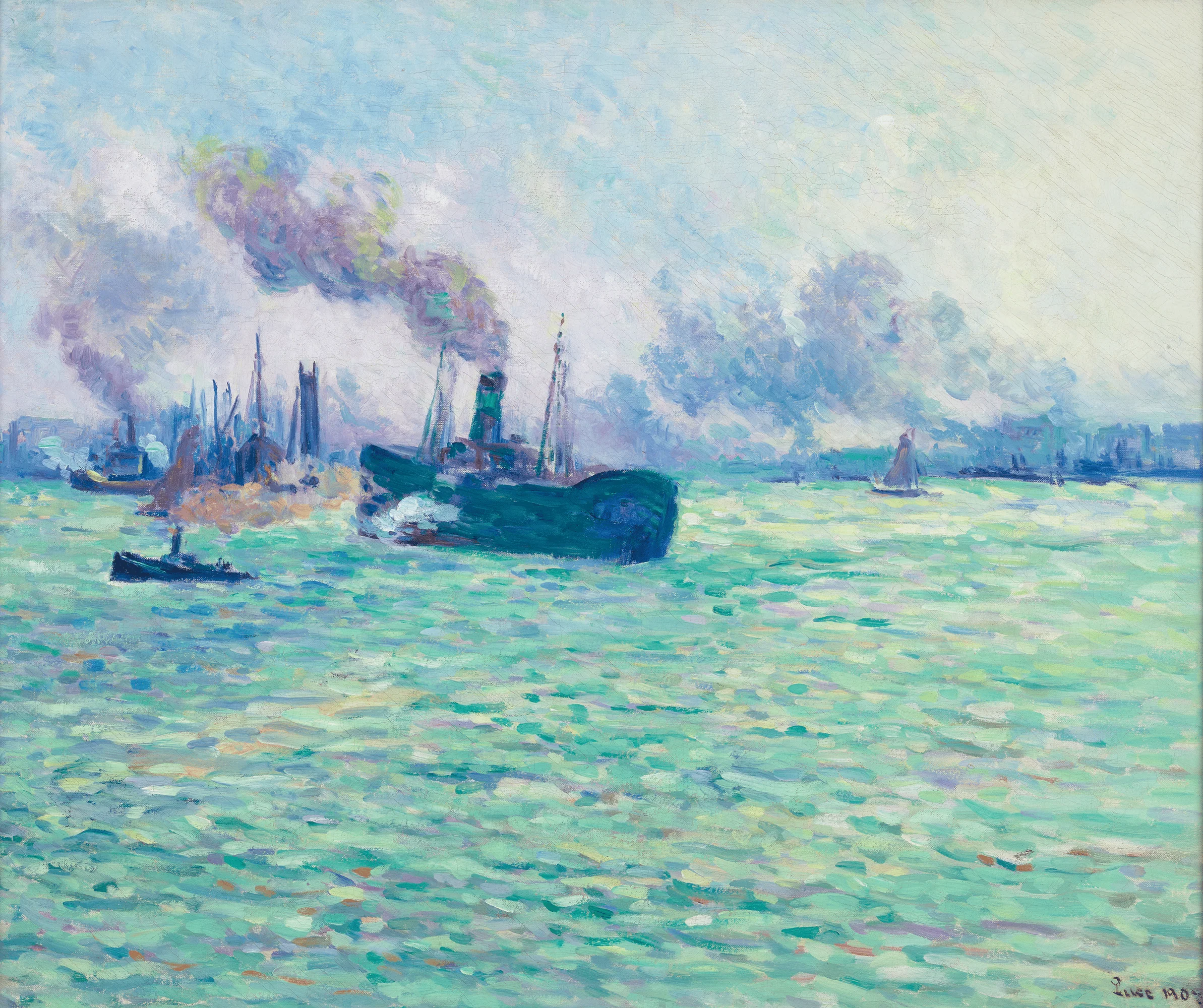
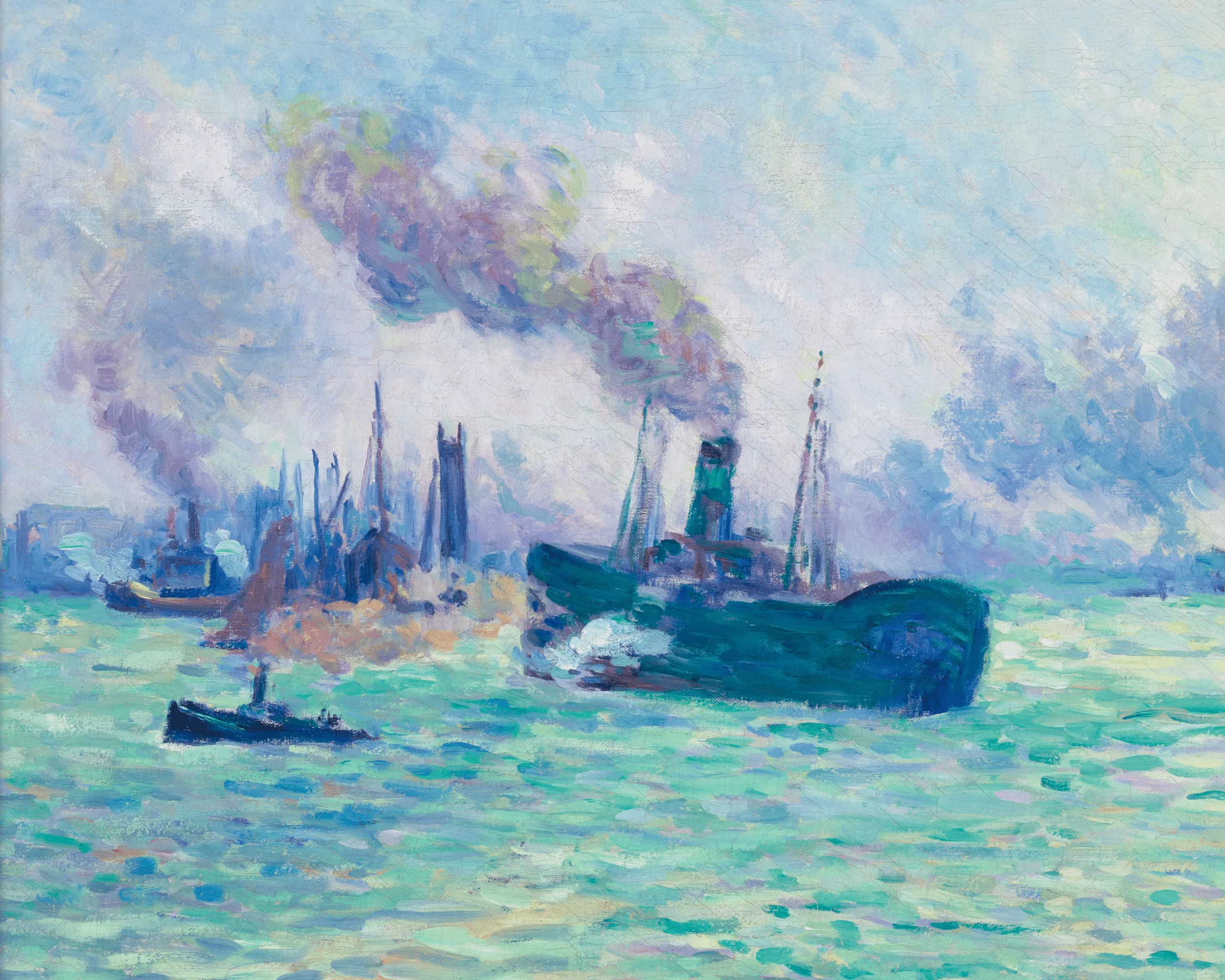
A luminous vision of modern life at the dawn of the 20th century, Rotterdam, Scène de Port is an exceptional work by Maximilien Luce, one of the most important figures of Neo-Impressionism. Painted in 1907, the canvas captures the bustling energy of Rotterdam’s harbor through a dazzling harmony of turquoise, violet, blue and sea-green, transforming an industrial port into a scene of extraordinary atmospheric beauty.
Luce was uniquely suited to this subject. Throughout his career, he found poetry in the modern working world, depicting laborers, construction sites, factories, bridges, ports and city streets with uncommon dignity and brilliance. Rotterdam offered him the perfect union of the themes that defined his art. In this painting, smoke rises from the dark hull of a steamship in soft plumes of lavender and gray, while the harbor glimmers beneath a pale, expansive sky. Rather than presenting industry as harsh or mechanical, Luce renders it radiant and alive.
The Rotterdam subject also holds special significance within the history of Neo-Impressionism. In the spring of 1907, Paul Signac exhibited his monumental Le Port de Rotterdam, now in the Museum Boijmans Van Beuningen, at the Salon des Indépendants, inspiring renewed interest among avant-garde painters in the Dutch harbor. Later that year, Luce traveled to the Netherlands with Kees van Dongen, the Rotterdam-born Fauve artist, and produced a group of works inspired by the port and its surroundings. Rotterdam, Scène de Port belongs to this important artistic moment, when the harbor became a modern subject worthy of the most advanced color theories of the age.
Born in Paris in 1858, Luce first trained as a wood engraver before studying painting and joining the Neo-Impressionist circle in the 1880s. He exhibited with the Société des Artistes Indépendants and became closely associated with Seurat, Signac and Pissarro. Though he later adopted a broader and freer handling of paint, he remained committed throughout his career to brilliant color, modern subjects and the lives of working people. His works are held in major museum collections, including the Musée d’Orsay in Paris, The Metropolitan Museum of Art in New York, the Art Institute of Chicago and the National Gallery of Art in Washington, D.C.
Dated 1907
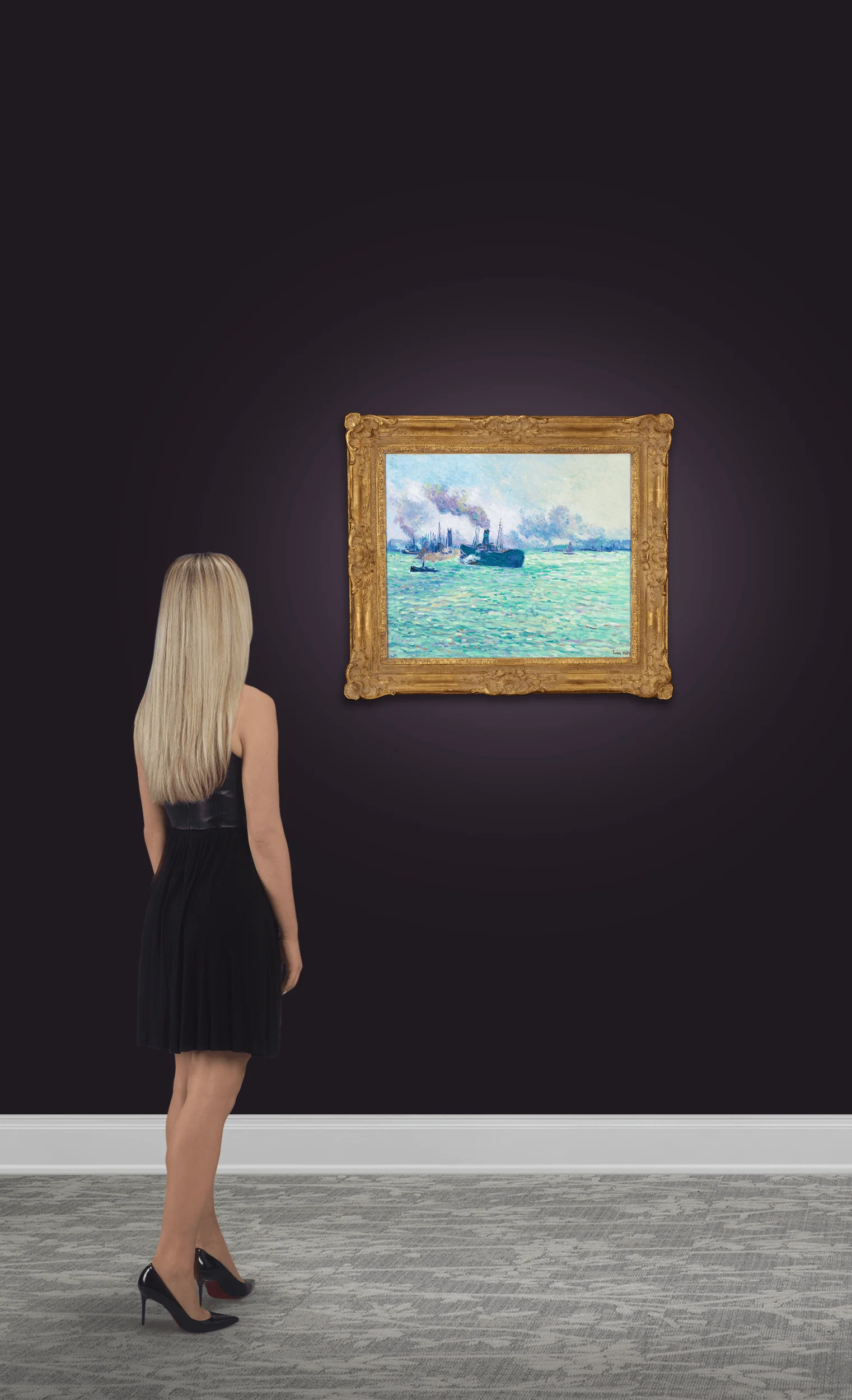
Canvas: 20 3/4" high x 24 3/4" wide (52.7 x 62.9 cm)
Framed: 28 1/2" high x 32 1/2" wide x 3" deep (72.4 x 82.6 x 7.6 cm)
Provenance:
Sale: Palais Galliera, Paris, 16th June 1961, lot 179
Private Collection, Switzerland
Sale of the above, Sotheby's, London, 29th March 1984, lot 535
Private Collection, Kentucky, purchased at the above sale
Private Collection, USA
Private Collection, Europe
Stern Pissarro Gallery, London
Private collection, London
M.S. Rau, New Orleans
Literature:
Denise Bazetoux, Maximilien Luce, Catalogue raisonné de l'œuvre peint, Paris, 1986, vol. II, no. 1486, illustrated p. 366
1858-1941 | French
Rotterdam, Scène de Port
Signed and dated “Luce 1907” (lower right)
Oil on canvas
A luminous vision of modern life at the dawn of the 20th century, Rotterdam, Scène de Port is an exceptional work by Maximilien Luce, one of the most important figures of Neo-Impressionism. Painted in 1907, the canvas captures the bustling energy of Rotterdam’s harbor through a dazzling harmony of turquoise, violet, blue and sea-green, transforming an industrial port into a scene of extraordinary atmospheric beauty.
Luce was uniquely suited to this subject. Throughout his career, he found poetry in the modern working world, depicting laborers, construction sites, factories, bridges, ports and city streets with uncommon dignity and brilliance. Rotterdam offered him the perfect union of the themes that defined his art. In this painting, smoke rises from the dark hull of a steamship in soft plumes of lavender and gray, while the harbor glimmers beneath a pale, expansive sky. Rather than presenting industry as harsh or mechanical, Luce renders it radiant and alive.
The Rotterdam subject also holds special significance within the history of Neo-Impressionism. In the spring of 1907, Paul Signac exhibited his monumental Le Port de Rotterdam, now in the Museum Boijmans Van Beuningen, at the Salon des Indépendants, inspiring renewed interest among avant-garde painters in the Dutch harbor. Later that year, Luce traveled to the Netherlands with Kees van Dongen, the Rotterdam-born Fauve artist, and produced a group of works inspired by the port and its surroundings. Rotterdam, Scène de Port belongs to this important artistic moment, when the harbor became a modern subject worthy of the most advanced color theories of the age.
Born in Paris in 1858, Luce first trained as a wood engraver before studying painting and joining the Neo-Impressionist circle in the 1880s. He exhibited with the Société des Artistes Indépendants and became closely associated with Seurat, Signac and Pissarro. Though he later adopted a broader and freer handling of paint, he remained committed throughout his career to brilliant color, modern subjects and the lives of working people. His works are held in major museum collections, including the Musée d’Orsay in Paris, The Metropolitan Museum of Art in New York, the Art Institute of Chicago and the National Gallery of Art in Washington, D.C.
Dated 1907
Canvas: 20 3/4" high x 24 3/4" wide (52.7 x 62.9 cm)
Framed: 28 1/2" high x 32 1/2" wide x 3" deep (72.4 x 82.6 x 7.6 cm)
Provenance:
Sale: Palais Galliera, Paris, 16th June 1961, lot 179
Private Collection, Switzerland
Sale of the above, Sotheby's, London, 29th March 1984, lot 535
Private Collection, Kentucky, purchased at the above sale
Private Collection, USA
Private Collection, Europe
Stern Pissarro Gallery, London
Private collection, London
M.S. Rau, New Orleans
Literature:
Denise Bazetoux, Maximilien Luce, Catalogue raisonné de l'œuvre peint, Paris, 1986, vol. II, no. 1486, illustrated p. 366
$48,475.00
Original: $138,500.00
-65%Rotterdam, Scène de Port by Maximilien Luce—
$138,500.00
$48,475.00More Images
Rotterdam, Scène de Port by Maximilien Luce
Maximilien Luce
1858-1941 | French
Rotterdam, Scène de Port
Signed and dated “Luce 1907” (lower right)
Oil on canvas
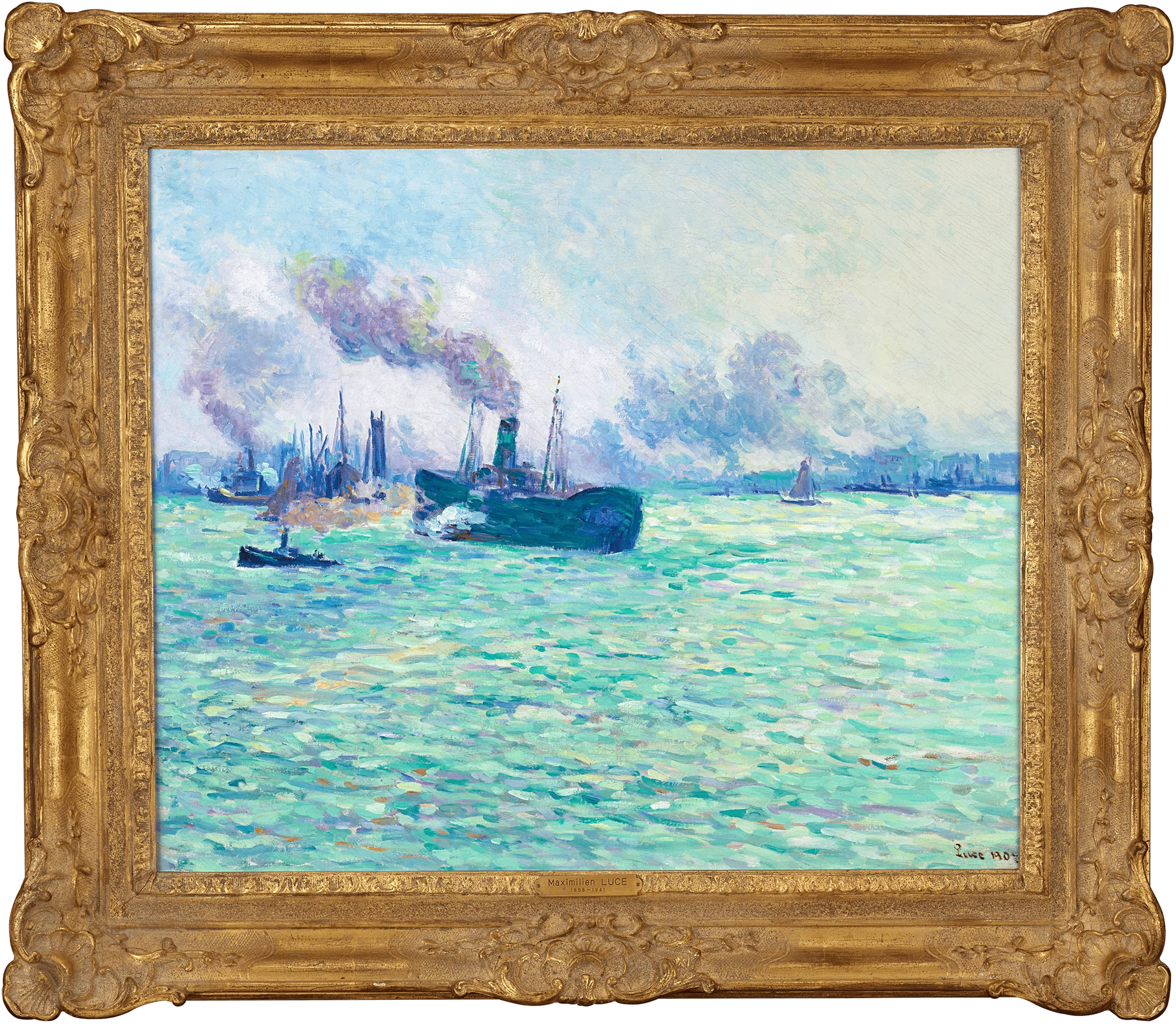
A luminous vision of modern life at the dawn of the 20th century, Rotterdam, Scène de Port is an exceptional work by Maximilien Luce, one of the most important figures of Neo-Impressionism. Painted in 1907, the canvas captures the bustling energy of Rotterdam’s harbor through a dazzling harmony of turquoise, violet, blue and sea-green, transforming an industrial port into a scene of extraordinary atmospheric beauty.
Luce was uniquely suited to this subject. Throughout his career, he found poetry in the modern working world, depicting laborers, construction sites, factories, bridges, ports and city streets with uncommon dignity and brilliance. Rotterdam offered him the perfect union of the themes that defined his art. In this painting, smoke rises from the dark hull of a steamship in soft plumes of lavender and gray, while the harbor glimmers beneath a pale, expansive sky. Rather than presenting industry as harsh or mechanical, Luce renders it radiant and alive.
The Rotterdam subject also holds special significance within the history of Neo-Impressionism. In the spring of 1907, Paul Signac exhibited his monumental Le Port de Rotterdam, now in the Museum Boijmans Van Beuningen, at the Salon des Indépendants, inspiring renewed interest among avant-garde painters in the Dutch harbor. Later that year, Luce traveled to the Netherlands with Kees van Dongen, the Rotterdam-born Fauve artist, and produced a group of works inspired by the port and its surroundings. Rotterdam, Scène de Port belongs to this important artistic moment, when the harbor became a modern subject worthy of the most advanced color theories of the age.
Born in Paris in 1858, Luce first trained as a wood engraver before studying painting and joining the Neo-Impressionist circle in the 1880s. He exhibited with the Société des Artistes Indépendants and became closely associated with Seurat, Signac and Pissarro. Though he later adopted a broader and freer handling of paint, he remained committed throughout his career to brilliant color, modern subjects and the lives of working people. His works are held in major museum collections, including the Musée d’Orsay in Paris, The Metropolitan Museum of Art in New York, the Art Institute of Chicago and the National Gallery of Art in Washington, D.C.
Dated 1907
Canvas: 20 3/4" high x 24 3/4" wide (52.7 x 62.9 cm)
Framed: 28 1/2" high x 32 1/2" wide x 3" deep (72.4 x 82.6 x 7.6 cm)
Provenance:
Sale: Palais Galliera, Paris, 16th June 1961, lot 179
Private Collection, Switzerland
Sale of the above, Sotheby's, London, 29th March 1984, lot 535
Private Collection, Kentucky, purchased at the above sale
Private Collection, USA
Private Collection, Europe
Stern Pissarro Gallery, London
Private collection, London
M.S. Rau, New Orleans
Literature:
Denise Bazetoux, Maximilien Luce, Catalogue raisonné de l'œuvre peint, Paris, 1986, vol. II, no. 1486, illustrated p. 366
1858-1941 | French
Rotterdam, Scène de Port
Signed and dated “Luce 1907” (lower right)
Oil on canvas
A luminous vision of modern life at the dawn of the 20th century, Rotterdam, Scène de Port is an exceptional work by Maximilien Luce, one of the most important figures of Neo-Impressionism. Painted in 1907, the canvas captures the bustling energy of Rotterdam’s harbor through a dazzling harmony of turquoise, violet, blue and sea-green, transforming an industrial port into a scene of extraordinary atmospheric beauty.
Luce was uniquely suited to this subject. Throughout his career, he found poetry in the modern working world, depicting laborers, construction sites, factories, bridges, ports and city streets with uncommon dignity and brilliance. Rotterdam offered him the perfect union of the themes that defined his art. In this painting, smoke rises from the dark hull of a steamship in soft plumes of lavender and gray, while the harbor glimmers beneath a pale, expansive sky. Rather than presenting industry as harsh or mechanical, Luce renders it radiant and alive.
The Rotterdam subject also holds special significance within the history of Neo-Impressionism. In the spring of 1907, Paul Signac exhibited his monumental Le Port de Rotterdam, now in the Museum Boijmans Van Beuningen, at the Salon des Indépendants, inspiring renewed interest among avant-garde painters in the Dutch harbor. Later that year, Luce traveled to the Netherlands with Kees van Dongen, the Rotterdam-born Fauve artist, and produced a group of works inspired by the port and its surroundings. Rotterdam, Scène de Port belongs to this important artistic moment, when the harbor became a modern subject worthy of the most advanced color theories of the age.
Born in Paris in 1858, Luce first trained as a wood engraver before studying painting and joining the Neo-Impressionist circle in the 1880s. He exhibited with the Société des Artistes Indépendants and became closely associated with Seurat, Signac and Pissarro. Though he later adopted a broader and freer handling of paint, he remained committed throughout his career to brilliant color, modern subjects and the lives of working people. His works are held in major museum collections, including the Musée d’Orsay in Paris, The Metropolitan Museum of Art in New York, the Art Institute of Chicago and the National Gallery of Art in Washington, D.C.
Dated 1907
Canvas: 20 3/4" high x 24 3/4" wide (52.7 x 62.9 cm)
Framed: 28 1/2" high x 32 1/2" wide x 3" deep (72.4 x 82.6 x 7.6 cm)
Provenance:
Sale: Palais Galliera, Paris, 16th June 1961, lot 179
Private Collection, Switzerland
Sale of the above, Sotheby's, London, 29th March 1984, lot 535
Private Collection, Kentucky, purchased at the above sale
Private Collection, USA
Private Collection, Europe
Stern Pissarro Gallery, London
Private collection, London
M.S. Rau, New Orleans
Literature:
Denise Bazetoux, Maximilien Luce, Catalogue raisonné de l'œuvre peint, Paris, 1986, vol. II, no. 1486, illustrated p. 366
Product Information
Product Information
Shipping & Returns
Shipping & Returns
Description
Maximilien Luce
1858-1941 | French
Rotterdam, Scène de Port
Signed and dated “Luce 1907” (lower right)
Oil on canvas
A luminous vision of modern life at the dawn of the 20th century, Rotterdam, Scène de Port is an exceptional work by Maximilien Luce, one of the most important figures of Neo-Impressionism. Painted in 1907, the canvas captures the bustling energy of Rotterdam’s harbor through a dazzling harmony of turquoise, violet, blue and sea-green, transforming an industrial port into a scene of extraordinary atmospheric beauty.
Luce was uniquely suited to this subject. Throughout his career, he found poetry in the modern working world, depicting laborers, construction sites, factories, bridges, ports and city streets with uncommon dignity and brilliance. Rotterdam offered him the perfect union of the themes that defined his art. In this painting, smoke rises from the dark hull of a steamship in soft plumes of lavender and gray, while the harbor glimmers beneath a pale, expansive sky. Rather than presenting industry as harsh or mechanical, Luce renders it radiant and alive.
The Rotterdam subject also holds special significance within the history of Neo-Impressionism. In the spring of 1907, Paul Signac exhibited his monumental Le Port de Rotterdam, now in the Museum Boijmans Van Beuningen, at the Salon des Indépendants, inspiring renewed interest among avant-garde painters in the Dutch harbor. Later that year, Luce traveled to the Netherlands with Kees van Dongen, the Rotterdam-born Fauve artist, and produced a group of works inspired by the port and its surroundings. Rotterdam, Scène de Port belongs to this important artistic moment, when the harbor became a modern subject worthy of the most advanced color theories of the age.
Born in Paris in 1858, Luce first trained as a wood engraver before studying painting and joining the Neo-Impressionist circle in the 1880s. He exhibited with the Société des Artistes Indépendants and became closely associated with Seurat, Signac and Pissarro. Though he later adopted a broader and freer handling of paint, he remained committed throughout his career to brilliant color, modern subjects and the lives of working people. His works are held in major museum collections, including the Musée d’Orsay in Paris, The Metropolitan Museum of Art in New York, the Art Institute of Chicago and the National Gallery of Art in Washington, D.C.
Dated 1907
Canvas: 20 3/4" high x 24 3/4" wide (52.7 x 62.9 cm)
Framed: 28 1/2" high x 32 1/2" wide x 3" deep (72.4 x 82.6 x 7.6 cm)
Provenance:
Sale: Palais Galliera, Paris, 16th June 1961, lot 179
Private Collection, Switzerland
Sale of the above, Sotheby's, London, 29th March 1984, lot 535
Private Collection, Kentucky, purchased at the above sale
Private Collection, USA
Private Collection, Europe
Stern Pissarro Gallery, London
Private collection, London
M.S. Rau, New Orleans
Literature:
Denise Bazetoux, Maximilien Luce, Catalogue raisonné de l'œuvre peint, Paris, 1986, vol. II, no. 1486, illustrated p. 366
1858-1941 | French
Rotterdam, Scène de Port
Signed and dated “Luce 1907” (lower right)
Oil on canvas
A luminous vision of modern life at the dawn of the 20th century, Rotterdam, Scène de Port is an exceptional work by Maximilien Luce, one of the most important figures of Neo-Impressionism. Painted in 1907, the canvas captures the bustling energy of Rotterdam’s harbor through a dazzling harmony of turquoise, violet, blue and sea-green, transforming an industrial port into a scene of extraordinary atmospheric beauty.
Luce was uniquely suited to this subject. Throughout his career, he found poetry in the modern working world, depicting laborers, construction sites, factories, bridges, ports and city streets with uncommon dignity and brilliance. Rotterdam offered him the perfect union of the themes that defined his art. In this painting, smoke rises from the dark hull of a steamship in soft plumes of lavender and gray, while the harbor glimmers beneath a pale, expansive sky. Rather than presenting industry as harsh or mechanical, Luce renders it radiant and alive.
The Rotterdam subject also holds special significance within the history of Neo-Impressionism. In the spring of 1907, Paul Signac exhibited his monumental Le Port de Rotterdam, now in the Museum Boijmans Van Beuningen, at the Salon des Indépendants, inspiring renewed interest among avant-garde painters in the Dutch harbor. Later that year, Luce traveled to the Netherlands with Kees van Dongen, the Rotterdam-born Fauve artist, and produced a group of works inspired by the port and its surroundings. Rotterdam, Scène de Port belongs to this important artistic moment, when the harbor became a modern subject worthy of the most advanced color theories of the age.
Born in Paris in 1858, Luce first trained as a wood engraver before studying painting and joining the Neo-Impressionist circle in the 1880s. He exhibited with the Société des Artistes Indépendants and became closely associated with Seurat, Signac and Pissarro. Though he later adopted a broader and freer handling of paint, he remained committed throughout his career to brilliant color, modern subjects and the lives of working people. His works are held in major museum collections, including the Musée d’Orsay in Paris, The Metropolitan Museum of Art in New York, the Art Institute of Chicago and the National Gallery of Art in Washington, D.C.
Dated 1907
Canvas: 20 3/4" high x 24 3/4" wide (52.7 x 62.9 cm)
Framed: 28 1/2" high x 32 1/2" wide x 3" deep (72.4 x 82.6 x 7.6 cm)
Provenance:
Sale: Palais Galliera, Paris, 16th June 1961, lot 179
Private Collection, Switzerland
Sale of the above, Sotheby's, London, 29th March 1984, lot 535
Private Collection, Kentucky, purchased at the above sale
Private Collection, USA
Private Collection, Europe
Stern Pissarro Gallery, London
Private collection, London
M.S. Rau, New Orleans
Literature:
Denise Bazetoux, Maximilien Luce, Catalogue raisonné de l'œuvre peint, Paris, 1986, vol. II, no. 1486, illustrated p. 366