✨ New Arrivals Just Dropped!Explore
Lilac by Marie Egner
Marie Egner
1850-1940 | Austrian
Lilac
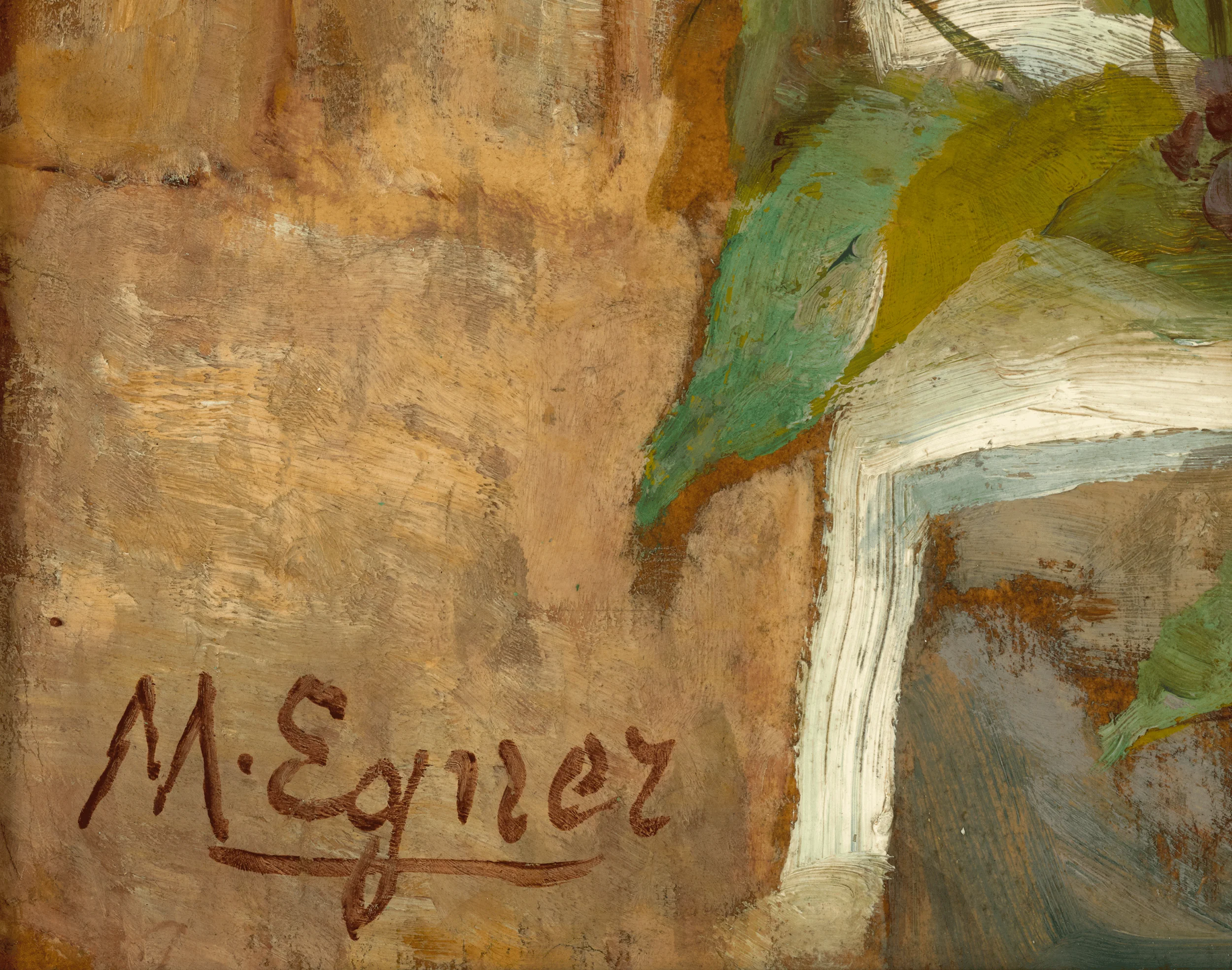
Signed "M. Egner" (lower left)
Oil on board on canvas
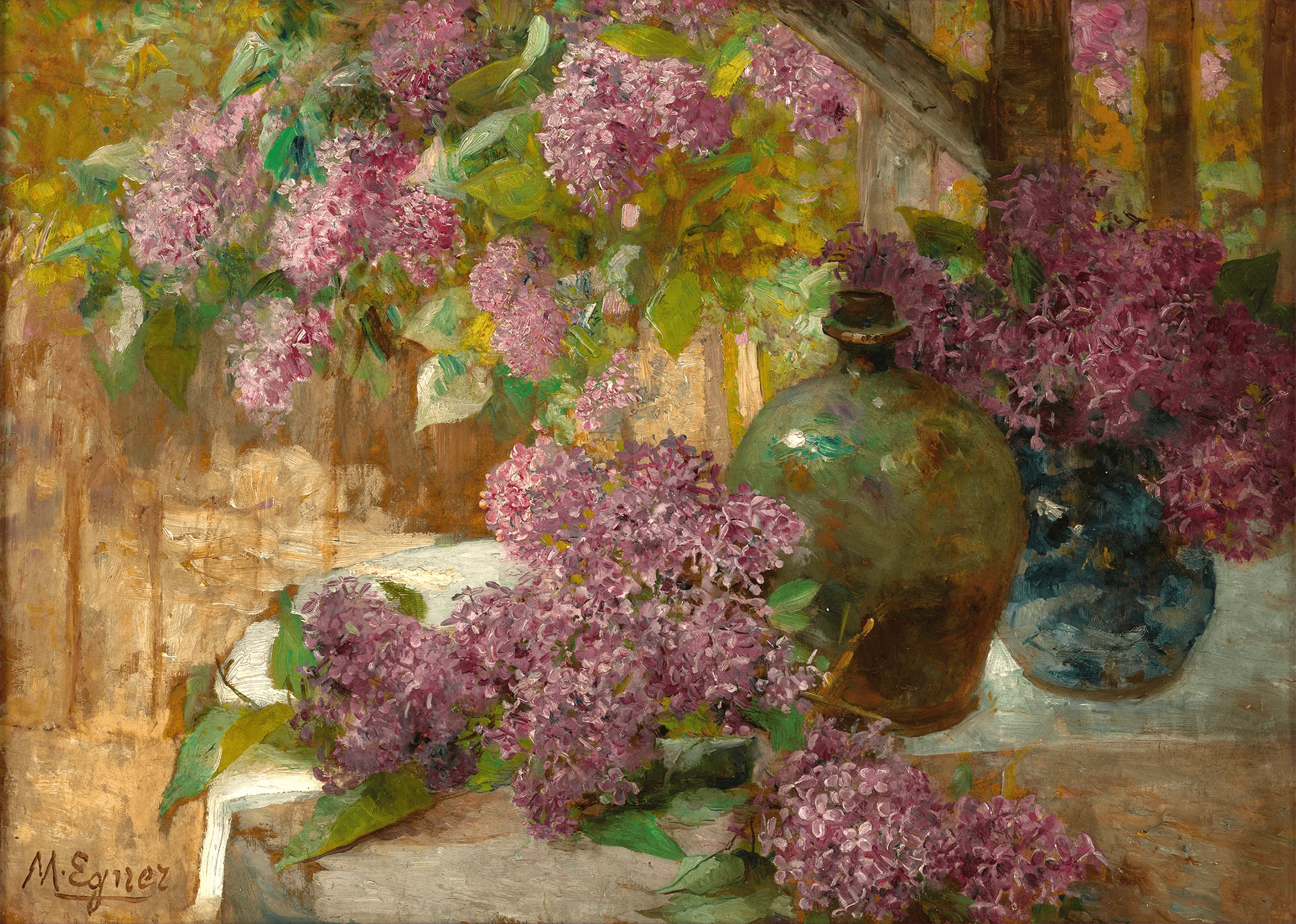
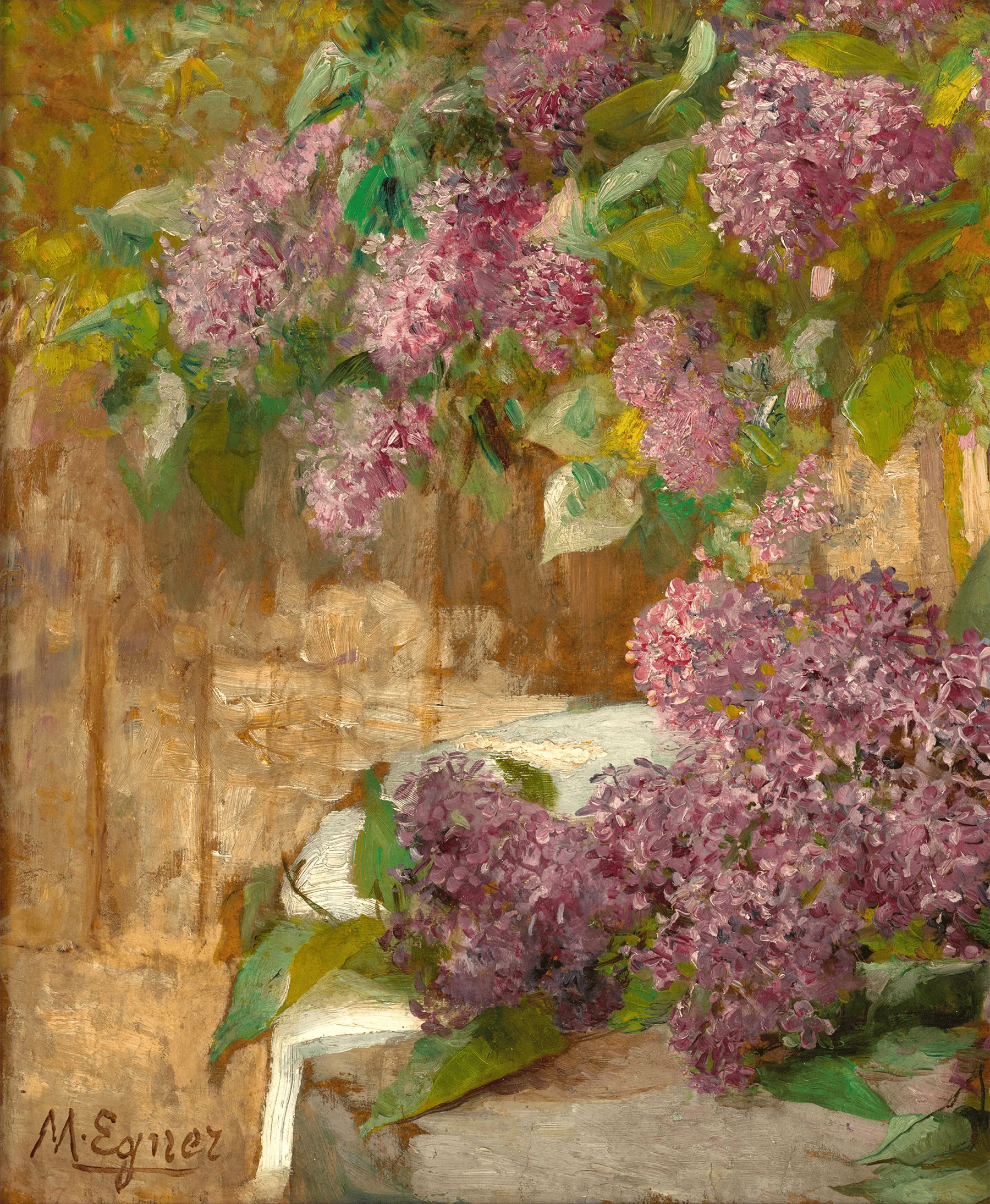
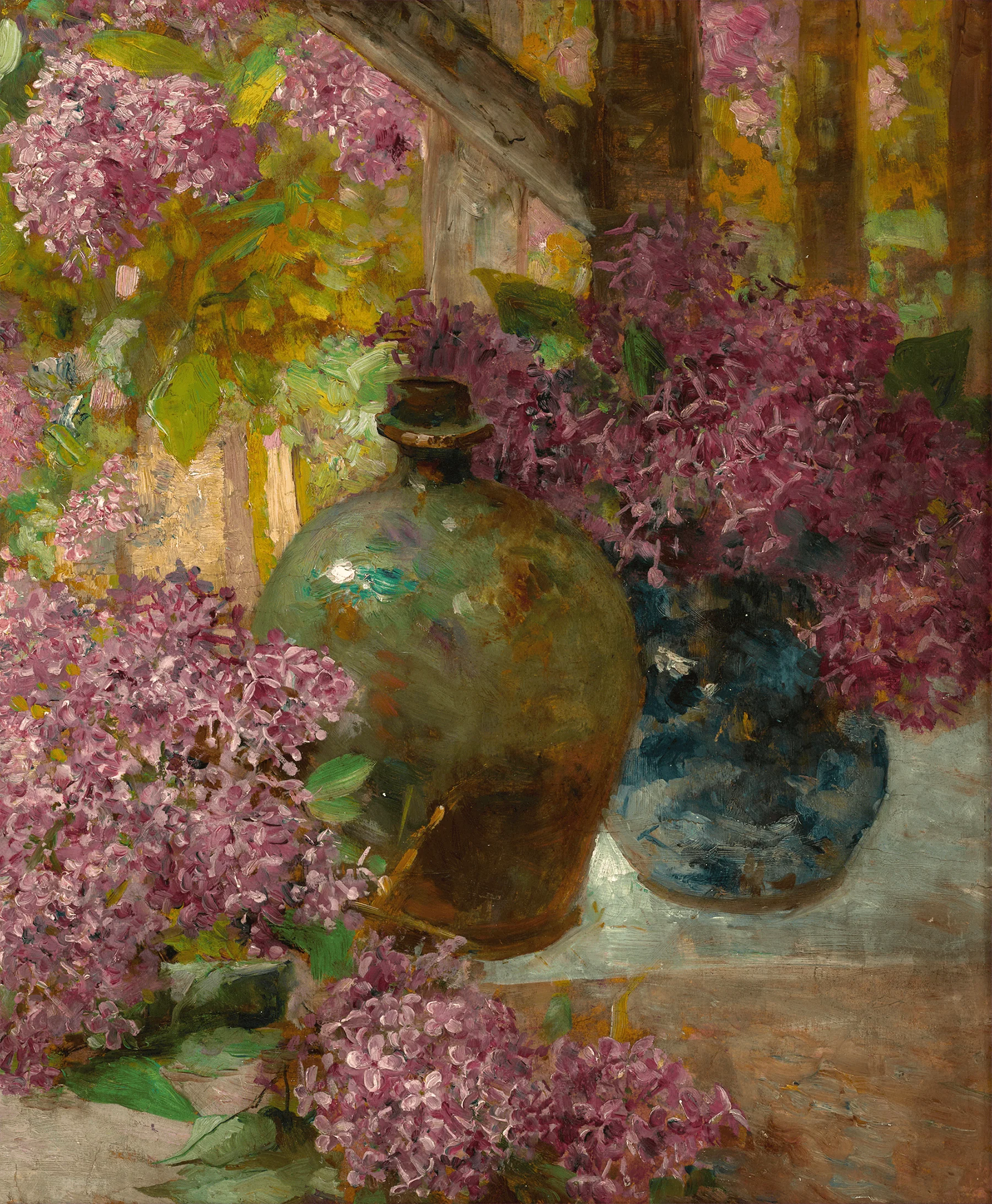
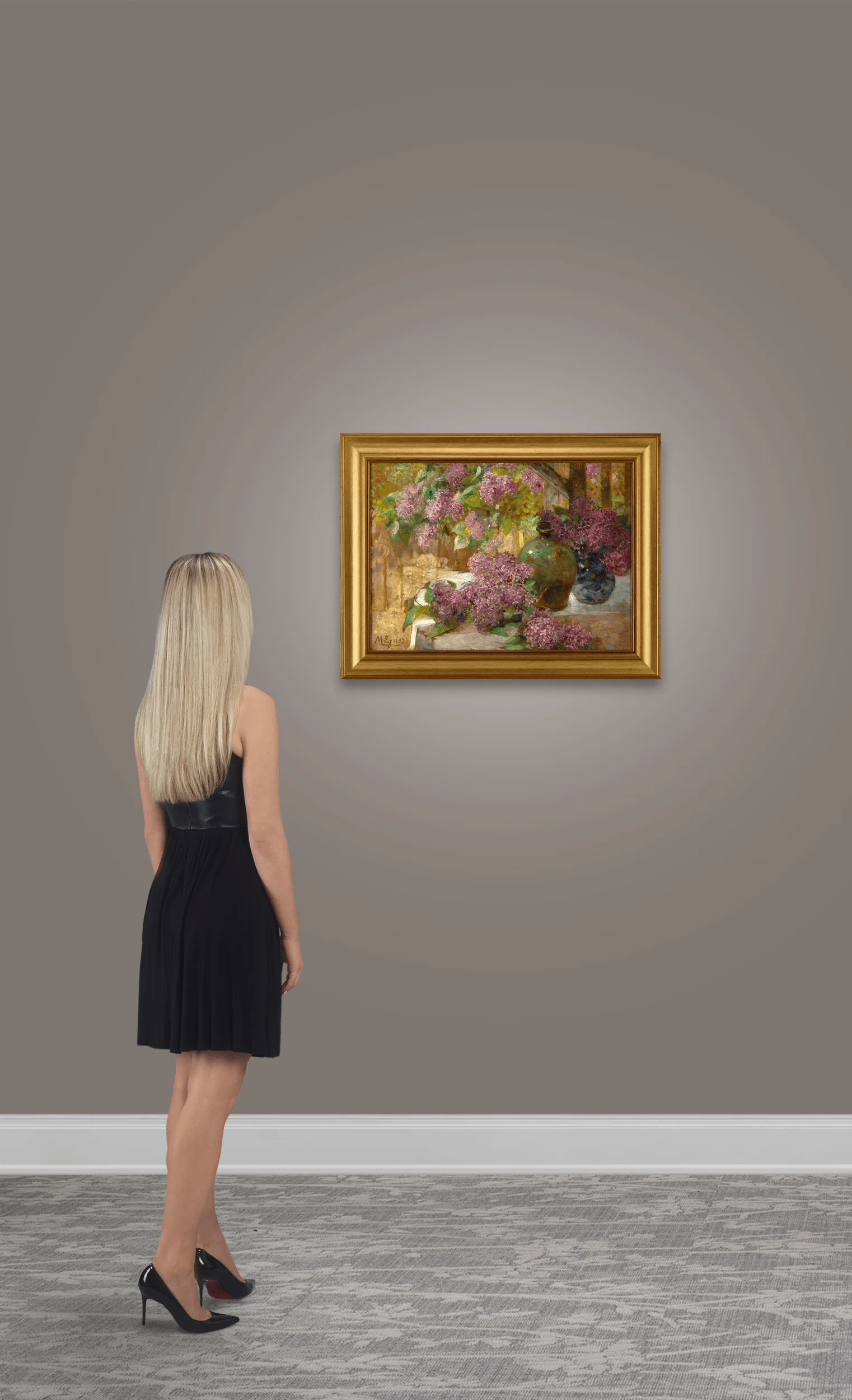
Bathed in warm, dappled light, this exquisite floral still life by Marie Egner captures the fleeting splendor of lilacs at the height of bloom. Lush clusters of violet, lavender and rose-colored blossoms spill across a sunlit tabletop, their delicate petals rendered with Egner’s characteristically lively, impressionistic brushwork.
Egner’s floral still lifes are among the most desirable in her oeuvre, and Lilac embodies the artist's mastery. Her palette is especially refined, pairing the cool purples of the flowers with golden browns, mossy greens and soft whites to create a richly harmonious scene. The result is both decorative and painterly, a work that celebrates color, texture and light with exceptional sensitivity.
As a woman artist working in late 19th- and early 20th-century Austria, Egner occupies an important place in the history of European art. She was associated with the circle of Emil Jakob Schindler, one of the leading figures of Austrian atmospheric landscape painting, and she is often discussed alongside important Austrian women artists such as Tina Blau and Olga Wisinger-Florian. Her lyrical landscapes and flower paintings are recognized as significant examples of Austrian Mood Impressionism, and her work is represented in major Austrian collections, including the Belvedere in Vienna, the Neue Galerie Graz and the Museum Niederösterreich.
Born in Bad Radkersburg, Austria, in 1850, Egner received her early training in Graz before studying in Düsseldorf with Carl Jungheim. After settling in Vienna, she continued her artistic development under Emil Jakob Schindler and became an active exhibitor in Austria and abroad. She also founded a private painting school for women, underscoring her role not only as an accomplished painter but also as an advocate for women’s artistic education. Egner is today regarded as one of Austria’s most important women artists of the turn of the 20th century, admired for works that unite technical skill, atmospheric sensitivity and a deeply poetic response to nature.
Canvas: 17 1/2” high x 24 1/2” wide (44.5 x 62.2 cm)
Frame: 23” high x 30” wide x 1 1/2” deep (58.4 x 76.2 x 3.8 cm)
Early 20th century
Provenance:
Private collection, Austria, for three generations
M.S. Rau, New Orleans
Literature:
Martin Suppan, Rupert Feuchtmüller, Marie Egner. Eine österreichische Stimmungsimpressionistin, Vol. II, Vienna 1993, p. 278
Exhibited:
Künstlerhaus Vienna, January 1925, no. 1064
1850-1940 | Austrian
Lilac
Signed "M. Egner" (lower left)
Oil on board on canvas
Bathed in warm, dappled light, this exquisite floral still life by Marie Egner captures the fleeting splendor of lilacs at the height of bloom. Lush clusters of violet, lavender and rose-colored blossoms spill across a sunlit tabletop, their delicate petals rendered with Egner’s characteristically lively, impressionistic brushwork.
Egner’s floral still lifes are among the most desirable in her oeuvre, and Lilac embodies the artist's mastery. Her palette is especially refined, pairing the cool purples of the flowers with golden browns, mossy greens and soft whites to create a richly harmonious scene. The result is both decorative and painterly, a work that celebrates color, texture and light with exceptional sensitivity.
As a woman artist working in late 19th- and early 20th-century Austria, Egner occupies an important place in the history of European art. She was associated with the circle of Emil Jakob Schindler, one of the leading figures of Austrian atmospheric landscape painting, and she is often discussed alongside important Austrian women artists such as Tina Blau and Olga Wisinger-Florian. Her lyrical landscapes and flower paintings are recognized as significant examples of Austrian Mood Impressionism, and her work is represented in major Austrian collections, including the Belvedere in Vienna, the Neue Galerie Graz and the Museum Niederösterreich.
Born in Bad Radkersburg, Austria, in 1850, Egner received her early training in Graz before studying in Düsseldorf with Carl Jungheim. After settling in Vienna, she continued her artistic development under Emil Jakob Schindler and became an active exhibitor in Austria and abroad. She also founded a private painting school for women, underscoring her role not only as an accomplished painter but also as an advocate for women’s artistic education. Egner is today regarded as one of Austria’s most important women artists of the turn of the 20th century, admired for works that unite technical skill, atmospheric sensitivity and a deeply poetic response to nature.
Canvas: 17 1/2” high x 24 1/2” wide (44.5 x 62.2 cm)
Frame: 23” high x 30” wide x 1 1/2” deep (58.4 x 76.2 x 3.8 cm)
Early 20th century
Provenance:
Private collection, Austria, for three generations
M.S. Rau, New Orleans
Literature:
Martin Suppan, Rupert Feuchtmüller, Marie Egner. Eine österreichische Stimmungsimpressionistin, Vol. II, Vienna 1993, p. 278
Exhibited:
Künstlerhaus Vienna, January 1925, no. 1064
$30,975.00
Original: $88,500.00
-65%Lilac by Marie Egner—
$88,500.00
$30,975.00More Images

Lilac by Marie Egner
Marie Egner
1850-1940 | Austrian
Lilac
Signed "M. Egner" (lower left)
Oil on board on canvas
Bathed in warm, dappled light, this exquisite floral still life by Marie Egner captures the fleeting splendor of lilacs at the height of bloom. Lush clusters of violet, lavender and rose-colored blossoms spill across a sunlit tabletop, their delicate petals rendered with Egner’s characteristically lively, impressionistic brushwork.
Egner’s floral still lifes are among the most desirable in her oeuvre, and Lilac embodies the artist's mastery. Her palette is especially refined, pairing the cool purples of the flowers with golden browns, mossy greens and soft whites to create a richly harmonious scene. The result is both decorative and painterly, a work that celebrates color, texture and light with exceptional sensitivity.
As a woman artist working in late 19th- and early 20th-century Austria, Egner occupies an important place in the history of European art. She was associated with the circle of Emil Jakob Schindler, one of the leading figures of Austrian atmospheric landscape painting, and she is often discussed alongside important Austrian women artists such as Tina Blau and Olga Wisinger-Florian. Her lyrical landscapes and flower paintings are recognized as significant examples of Austrian Mood Impressionism, and her work is represented in major Austrian collections, including the Belvedere in Vienna, the Neue Galerie Graz and the Museum Niederösterreich.
Born in Bad Radkersburg, Austria, in 1850, Egner received her early training in Graz before studying in Düsseldorf with Carl Jungheim. After settling in Vienna, she continued her artistic development under Emil Jakob Schindler and became an active exhibitor in Austria and abroad. She also founded a private painting school for women, underscoring her role not only as an accomplished painter but also as an advocate for women’s artistic education. Egner is today regarded as one of Austria’s most important women artists of the turn of the 20th century, admired for works that unite technical skill, atmospheric sensitivity and a deeply poetic response to nature.
Canvas: 17 1/2” high x 24 1/2” wide (44.5 x 62.2 cm)
Frame: 23” high x 30” wide x 1 1/2” deep (58.4 x 76.2 x 3.8 cm)
Early 20th century
Provenance:
Private collection, Austria, for three generations
M.S. Rau, New Orleans
Literature:
Martin Suppan, Rupert Feuchtmüller, Marie Egner. Eine österreichische Stimmungsimpressionistin, Vol. II, Vienna 1993, p. 278
Exhibited:
Künstlerhaus Vienna, January 1925, no. 1064
1850-1940 | Austrian
Lilac
Signed "M. Egner" (lower left)
Oil on board on canvas
Bathed in warm, dappled light, this exquisite floral still life by Marie Egner captures the fleeting splendor of lilacs at the height of bloom. Lush clusters of violet, lavender and rose-colored blossoms spill across a sunlit tabletop, their delicate petals rendered with Egner’s characteristically lively, impressionistic brushwork.
Egner’s floral still lifes are among the most desirable in her oeuvre, and Lilac embodies the artist's mastery. Her palette is especially refined, pairing the cool purples of the flowers with golden browns, mossy greens and soft whites to create a richly harmonious scene. The result is both decorative and painterly, a work that celebrates color, texture and light with exceptional sensitivity.
As a woman artist working in late 19th- and early 20th-century Austria, Egner occupies an important place in the history of European art. She was associated with the circle of Emil Jakob Schindler, one of the leading figures of Austrian atmospheric landscape painting, and she is often discussed alongside important Austrian women artists such as Tina Blau and Olga Wisinger-Florian. Her lyrical landscapes and flower paintings are recognized as significant examples of Austrian Mood Impressionism, and her work is represented in major Austrian collections, including the Belvedere in Vienna, the Neue Galerie Graz and the Museum Niederösterreich.
Born in Bad Radkersburg, Austria, in 1850, Egner received her early training in Graz before studying in Düsseldorf with Carl Jungheim. After settling in Vienna, she continued her artistic development under Emil Jakob Schindler and became an active exhibitor in Austria and abroad. She also founded a private painting school for women, underscoring her role not only as an accomplished painter but also as an advocate for women’s artistic education. Egner is today regarded as one of Austria’s most important women artists of the turn of the 20th century, admired for works that unite technical skill, atmospheric sensitivity and a deeply poetic response to nature.
Canvas: 17 1/2” high x 24 1/2” wide (44.5 x 62.2 cm)
Frame: 23” high x 30” wide x 1 1/2” deep (58.4 x 76.2 x 3.8 cm)
Early 20th century
Provenance:
Private collection, Austria, for three generations
M.S. Rau, New Orleans
Literature:
Martin Suppan, Rupert Feuchtmüller, Marie Egner. Eine österreichische Stimmungsimpressionistin, Vol. II, Vienna 1993, p. 278
Exhibited:
Künstlerhaus Vienna, January 1925, no. 1064
Product Information
Product Information
Shipping & Returns
Shipping & Returns
Description
Marie Egner
1850-1940 | Austrian
Lilac
Signed "M. Egner" (lower left)
Oil on board on canvas
Bathed in warm, dappled light, this exquisite floral still life by Marie Egner captures the fleeting splendor of lilacs at the height of bloom. Lush clusters of violet, lavender and rose-colored blossoms spill across a sunlit tabletop, their delicate petals rendered with Egner’s characteristically lively, impressionistic brushwork.
Egner’s floral still lifes are among the most desirable in her oeuvre, and Lilac embodies the artist's mastery. Her palette is especially refined, pairing the cool purples of the flowers with golden browns, mossy greens and soft whites to create a richly harmonious scene. The result is both decorative and painterly, a work that celebrates color, texture and light with exceptional sensitivity.
As a woman artist working in late 19th- and early 20th-century Austria, Egner occupies an important place in the history of European art. She was associated with the circle of Emil Jakob Schindler, one of the leading figures of Austrian atmospheric landscape painting, and she is often discussed alongside important Austrian women artists such as Tina Blau and Olga Wisinger-Florian. Her lyrical landscapes and flower paintings are recognized as significant examples of Austrian Mood Impressionism, and her work is represented in major Austrian collections, including the Belvedere in Vienna, the Neue Galerie Graz and the Museum Niederösterreich.
Born in Bad Radkersburg, Austria, in 1850, Egner received her early training in Graz before studying in Düsseldorf with Carl Jungheim. After settling in Vienna, she continued her artistic development under Emil Jakob Schindler and became an active exhibitor in Austria and abroad. She also founded a private painting school for women, underscoring her role not only as an accomplished painter but also as an advocate for women’s artistic education. Egner is today regarded as one of Austria’s most important women artists of the turn of the 20th century, admired for works that unite technical skill, atmospheric sensitivity and a deeply poetic response to nature.
Canvas: 17 1/2” high x 24 1/2” wide (44.5 x 62.2 cm)
Frame: 23” high x 30” wide x 1 1/2” deep (58.4 x 76.2 x 3.8 cm)
Early 20th century
Provenance:
Private collection, Austria, for three generations
M.S. Rau, New Orleans
Literature:
Martin Suppan, Rupert Feuchtmüller, Marie Egner. Eine österreichische Stimmungsimpressionistin, Vol. II, Vienna 1993, p. 278
Exhibited:
Künstlerhaus Vienna, January 1925, no. 1064
1850-1940 | Austrian
Lilac
Signed "M. Egner" (lower left)
Oil on board on canvas
Bathed in warm, dappled light, this exquisite floral still life by Marie Egner captures the fleeting splendor of lilacs at the height of bloom. Lush clusters of violet, lavender and rose-colored blossoms spill across a sunlit tabletop, their delicate petals rendered with Egner’s characteristically lively, impressionistic brushwork.
Egner’s floral still lifes are among the most desirable in her oeuvre, and Lilac embodies the artist's mastery. Her palette is especially refined, pairing the cool purples of the flowers with golden browns, mossy greens and soft whites to create a richly harmonious scene. The result is both decorative and painterly, a work that celebrates color, texture and light with exceptional sensitivity.
As a woman artist working in late 19th- and early 20th-century Austria, Egner occupies an important place in the history of European art. She was associated with the circle of Emil Jakob Schindler, one of the leading figures of Austrian atmospheric landscape painting, and she is often discussed alongside important Austrian women artists such as Tina Blau and Olga Wisinger-Florian. Her lyrical landscapes and flower paintings are recognized as significant examples of Austrian Mood Impressionism, and her work is represented in major Austrian collections, including the Belvedere in Vienna, the Neue Galerie Graz and the Museum Niederösterreich.
Born in Bad Radkersburg, Austria, in 1850, Egner received her early training in Graz before studying in Düsseldorf with Carl Jungheim. After settling in Vienna, she continued her artistic development under Emil Jakob Schindler and became an active exhibitor in Austria and abroad. She also founded a private painting school for women, underscoring her role not only as an accomplished painter but also as an advocate for women’s artistic education. Egner is today regarded as one of Austria’s most important women artists of the turn of the 20th century, admired for works that unite technical skill, atmospheric sensitivity and a deeply poetic response to nature.
Canvas: 17 1/2” high x 24 1/2” wide (44.5 x 62.2 cm)
Frame: 23” high x 30” wide x 1 1/2” deep (58.4 x 76.2 x 3.8 cm)
Early 20th century
Provenance:
Private collection, Austria, for three generations
M.S. Rau, New Orleans
Literature:
Martin Suppan, Rupert Feuchtmüller, Marie Egner. Eine österreichische Stimmungsimpressionistin, Vol. II, Vienna 1993, p. 278
Exhibited:
Künstlerhaus Vienna, January 1925, no. 1064