✨ New Arrivals Just Dropped!Explore
Jan Uytenbogaert, Preacher of the Remonstrants by Rembrandt van Rijn
Rembrandt van Rijn
1606-1669 | Dutch
Jan Uytenbogaert, Preacher of the Remonstrants
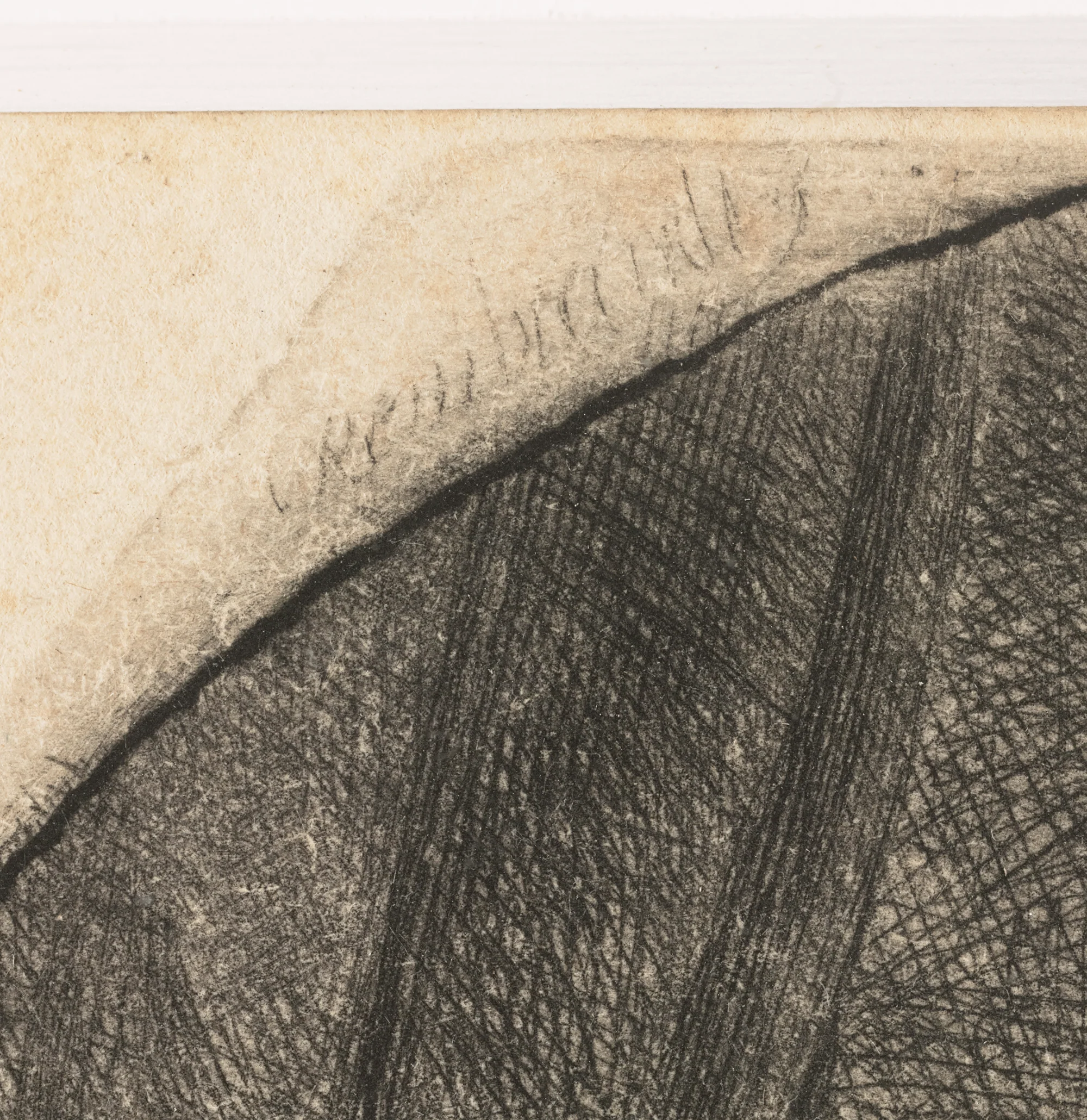
Signed “Rembrandt f.” in the plate (upper left)
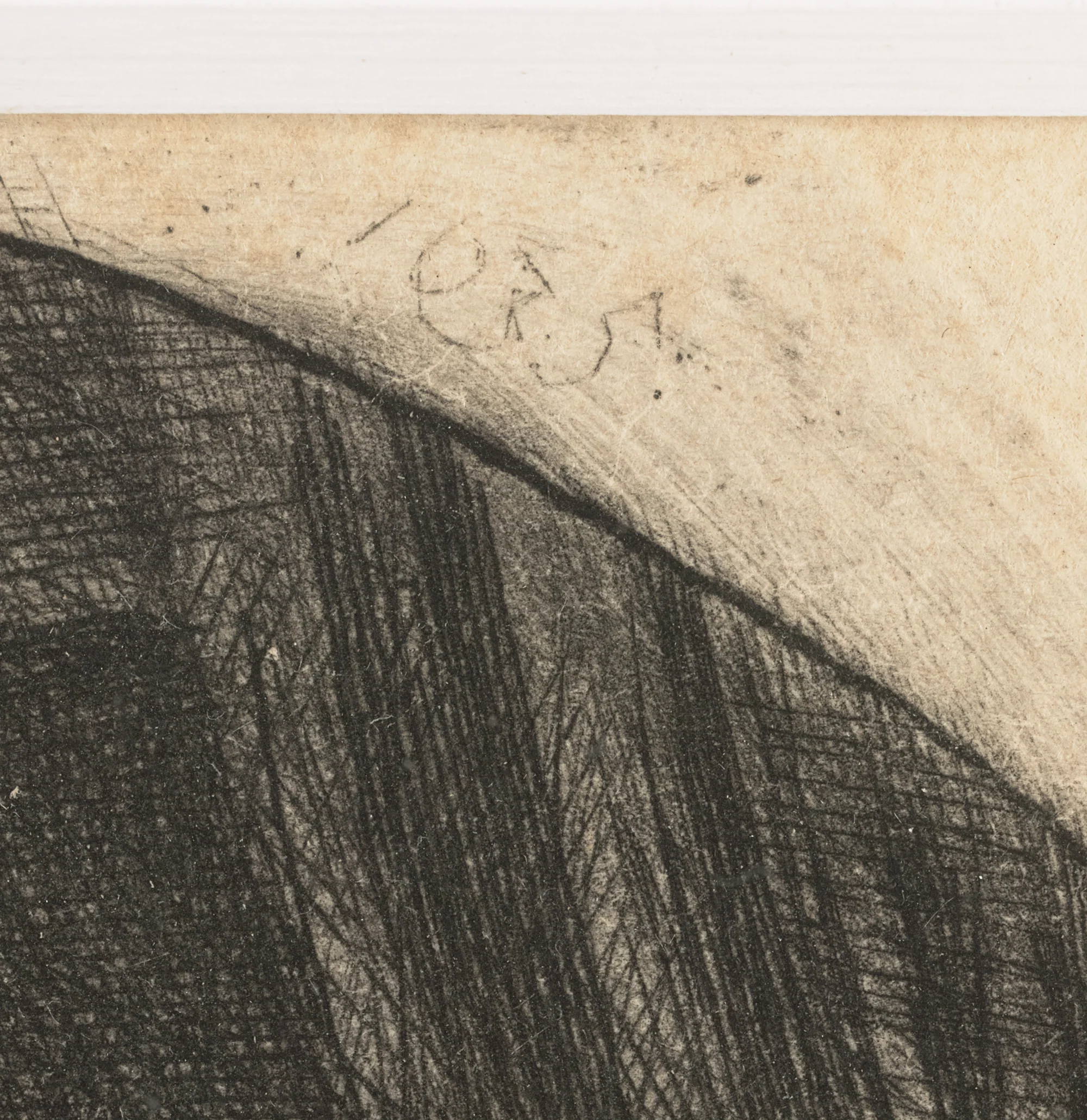
Dated “1635” in the plate (upper right)
Etching, drypoint and burin on wove paper
New Hollstein 153, state VIII of IX
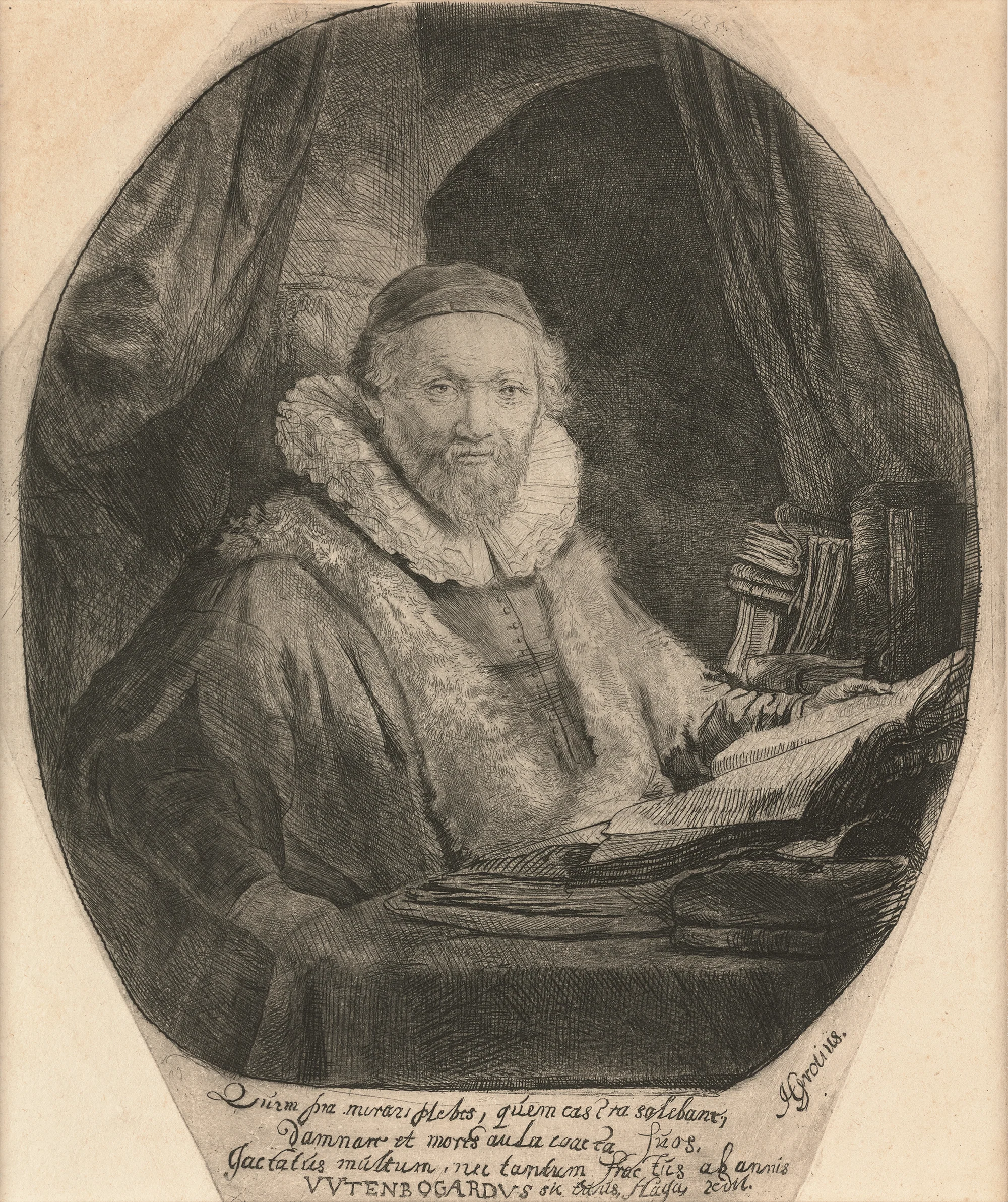
Among the greatest of the Old Masters was the revered Dutch artist Rembrandt van Rijn, arguably the greatest etcher in the history of art. The most important Dutch printmaker of all time, his oeuvre features close to 300 known prints, and his innovative techniques in the medium are without precedent. This composition is regarded as Rembrandt’s first commissioned portrait print and stands among his most sophisticated achievements in etching. It depicts Jan Uytenbogaert, one of the most influential religious and political figures of the Dutch Golden Age.
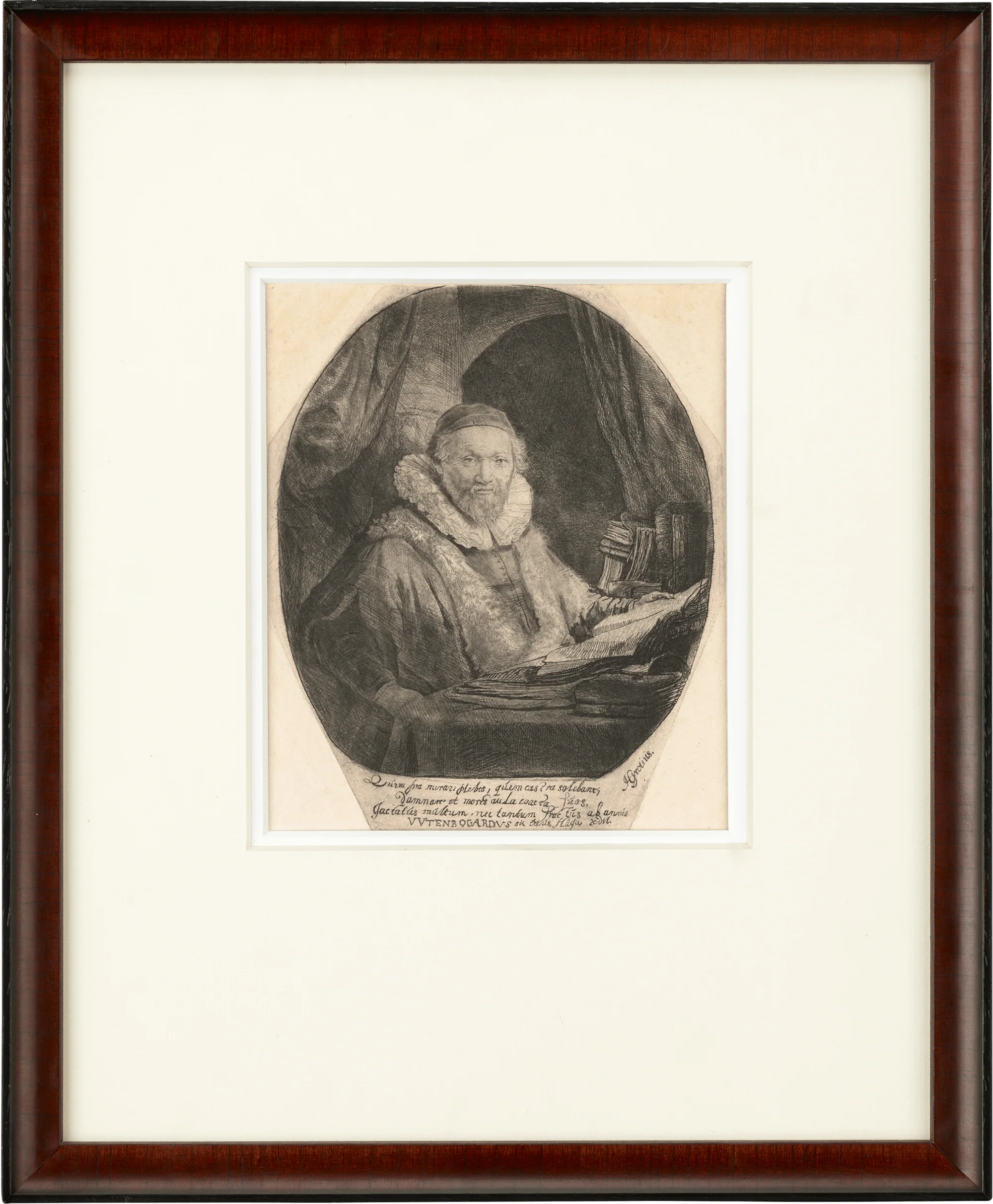
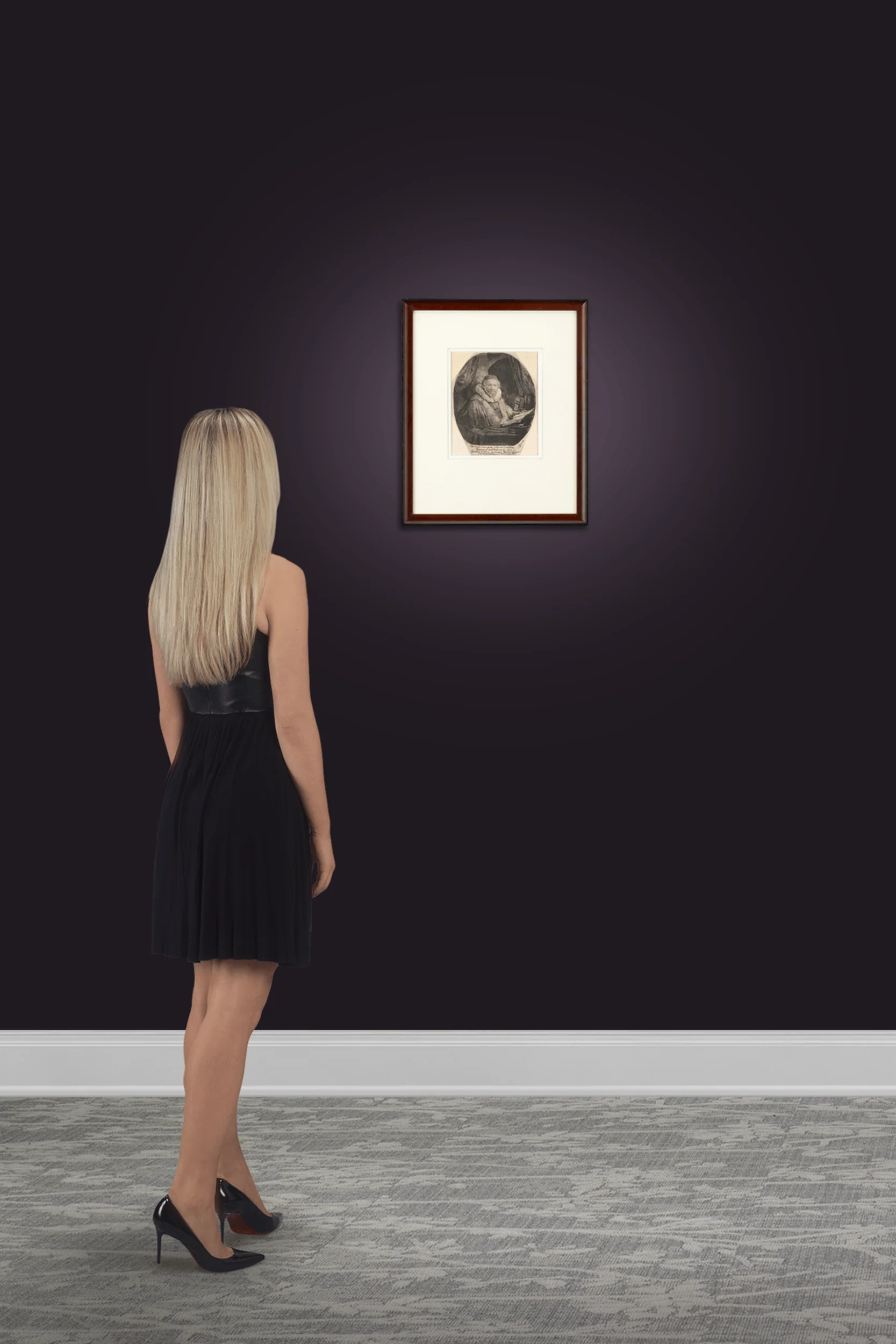
Bedecked in elaborate garb, Jan Uytenbogaert, a Remonstrant preacher, sits in his study, an open book in front of him. Rembrandt highlights his subject by illuminating him in light, creating a strong contrast against the dark, draped background. Intricate lines convey the feel of rich fabric, particularly in Uytenbogaert’s collar and the fur-lined coat thrown over his shoulders.
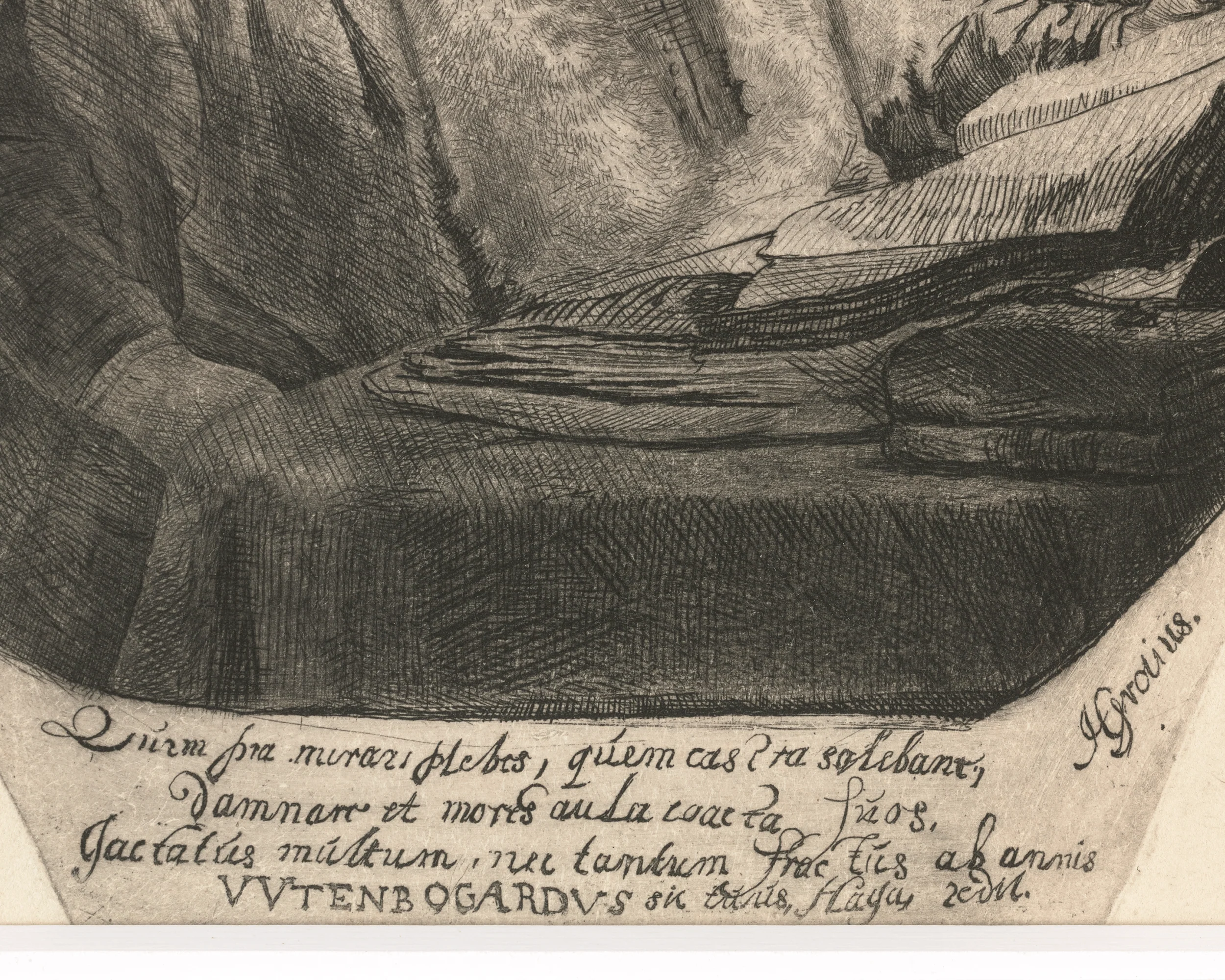
Jan Uytenbogaert was a leading figure of the Remonstrant movement and formerly served as chaplain to Prince Maurice of Orange and tutor to the future stadholder Frederick Henry. Banished from the Netherlands following the Synod of Dort, he later returned from exile and resumed preaching in Amsterdam. The Latin verse beneath his portrait, composed by the renowned scholar Hugo Grotius, celebrates his return and resilience after years of political and religious persecution.
Rembrandt was one of history’s greatest printmakers, transforming etching through his unrivaled command of light, atmosphere and human emotion. His prints traveled more widely than his paintings and played an essential role in establishing his international renown during his lifetime. New Hollstein records nine states of this portrait, with the fifth representing the final state worked by Rembrandt himself. The eighth state was subsequently retouched with delicate lines, likely during the 18th century. Printed on wove paper, this posthumous impression reflects the enduring demand for Rembrandt’s graphic masterpieces generations after his death.
Earlier examples of this impression are unobtainable—Hinterding and Rutgers record only five impressions of the first three states in total. Impressions of this etching reside in numerous museums, including the Rijksmuseum in Amsterdam, the British Museum and the Saint Louis Art Museum.
Plate created 1635
Likely printed in the 18th century
Paper: 17 1/2" high x 13 3/4" wide (44.45 x 34.93 cm)
Frame: 19" high x 16" wide x 1" deep (48.32 x 40.64 x 2.54 cm)
Provenance:
Private collection, Switzerland
M.S. Rau, New Orleans
1606-1669 | Dutch
Jan Uytenbogaert, Preacher of the Remonstrants
Signed “Rembrandt f.” in the plate (upper left)
Dated “1635” in the plate (upper right)
Etching, drypoint and burin on wove paper
New Hollstein 153, state VIII of IX
Among the greatest of the Old Masters was the revered Dutch artist Rembrandt van Rijn, arguably the greatest etcher in the history of art. The most important Dutch printmaker of all time, his oeuvre features close to 300 known prints, and his innovative techniques in the medium are without precedent. This composition is regarded as Rembrandt’s first commissioned portrait print and stands among his most sophisticated achievements in etching. It depicts Jan Uytenbogaert, one of the most influential religious and political figures of the Dutch Golden Age.
Bedecked in elaborate garb, Jan Uytenbogaert, a Remonstrant preacher, sits in his study, an open book in front of him. Rembrandt highlights his subject by illuminating him in light, creating a strong contrast against the dark, draped background. Intricate lines convey the feel of rich fabric, particularly in Uytenbogaert’s collar and the fur-lined coat thrown over his shoulders.
Jan Uytenbogaert was a leading figure of the Remonstrant movement and formerly served as chaplain to Prince Maurice of Orange and tutor to the future stadholder Frederick Henry. Banished from the Netherlands following the Synod of Dort, he later returned from exile and resumed preaching in Amsterdam. The Latin verse beneath his portrait, composed by the renowned scholar Hugo Grotius, celebrates his return and resilience after years of political and religious persecution.
Rembrandt was one of history’s greatest printmakers, transforming etching through his unrivaled command of light, atmosphere and human emotion. His prints traveled more widely than his paintings and played an essential role in establishing his international renown during his lifetime. New Hollstein records nine states of this portrait, with the fifth representing the final state worked by Rembrandt himself. The eighth state was subsequently retouched with delicate lines, likely during the 18th century. Printed on wove paper, this posthumous impression reflects the enduring demand for Rembrandt’s graphic masterpieces generations after his death.
Earlier examples of this impression are unobtainable—Hinterding and Rutgers record only five impressions of the first three states in total. Impressions of this etching reside in numerous museums, including the Rijksmuseum in Amsterdam, the British Museum and the Saint Louis Art Museum.
Plate created 1635
Likely printed in the 18th century
Paper: 17 1/2" high x 13 3/4" wide (44.45 x 34.93 cm)
Frame: 19" high x 16" wide x 1" deep (48.32 x 40.64 x 2.54 cm)
Provenance:
Private collection, Switzerland
M.S. Rau, New Orleans
$4,497.50
Original: $12,850.00
-65%Jan Uytenbogaert, Preacher of the Remonstrants by Rembrandt van Rijn—
$12,850.00
$4,497.50More Images
Jan Uytenbogaert, Preacher of the Remonstrants by Rembrandt van Rijn
Rembrandt van Rijn
1606-1669 | Dutch
Jan Uytenbogaert, Preacher of the Remonstrants
Signed “Rembrandt f.” in the plate (upper left)
Dated “1635” in the plate (upper right)
Etching, drypoint and burin on wove paper
New Hollstein 153, state VIII of IX
Among the greatest of the Old Masters was the revered Dutch artist Rembrandt van Rijn, arguably the greatest etcher in the history of art. The most important Dutch printmaker of all time, his oeuvre features close to 300 known prints, and his innovative techniques in the medium are without precedent. This composition is regarded as Rembrandt’s first commissioned portrait print and stands among his most sophisticated achievements in etching. It depicts Jan Uytenbogaert, one of the most influential religious and political figures of the Dutch Golden Age.
Bedecked in elaborate garb, Jan Uytenbogaert, a Remonstrant preacher, sits in his study, an open book in front of him. Rembrandt highlights his subject by illuminating him in light, creating a strong contrast against the dark, draped background. Intricate lines convey the feel of rich fabric, particularly in Uytenbogaert’s collar and the fur-lined coat thrown over his shoulders.
Jan Uytenbogaert was a leading figure of the Remonstrant movement and formerly served as chaplain to Prince Maurice of Orange and tutor to the future stadholder Frederick Henry. Banished from the Netherlands following the Synod of Dort, he later returned from exile and resumed preaching in Amsterdam. The Latin verse beneath his portrait, composed by the renowned scholar Hugo Grotius, celebrates his return and resilience after years of political and religious persecution.
Rembrandt was one of history’s greatest printmakers, transforming etching through his unrivaled command of light, atmosphere and human emotion. His prints traveled more widely than his paintings and played an essential role in establishing his international renown during his lifetime. New Hollstein records nine states of this portrait, with the fifth representing the final state worked by Rembrandt himself. The eighth state was subsequently retouched with delicate lines, likely during the 18th century. Printed on wove paper, this posthumous impression reflects the enduring demand for Rembrandt’s graphic masterpieces generations after his death.
Earlier examples of this impression are unobtainable—Hinterding and Rutgers record only five impressions of the first three states in total. Impressions of this etching reside in numerous museums, including the Rijksmuseum in Amsterdam, the British Museum and the Saint Louis Art Museum.
Plate created 1635
Likely printed in the 18th century
Paper: 17 1/2" high x 13 3/4" wide (44.45 x 34.93 cm)
Frame: 19" high x 16" wide x 1" deep (48.32 x 40.64 x 2.54 cm)
Provenance:
Private collection, Switzerland
M.S. Rau, New Orleans
1606-1669 | Dutch
Jan Uytenbogaert, Preacher of the Remonstrants
Signed “Rembrandt f.” in the plate (upper left)
Dated “1635” in the plate (upper right)
Etching, drypoint and burin on wove paper
New Hollstein 153, state VIII of IX
Among the greatest of the Old Masters was the revered Dutch artist Rembrandt van Rijn, arguably the greatest etcher in the history of art. The most important Dutch printmaker of all time, his oeuvre features close to 300 known prints, and his innovative techniques in the medium are without precedent. This composition is regarded as Rembrandt’s first commissioned portrait print and stands among his most sophisticated achievements in etching. It depicts Jan Uytenbogaert, one of the most influential religious and political figures of the Dutch Golden Age.
Bedecked in elaborate garb, Jan Uytenbogaert, a Remonstrant preacher, sits in his study, an open book in front of him. Rembrandt highlights his subject by illuminating him in light, creating a strong contrast against the dark, draped background. Intricate lines convey the feel of rich fabric, particularly in Uytenbogaert’s collar and the fur-lined coat thrown over his shoulders.
Jan Uytenbogaert was a leading figure of the Remonstrant movement and formerly served as chaplain to Prince Maurice of Orange and tutor to the future stadholder Frederick Henry. Banished from the Netherlands following the Synod of Dort, he later returned from exile and resumed preaching in Amsterdam. The Latin verse beneath his portrait, composed by the renowned scholar Hugo Grotius, celebrates his return and resilience after years of political and religious persecution.
Rembrandt was one of history’s greatest printmakers, transforming etching through his unrivaled command of light, atmosphere and human emotion. His prints traveled more widely than his paintings and played an essential role in establishing his international renown during his lifetime. New Hollstein records nine states of this portrait, with the fifth representing the final state worked by Rembrandt himself. The eighth state was subsequently retouched with delicate lines, likely during the 18th century. Printed on wove paper, this posthumous impression reflects the enduring demand for Rembrandt’s graphic masterpieces generations after his death.
Earlier examples of this impression are unobtainable—Hinterding and Rutgers record only five impressions of the first three states in total. Impressions of this etching reside in numerous museums, including the Rijksmuseum in Amsterdam, the British Museum and the Saint Louis Art Museum.
Plate created 1635
Likely printed in the 18th century
Paper: 17 1/2" high x 13 3/4" wide (44.45 x 34.93 cm)
Frame: 19" high x 16" wide x 1" deep (48.32 x 40.64 x 2.54 cm)
Provenance:
Private collection, Switzerland
M.S. Rau, New Orleans
Product Information
Product Information
Shipping & Returns
Shipping & Returns
Description
Rembrandt van Rijn
1606-1669 | Dutch
Jan Uytenbogaert, Preacher of the Remonstrants
Signed “Rembrandt f.” in the plate (upper left)
Dated “1635” in the plate (upper right)
Etching, drypoint and burin on wove paper
New Hollstein 153, state VIII of IX
Among the greatest of the Old Masters was the revered Dutch artist Rembrandt van Rijn, arguably the greatest etcher in the history of art. The most important Dutch printmaker of all time, his oeuvre features close to 300 known prints, and his innovative techniques in the medium are without precedent. This composition is regarded as Rembrandt’s first commissioned portrait print and stands among his most sophisticated achievements in etching. It depicts Jan Uytenbogaert, one of the most influential religious and political figures of the Dutch Golden Age.
Bedecked in elaborate garb, Jan Uytenbogaert, a Remonstrant preacher, sits in his study, an open book in front of him. Rembrandt highlights his subject by illuminating him in light, creating a strong contrast against the dark, draped background. Intricate lines convey the feel of rich fabric, particularly in Uytenbogaert’s collar and the fur-lined coat thrown over his shoulders.
Jan Uytenbogaert was a leading figure of the Remonstrant movement and formerly served as chaplain to Prince Maurice of Orange and tutor to the future stadholder Frederick Henry. Banished from the Netherlands following the Synod of Dort, he later returned from exile and resumed preaching in Amsterdam. The Latin verse beneath his portrait, composed by the renowned scholar Hugo Grotius, celebrates his return and resilience after years of political and religious persecution.
Rembrandt was one of history’s greatest printmakers, transforming etching through his unrivaled command of light, atmosphere and human emotion. His prints traveled more widely than his paintings and played an essential role in establishing his international renown during his lifetime. New Hollstein records nine states of this portrait, with the fifth representing the final state worked by Rembrandt himself. The eighth state was subsequently retouched with delicate lines, likely during the 18th century. Printed on wove paper, this posthumous impression reflects the enduring demand for Rembrandt’s graphic masterpieces generations after his death.
Earlier examples of this impression are unobtainable—Hinterding and Rutgers record only five impressions of the first three states in total. Impressions of this etching reside in numerous museums, including the Rijksmuseum in Amsterdam, the British Museum and the Saint Louis Art Museum.
Plate created 1635
Likely printed in the 18th century
Paper: 17 1/2" high x 13 3/4" wide (44.45 x 34.93 cm)
Frame: 19" high x 16" wide x 1" deep (48.32 x 40.64 x 2.54 cm)
Provenance:
Private collection, Switzerland
M.S. Rau, New Orleans
1606-1669 | Dutch
Jan Uytenbogaert, Preacher of the Remonstrants
Signed “Rembrandt f.” in the plate (upper left)
Dated “1635” in the plate (upper right)
Etching, drypoint and burin on wove paper
New Hollstein 153, state VIII of IX
Among the greatest of the Old Masters was the revered Dutch artist Rembrandt van Rijn, arguably the greatest etcher in the history of art. The most important Dutch printmaker of all time, his oeuvre features close to 300 known prints, and his innovative techniques in the medium are without precedent. This composition is regarded as Rembrandt’s first commissioned portrait print and stands among his most sophisticated achievements in etching. It depicts Jan Uytenbogaert, one of the most influential religious and political figures of the Dutch Golden Age.
Bedecked in elaborate garb, Jan Uytenbogaert, a Remonstrant preacher, sits in his study, an open book in front of him. Rembrandt highlights his subject by illuminating him in light, creating a strong contrast against the dark, draped background. Intricate lines convey the feel of rich fabric, particularly in Uytenbogaert’s collar and the fur-lined coat thrown over his shoulders.
Jan Uytenbogaert was a leading figure of the Remonstrant movement and formerly served as chaplain to Prince Maurice of Orange and tutor to the future stadholder Frederick Henry. Banished from the Netherlands following the Synod of Dort, he later returned from exile and resumed preaching in Amsterdam. The Latin verse beneath his portrait, composed by the renowned scholar Hugo Grotius, celebrates his return and resilience after years of political and religious persecution.
Rembrandt was one of history’s greatest printmakers, transforming etching through his unrivaled command of light, atmosphere and human emotion. His prints traveled more widely than his paintings and played an essential role in establishing his international renown during his lifetime. New Hollstein records nine states of this portrait, with the fifth representing the final state worked by Rembrandt himself. The eighth state was subsequently retouched with delicate lines, likely during the 18th century. Printed on wove paper, this posthumous impression reflects the enduring demand for Rembrandt’s graphic masterpieces generations after his death.
Earlier examples of this impression are unobtainable—Hinterding and Rutgers record only five impressions of the first three states in total. Impressions of this etching reside in numerous museums, including the Rijksmuseum in Amsterdam, the British Museum and the Saint Louis Art Museum.
Plate created 1635
Likely printed in the 18th century
Paper: 17 1/2" high x 13 3/4" wide (44.45 x 34.93 cm)
Frame: 19" high x 16" wide x 1" deep (48.32 x 40.64 x 2.54 cm)
Provenance:
Private collection, Switzerland
M.S. Rau, New Orleans