✨ New Arrivals Just Dropped!Explore
Hunting Scene by Sir Alfred J. Munnings
Sir Alfred James Munnings
1878-1959 | British
Hunting Scene
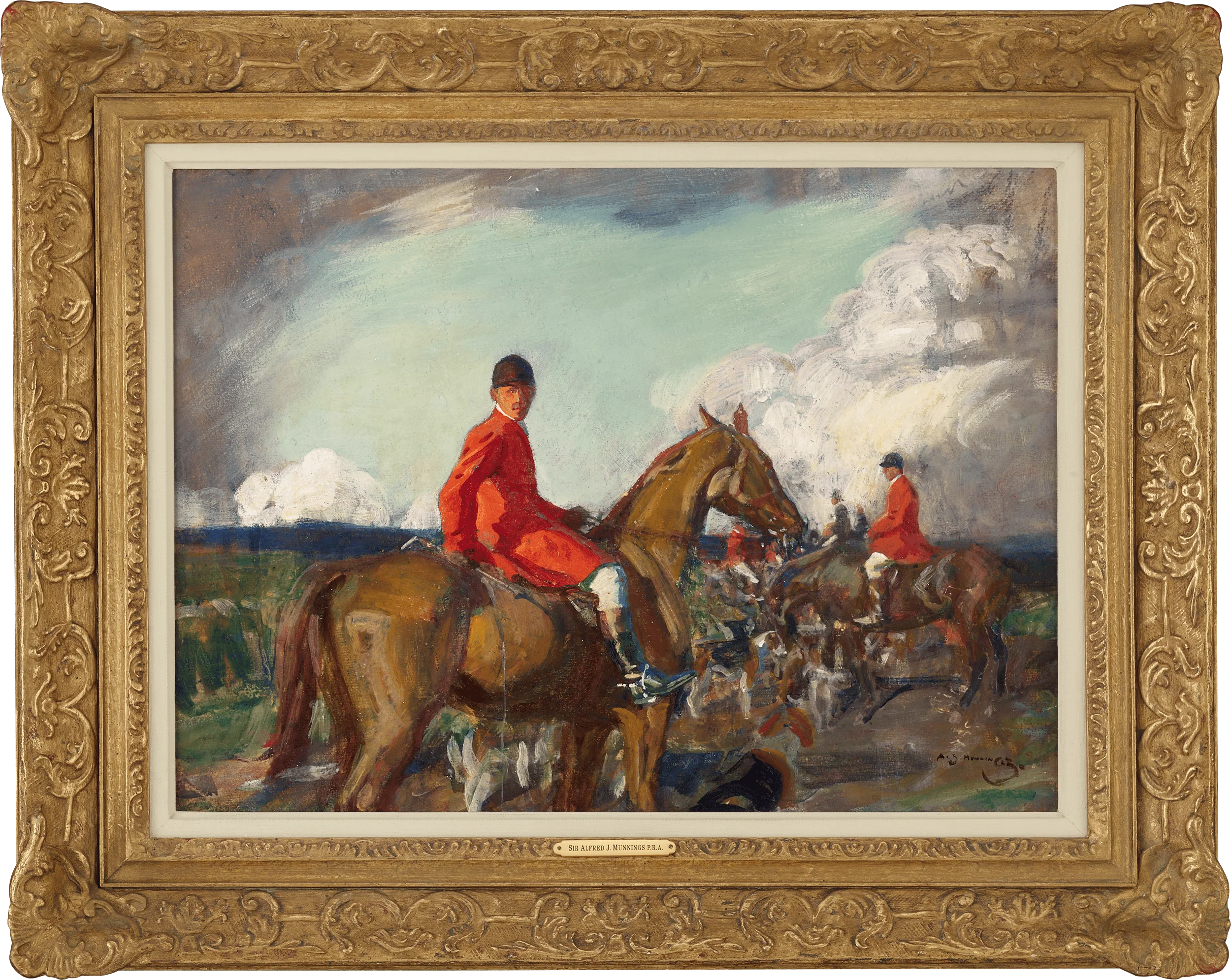
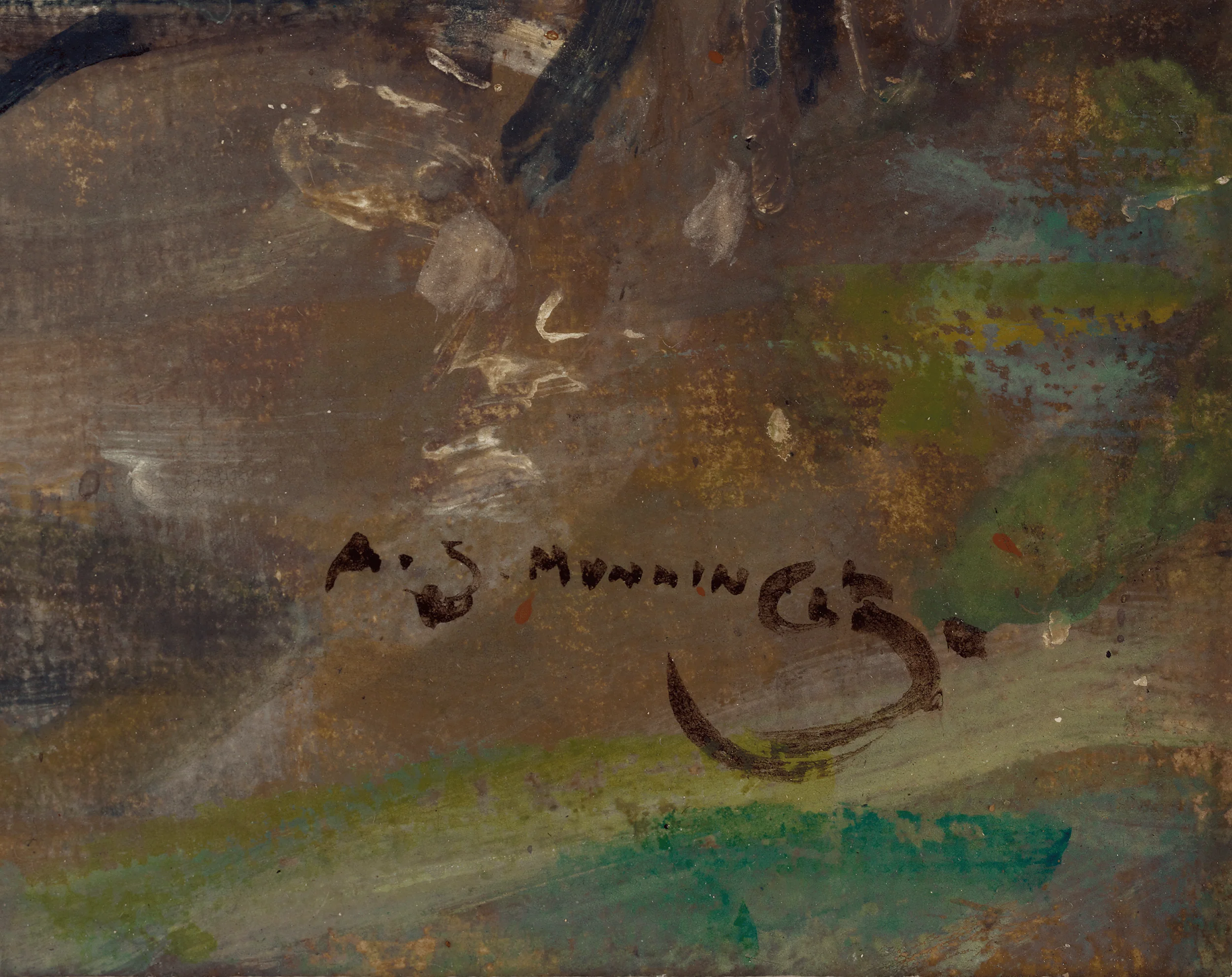
Signed “A J Munnings” (lower right)
Oil on board
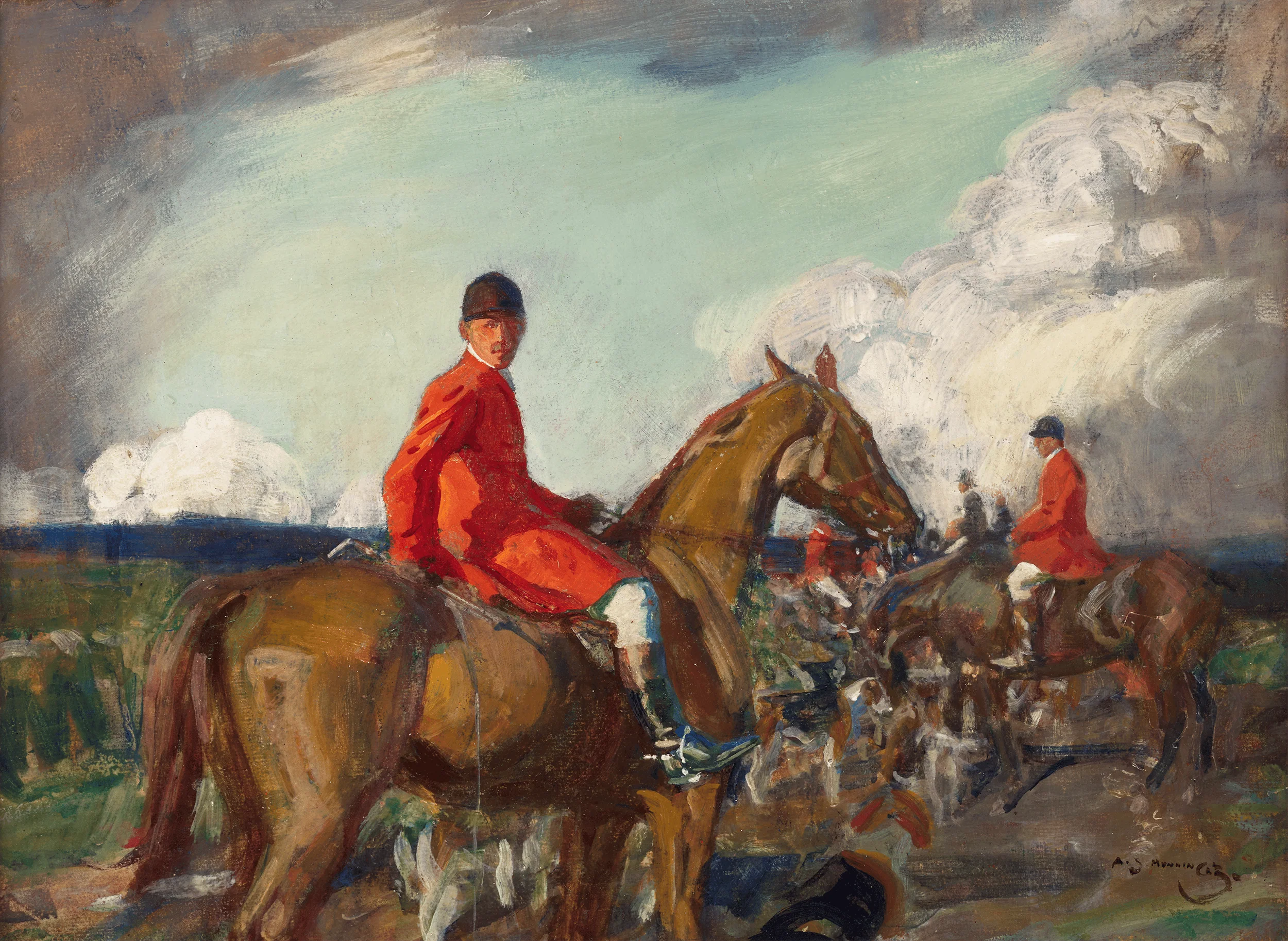
The exciting atmosphere of the hunt is masterfully captured in this exceptional painting by Sir Alfred James Munnings—widely considered among the world’s greatest equine painters.
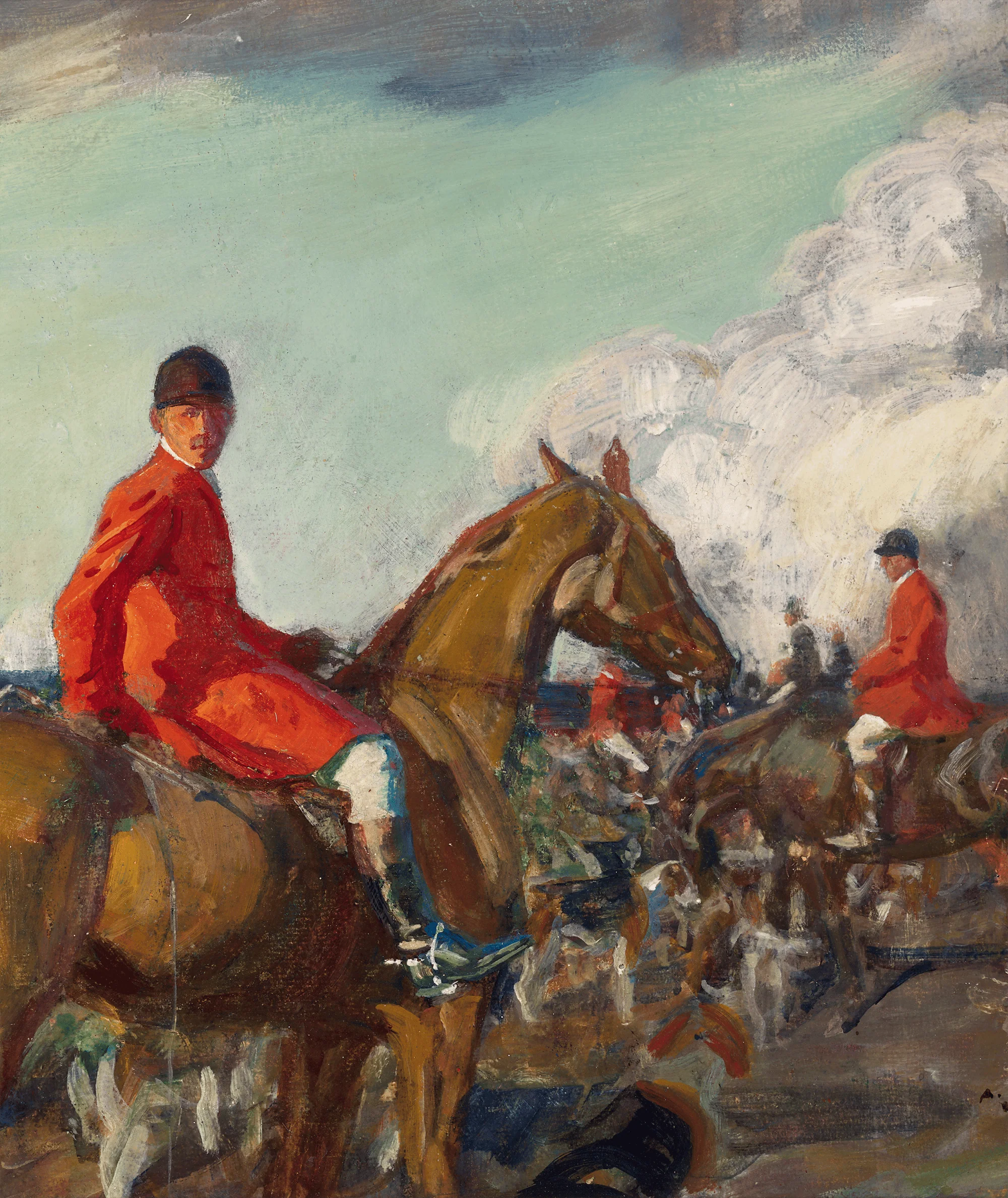
Hunting Scene is a superior example of Munnings’ unmatched gift for interpreting the spirit and power of the horse in his works. Here, scarlet-coated huntsmen are seated on their beautifully poised mounts, building the anticipation of a hunt about to begin. With bold brushwork and a vibrant palette, Munnings transformed this traditional sporting subject into an iconic image of vitality, pageantry and English country life.
Munnings, born and raised in the countryside of Suffolk, England, showed a talent for art at a young age. At 14, he became apprenticed to the lithography firm of Page Brothers, designing posters, and began studying painting at the Norwich School of Art at night. In 1899, he entered two works to the Royal Academy’s Summer Exhibition that were accepted with much acclaim. He soon gained favor for his captivating equine portraits, depicting these wondrous animals in a multitude of fashions, yet always staying true to their innate power, beauty and tender nature.
During World War I, Munnings also served the roles of war artist and horse processor in Canada, ensuring the safe and efficient delivery of military horses to the front in the latter position. He had spent his childhood surrounded by these majestic beasts and was well suited for this task. As a war artist, he executed drawings, watercolors and oils with the primary focus on the horse’s use both on the battlefield and behind the scenes. The Canadian War Records Exhibition at the Royal Academy after the war’s end included 45 of Munnings extraordinary paintings.
By the height of his career, Munnings was famous on both sides of the Atlantic, with patrons and friends that included Rothschilds, Astors, members of the royal family and Sir Winston Churchill. He went on to earn a knighthood and held the coveted position of President of the Royal Academy of Arts from 1944 to 1949. After his death in 1959, his home in Dedham was transformed into a museum dedicated entirely to his work. Other examples of Munnings' legendary equine paintings can be found in prestigious institutions worldwide, including the British Royal Collection, the Tate and the Yale Center for British Art.
Circa 1920
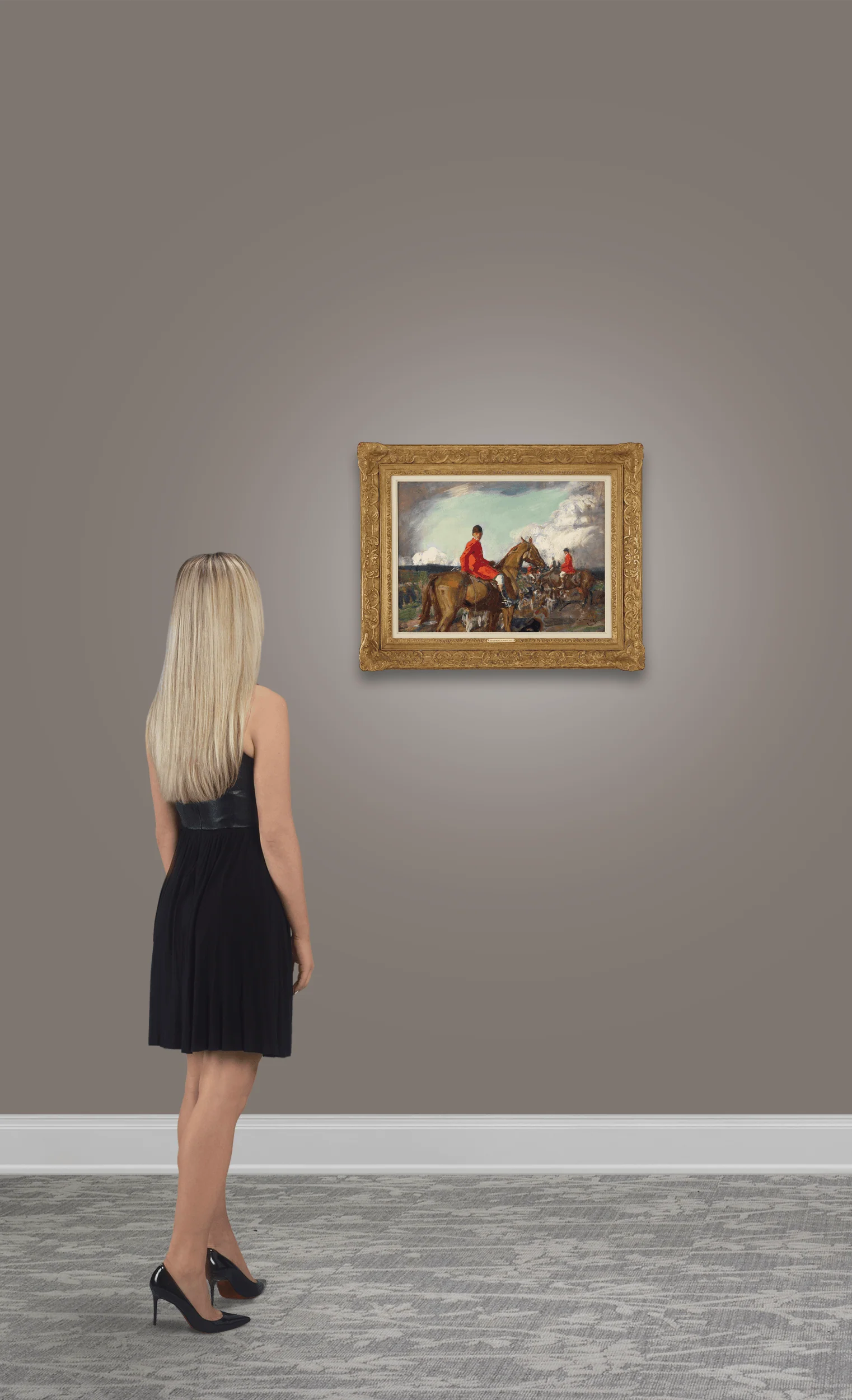
Board: 14 5/8" high x 20" wide (37.2 x 50.8 cm)
Frame: 22" high x 27 3/8" wide x 2" deep (55.9 x 69.5 x 5.2 cm)
Provenance:
Private collection, United States
MacConnal-Mason, London, 2000
Private collection, United Kingdom
M.S. Rau, New Orleans
1878-1959 | British
Hunting Scene
Signed “A J Munnings” (lower right)
Oil on board
The exciting atmosphere of the hunt is masterfully captured in this exceptional painting by Sir Alfred James Munnings—widely considered among the world’s greatest equine painters.
Hunting Scene is a superior example of Munnings’ unmatched gift for interpreting the spirit and power of the horse in his works. Here, scarlet-coated huntsmen are seated on their beautifully poised mounts, building the anticipation of a hunt about to begin. With bold brushwork and a vibrant palette, Munnings transformed this traditional sporting subject into an iconic image of vitality, pageantry and English country life.
Munnings, born and raised in the countryside of Suffolk, England, showed a talent for art at a young age. At 14, he became apprenticed to the lithography firm of Page Brothers, designing posters, and began studying painting at the Norwich School of Art at night. In 1899, he entered two works to the Royal Academy’s Summer Exhibition that were accepted with much acclaim. He soon gained favor for his captivating equine portraits, depicting these wondrous animals in a multitude of fashions, yet always staying true to their innate power, beauty and tender nature.
During World War I, Munnings also served the roles of war artist and horse processor in Canada, ensuring the safe and efficient delivery of military horses to the front in the latter position. He had spent his childhood surrounded by these majestic beasts and was well suited for this task. As a war artist, he executed drawings, watercolors and oils with the primary focus on the horse’s use both on the battlefield and behind the scenes. The Canadian War Records Exhibition at the Royal Academy after the war’s end included 45 of Munnings extraordinary paintings.
By the height of his career, Munnings was famous on both sides of the Atlantic, with patrons and friends that included Rothschilds, Astors, members of the royal family and Sir Winston Churchill. He went on to earn a knighthood and held the coveted position of President of the Royal Academy of Arts from 1944 to 1949. After his death in 1959, his home in Dedham was transformed into a museum dedicated entirely to his work. Other examples of Munnings' legendary equine paintings can be found in prestigious institutions worldwide, including the British Royal Collection, the Tate and the Yale Center for British Art.
Circa 1920
Board: 14 5/8" high x 20" wide (37.2 x 50.8 cm)
Frame: 22" high x 27 3/8" wide x 2" deep (55.9 x 69.5 x 5.2 cm)
Provenance:
Private collection, United States
MacConnal-Mason, London, 2000
Private collection, United Kingdom
M.S. Rau, New Orleans
$69,475.00
Original: $198,500.00
-65%Hunting Scene by Sir Alfred J. Munnings—
$198,500.00
$69,475.00More Images
Hunting Scene by Sir Alfred J. Munnings
Sir Alfred James Munnings
1878-1959 | British
Hunting Scene
Signed “A J Munnings” (lower right)
Oil on board
The exciting atmosphere of the hunt is masterfully captured in this exceptional painting by Sir Alfred James Munnings—widely considered among the world’s greatest equine painters.
Hunting Scene is a superior example of Munnings’ unmatched gift for interpreting the spirit and power of the horse in his works. Here, scarlet-coated huntsmen are seated on their beautifully poised mounts, building the anticipation of a hunt about to begin. With bold brushwork and a vibrant palette, Munnings transformed this traditional sporting subject into an iconic image of vitality, pageantry and English country life.
Munnings, born and raised in the countryside of Suffolk, England, showed a talent for art at a young age. At 14, he became apprenticed to the lithography firm of Page Brothers, designing posters, and began studying painting at the Norwich School of Art at night. In 1899, he entered two works to the Royal Academy’s Summer Exhibition that were accepted with much acclaim. He soon gained favor for his captivating equine portraits, depicting these wondrous animals in a multitude of fashions, yet always staying true to their innate power, beauty and tender nature.
During World War I, Munnings also served the roles of war artist and horse processor in Canada, ensuring the safe and efficient delivery of military horses to the front in the latter position. He had spent his childhood surrounded by these majestic beasts and was well suited for this task. As a war artist, he executed drawings, watercolors and oils with the primary focus on the horse’s use both on the battlefield and behind the scenes. The Canadian War Records Exhibition at the Royal Academy after the war’s end included 45 of Munnings extraordinary paintings.
By the height of his career, Munnings was famous on both sides of the Atlantic, with patrons and friends that included Rothschilds, Astors, members of the royal family and Sir Winston Churchill. He went on to earn a knighthood and held the coveted position of President of the Royal Academy of Arts from 1944 to 1949. After his death in 1959, his home in Dedham was transformed into a museum dedicated entirely to his work. Other examples of Munnings' legendary equine paintings can be found in prestigious institutions worldwide, including the British Royal Collection, the Tate and the Yale Center for British Art.
Circa 1920
Board: 14 5/8" high x 20" wide (37.2 x 50.8 cm)
Frame: 22" high x 27 3/8" wide x 2" deep (55.9 x 69.5 x 5.2 cm)
Provenance:
Private collection, United States
MacConnal-Mason, London, 2000
Private collection, United Kingdom
M.S. Rau, New Orleans
1878-1959 | British
Hunting Scene
Signed “A J Munnings” (lower right)
Oil on board
The exciting atmosphere of the hunt is masterfully captured in this exceptional painting by Sir Alfred James Munnings—widely considered among the world’s greatest equine painters.
Hunting Scene is a superior example of Munnings’ unmatched gift for interpreting the spirit and power of the horse in his works. Here, scarlet-coated huntsmen are seated on their beautifully poised mounts, building the anticipation of a hunt about to begin. With bold brushwork and a vibrant palette, Munnings transformed this traditional sporting subject into an iconic image of vitality, pageantry and English country life.
Munnings, born and raised in the countryside of Suffolk, England, showed a talent for art at a young age. At 14, he became apprenticed to the lithography firm of Page Brothers, designing posters, and began studying painting at the Norwich School of Art at night. In 1899, he entered two works to the Royal Academy’s Summer Exhibition that were accepted with much acclaim. He soon gained favor for his captivating equine portraits, depicting these wondrous animals in a multitude of fashions, yet always staying true to their innate power, beauty and tender nature.
During World War I, Munnings also served the roles of war artist and horse processor in Canada, ensuring the safe and efficient delivery of military horses to the front in the latter position. He had spent his childhood surrounded by these majestic beasts and was well suited for this task. As a war artist, he executed drawings, watercolors and oils with the primary focus on the horse’s use both on the battlefield and behind the scenes. The Canadian War Records Exhibition at the Royal Academy after the war’s end included 45 of Munnings extraordinary paintings.
By the height of his career, Munnings was famous on both sides of the Atlantic, with patrons and friends that included Rothschilds, Astors, members of the royal family and Sir Winston Churchill. He went on to earn a knighthood and held the coveted position of President of the Royal Academy of Arts from 1944 to 1949. After his death in 1959, his home in Dedham was transformed into a museum dedicated entirely to his work. Other examples of Munnings' legendary equine paintings can be found in prestigious institutions worldwide, including the British Royal Collection, the Tate and the Yale Center for British Art.
Circa 1920
Board: 14 5/8" high x 20" wide (37.2 x 50.8 cm)
Frame: 22" high x 27 3/8" wide x 2" deep (55.9 x 69.5 x 5.2 cm)
Provenance:
Private collection, United States
MacConnal-Mason, London, 2000
Private collection, United Kingdom
M.S. Rau, New Orleans
Product Information
Product Information
Shipping & Returns
Shipping & Returns
Description
Sir Alfred James Munnings
1878-1959 | British
Hunting Scene
Signed “A J Munnings” (lower right)
Oil on board
The exciting atmosphere of the hunt is masterfully captured in this exceptional painting by Sir Alfred James Munnings—widely considered among the world’s greatest equine painters.
Hunting Scene is a superior example of Munnings’ unmatched gift for interpreting the spirit and power of the horse in his works. Here, scarlet-coated huntsmen are seated on their beautifully poised mounts, building the anticipation of a hunt about to begin. With bold brushwork and a vibrant palette, Munnings transformed this traditional sporting subject into an iconic image of vitality, pageantry and English country life.
Munnings, born and raised in the countryside of Suffolk, England, showed a talent for art at a young age. At 14, he became apprenticed to the lithography firm of Page Brothers, designing posters, and began studying painting at the Norwich School of Art at night. In 1899, he entered two works to the Royal Academy’s Summer Exhibition that were accepted with much acclaim. He soon gained favor for his captivating equine portraits, depicting these wondrous animals in a multitude of fashions, yet always staying true to their innate power, beauty and tender nature.
During World War I, Munnings also served the roles of war artist and horse processor in Canada, ensuring the safe and efficient delivery of military horses to the front in the latter position. He had spent his childhood surrounded by these majestic beasts and was well suited for this task. As a war artist, he executed drawings, watercolors and oils with the primary focus on the horse’s use both on the battlefield and behind the scenes. The Canadian War Records Exhibition at the Royal Academy after the war’s end included 45 of Munnings extraordinary paintings.
By the height of his career, Munnings was famous on both sides of the Atlantic, with patrons and friends that included Rothschilds, Astors, members of the royal family and Sir Winston Churchill. He went on to earn a knighthood and held the coveted position of President of the Royal Academy of Arts from 1944 to 1949. After his death in 1959, his home in Dedham was transformed into a museum dedicated entirely to his work. Other examples of Munnings' legendary equine paintings can be found in prestigious institutions worldwide, including the British Royal Collection, the Tate and the Yale Center for British Art.
Circa 1920
Board: 14 5/8" high x 20" wide (37.2 x 50.8 cm)
Frame: 22" high x 27 3/8" wide x 2" deep (55.9 x 69.5 x 5.2 cm)
Provenance:
Private collection, United States
MacConnal-Mason, London, 2000
Private collection, United Kingdom
M.S. Rau, New Orleans
1878-1959 | British
Hunting Scene
Signed “A J Munnings” (lower right)
Oil on board
The exciting atmosphere of the hunt is masterfully captured in this exceptional painting by Sir Alfred James Munnings—widely considered among the world’s greatest equine painters.
Hunting Scene is a superior example of Munnings’ unmatched gift for interpreting the spirit and power of the horse in his works. Here, scarlet-coated huntsmen are seated on their beautifully poised mounts, building the anticipation of a hunt about to begin. With bold brushwork and a vibrant palette, Munnings transformed this traditional sporting subject into an iconic image of vitality, pageantry and English country life.
Munnings, born and raised in the countryside of Suffolk, England, showed a talent for art at a young age. At 14, he became apprenticed to the lithography firm of Page Brothers, designing posters, and began studying painting at the Norwich School of Art at night. In 1899, he entered two works to the Royal Academy’s Summer Exhibition that were accepted with much acclaim. He soon gained favor for his captivating equine portraits, depicting these wondrous animals in a multitude of fashions, yet always staying true to their innate power, beauty and tender nature.
During World War I, Munnings also served the roles of war artist and horse processor in Canada, ensuring the safe and efficient delivery of military horses to the front in the latter position. He had spent his childhood surrounded by these majestic beasts and was well suited for this task. As a war artist, he executed drawings, watercolors and oils with the primary focus on the horse’s use both on the battlefield and behind the scenes. The Canadian War Records Exhibition at the Royal Academy after the war’s end included 45 of Munnings extraordinary paintings.
By the height of his career, Munnings was famous on both sides of the Atlantic, with patrons and friends that included Rothschilds, Astors, members of the royal family and Sir Winston Churchill. He went on to earn a knighthood and held the coveted position of President of the Royal Academy of Arts from 1944 to 1949. After his death in 1959, his home in Dedham was transformed into a museum dedicated entirely to his work. Other examples of Munnings' legendary equine paintings can be found in prestigious institutions worldwide, including the British Royal Collection, the Tate and the Yale Center for British Art.
Circa 1920
Board: 14 5/8" high x 20" wide (37.2 x 50.8 cm)
Frame: 22" high x 27 3/8" wide x 2" deep (55.9 x 69.5 x 5.2 cm)
Provenance:
Private collection, United States
MacConnal-Mason, London, 2000
Private collection, United Kingdom
M.S. Rau, New Orleans