✨ New Arrivals Just Dropped!Explore

Griotte Rouge Vases attributed to Charles-Henri-Joseph Cordier
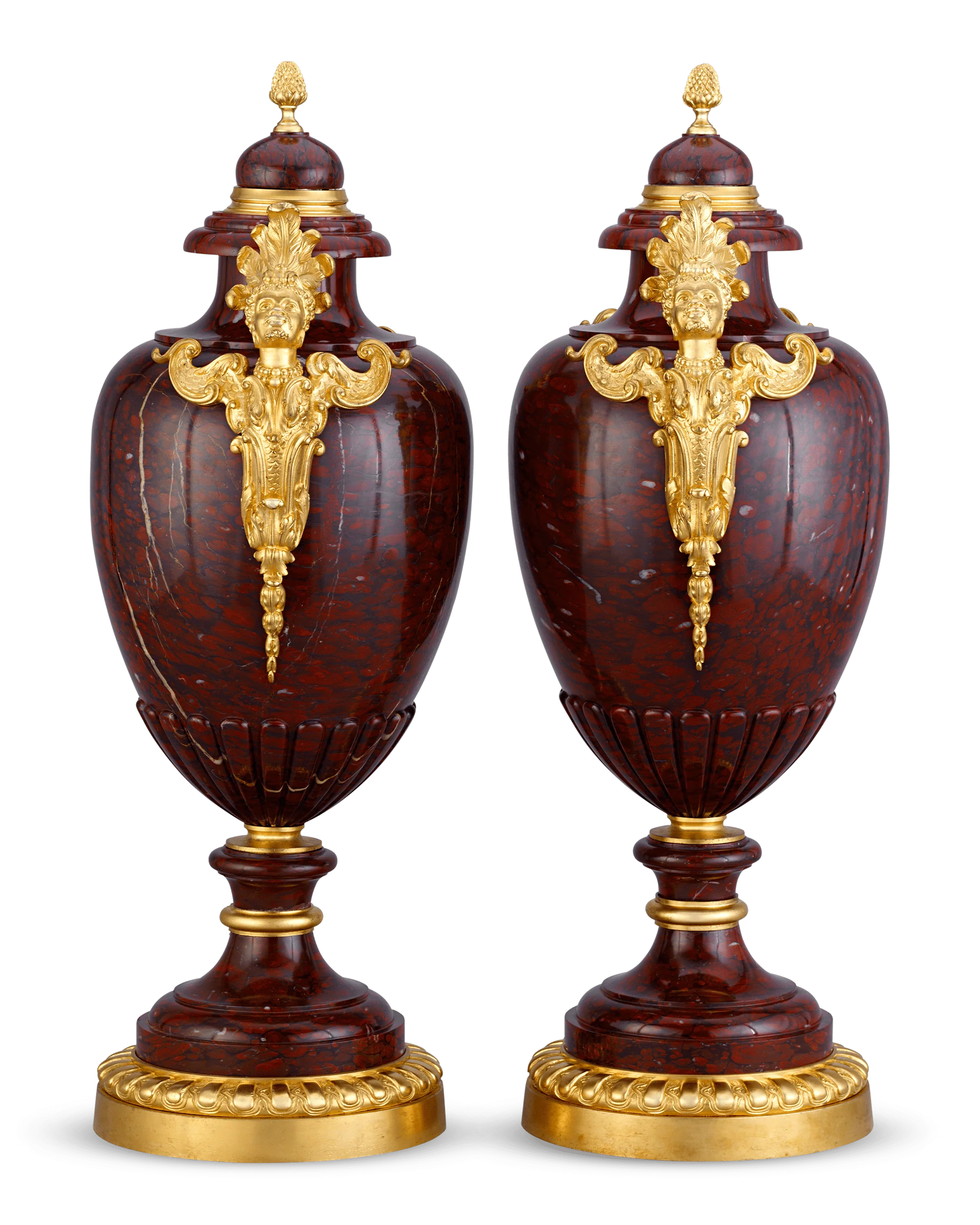
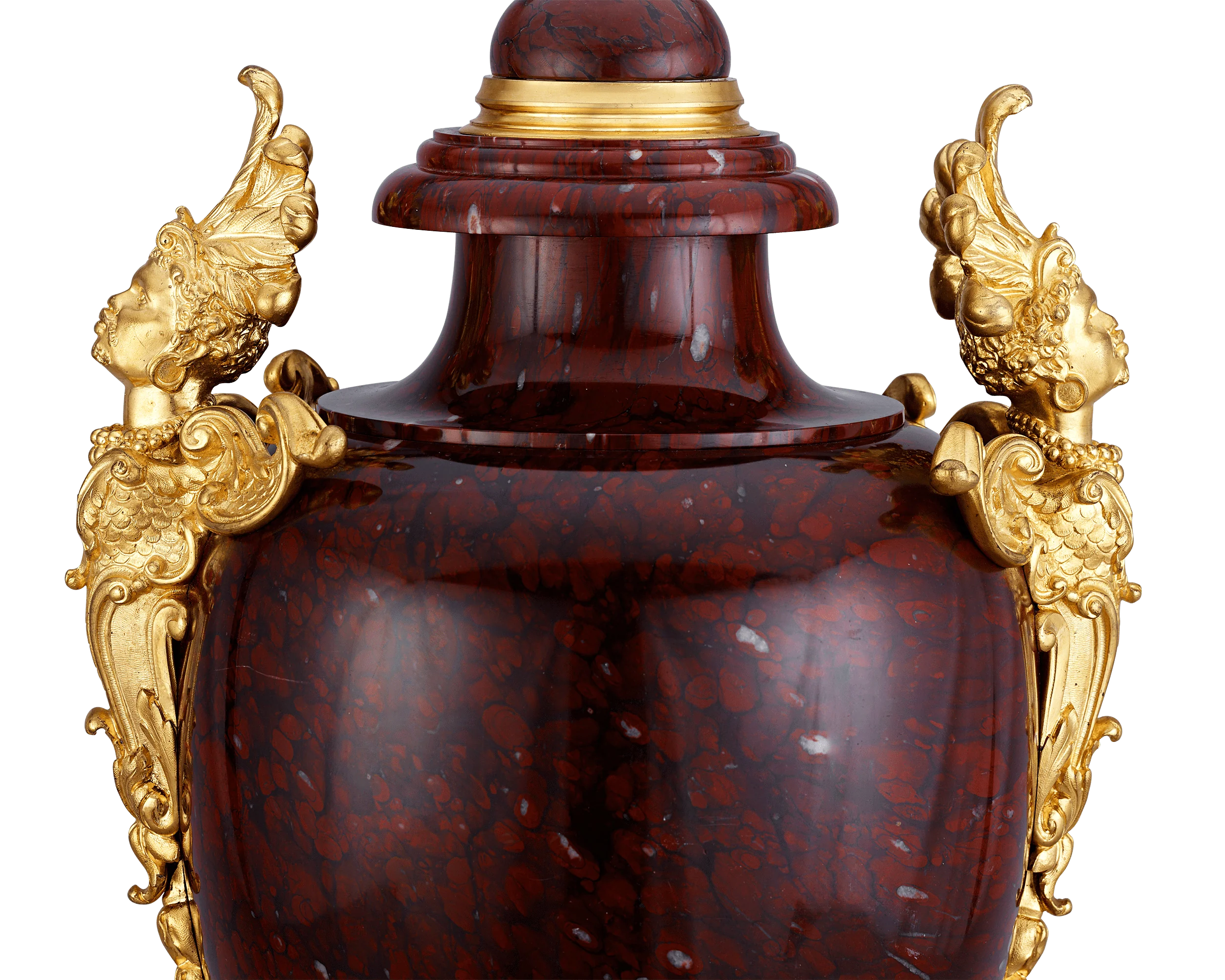
Fashioned of rare and precious griotte rouge marble and gilt bronze, these vases embody neoclassical elegance at its finest. Borrowing its forms and motifs derived from classical Roman and Greek antiquity, the gilt bronze contrasts beautifully with the griotte rouge marble, a material that has been highly prized for centuries. Each urn features two mounts depicting a resplendent African King in all his finery, sculpted without the intent of caricature. These superb urns show the influence and similarity to the work of the French master Charles-Henri-Joseph Cordier, a highly talented Parisian sculptor of the 19th century.
Griotte rouge marble gets its name from the morello cherry (griotte in French), which has a distinctively vivid red color. Louis XIV was especially fond of this color and ordered fireplaces made of this marble for the Palace of Versailles. Fireplaces in the Château de Fontainebleau, and the grand foyer of the Opéra Garnier in Paris are also crafted of griotte rouge marble. From the opulent color and rich veins running along the surface, it is clear why royalty preferred this marble in the 18th and 19th centuries.
Charles-Henri-Joseph Cordier was appointed the ethnographic sculptor to the Muséum national d’histoire naturelle in Paris in 1851, and established an international reputation for his warm renderings of different ethnicities. Originally inspired by Orientalists like Delacroix, his ethnographic interests led the sculptor to focus more intently on the costuming and posing of his non-European subjects. In 1862, Cordier is quoted as saying: "Beauty does not belong to a single, privileged race, I have promoted throughout the World of art the idea that beauty is everywhere. Every race has its own beauty, which differs from that of others."
Mid-19th century
26" high x 12 1/4" wide x 9" deep
Griotte rouge marble gets its name from the morello cherry (griotte in French), which has a distinctively vivid red color. Louis XIV was especially fond of this color and ordered fireplaces made of this marble for the Palace of Versailles. Fireplaces in the Château de Fontainebleau, and the grand foyer of the Opéra Garnier in Paris are also crafted of griotte rouge marble. From the opulent color and rich veins running along the surface, it is clear why royalty preferred this marble in the 18th and 19th centuries.
Charles-Henri-Joseph Cordier was appointed the ethnographic sculptor to the Muséum national d’histoire naturelle in Paris in 1851, and established an international reputation for his warm renderings of different ethnicities. Originally inspired by Orientalists like Delacroix, his ethnographic interests led the sculptor to focus more intently on the costuming and posing of his non-European subjects. In 1862, Cordier is quoted as saying: "Beauty does not belong to a single, privileged race, I have promoted throughout the World of art the idea that beauty is everywhere. Every race has its own beauty, which differs from that of others."
Mid-19th century
26" high x 12 1/4" wide x 9" deep
$15,575.00
Original: $44,500.00
-65%Griotte Rouge Vases attributed to Charles-Henri-Joseph Cordier—
$44,500.00
$15,575.00More Images


Griotte Rouge Vases attributed to Charles-Henri-Joseph Cordier
Fashioned of rare and precious griotte rouge marble and gilt bronze, these vases embody neoclassical elegance at its finest. Borrowing its forms and motifs derived from classical Roman and Greek antiquity, the gilt bronze contrasts beautifully with the griotte rouge marble, a material that has been highly prized for centuries. Each urn features two mounts depicting a resplendent African King in all his finery, sculpted without the intent of caricature. These superb urns show the influence and similarity to the work of the French master Charles-Henri-Joseph Cordier, a highly talented Parisian sculptor of the 19th century.
Griotte rouge marble gets its name from the morello cherry (griotte in French), which has a distinctively vivid red color. Louis XIV was especially fond of this color and ordered fireplaces made of this marble for the Palace of Versailles. Fireplaces in the Château de Fontainebleau, and the grand foyer of the Opéra Garnier in Paris are also crafted of griotte rouge marble. From the opulent color and rich veins running along the surface, it is clear why royalty preferred this marble in the 18th and 19th centuries.
Charles-Henri-Joseph Cordier was appointed the ethnographic sculptor to the Muséum national d’histoire naturelle in Paris in 1851, and established an international reputation for his warm renderings of different ethnicities. Originally inspired by Orientalists like Delacroix, his ethnographic interests led the sculptor to focus more intently on the costuming and posing of his non-European subjects. In 1862, Cordier is quoted as saying: "Beauty does not belong to a single, privileged race, I have promoted throughout the World of art the idea that beauty is everywhere. Every race has its own beauty, which differs from that of others."
Mid-19th century
26" high x 12 1/4" wide x 9" deep
Griotte rouge marble gets its name from the morello cherry (griotte in French), which has a distinctively vivid red color. Louis XIV was especially fond of this color and ordered fireplaces made of this marble for the Palace of Versailles. Fireplaces in the Château de Fontainebleau, and the grand foyer of the Opéra Garnier in Paris are also crafted of griotte rouge marble. From the opulent color and rich veins running along the surface, it is clear why royalty preferred this marble in the 18th and 19th centuries.
Charles-Henri-Joseph Cordier was appointed the ethnographic sculptor to the Muséum national d’histoire naturelle in Paris in 1851, and established an international reputation for his warm renderings of different ethnicities. Originally inspired by Orientalists like Delacroix, his ethnographic interests led the sculptor to focus more intently on the costuming and posing of his non-European subjects. In 1862, Cordier is quoted as saying: "Beauty does not belong to a single, privileged race, I have promoted throughout the World of art the idea that beauty is everywhere. Every race has its own beauty, which differs from that of others."
Mid-19th century
26" high x 12 1/4" wide x 9" deep
Product Information
Product Information
Shipping & Returns
Shipping & Returns
Description
Fashioned of rare and precious griotte rouge marble and gilt bronze, these vases embody neoclassical elegance at its finest. Borrowing its forms and motifs derived from classical Roman and Greek antiquity, the gilt bronze contrasts beautifully with the griotte rouge marble, a material that has been highly prized for centuries. Each urn features two mounts depicting a resplendent African King in all his finery, sculpted without the intent of caricature. These superb urns show the influence and similarity to the work of the French master Charles-Henri-Joseph Cordier, a highly talented Parisian sculptor of the 19th century.
Griotte rouge marble gets its name from the morello cherry (griotte in French), which has a distinctively vivid red color. Louis XIV was especially fond of this color and ordered fireplaces made of this marble for the Palace of Versailles. Fireplaces in the Château de Fontainebleau, and the grand foyer of the Opéra Garnier in Paris are also crafted of griotte rouge marble. From the opulent color and rich veins running along the surface, it is clear why royalty preferred this marble in the 18th and 19th centuries.
Charles-Henri-Joseph Cordier was appointed the ethnographic sculptor to the Muséum national d’histoire naturelle in Paris in 1851, and established an international reputation for his warm renderings of different ethnicities. Originally inspired by Orientalists like Delacroix, his ethnographic interests led the sculptor to focus more intently on the costuming and posing of his non-European subjects. In 1862, Cordier is quoted as saying: "Beauty does not belong to a single, privileged race, I have promoted throughout the World of art the idea that beauty is everywhere. Every race has its own beauty, which differs from that of others."
Mid-19th century
26" high x 12 1/4" wide x 9" deep
Griotte rouge marble gets its name from the morello cherry (griotte in French), which has a distinctively vivid red color. Louis XIV was especially fond of this color and ordered fireplaces made of this marble for the Palace of Versailles. Fireplaces in the Château de Fontainebleau, and the grand foyer of the Opéra Garnier in Paris are also crafted of griotte rouge marble. From the opulent color and rich veins running along the surface, it is clear why royalty preferred this marble in the 18th and 19th centuries.
Charles-Henri-Joseph Cordier was appointed the ethnographic sculptor to the Muséum national d’histoire naturelle in Paris in 1851, and established an international reputation for his warm renderings of different ethnicities. Originally inspired by Orientalists like Delacroix, his ethnographic interests led the sculptor to focus more intently on the costuming and posing of his non-European subjects. In 1862, Cordier is quoted as saying: "Beauty does not belong to a single, privileged race, I have promoted throughout the World of art the idea that beauty is everywhere. Every race has its own beauty, which differs from that of others."
Mid-19th century
26" high x 12 1/4" wide x 9" deep