✨ New Arrivals Just Dropped!Explore
French Dueling Pistols by Deboubert
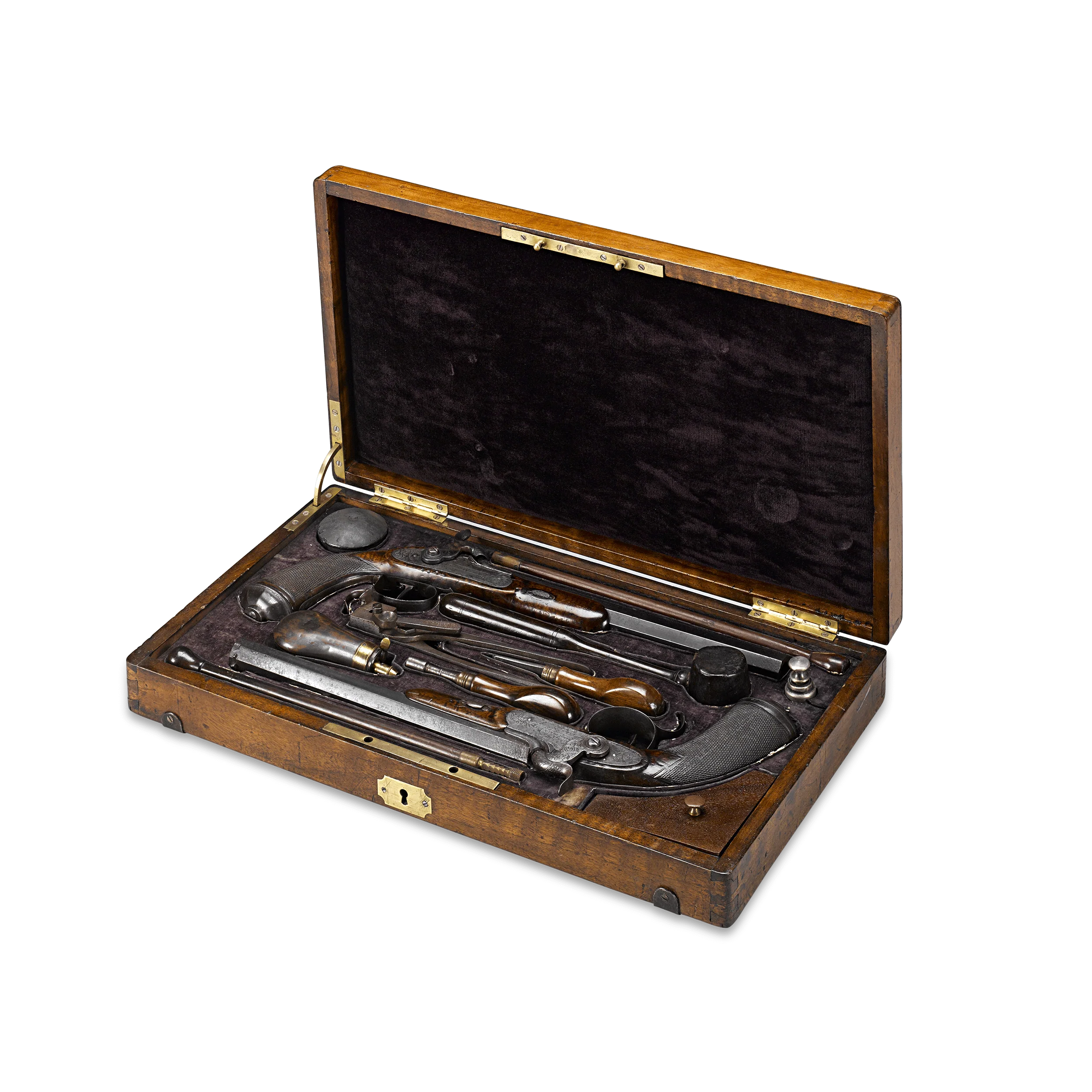
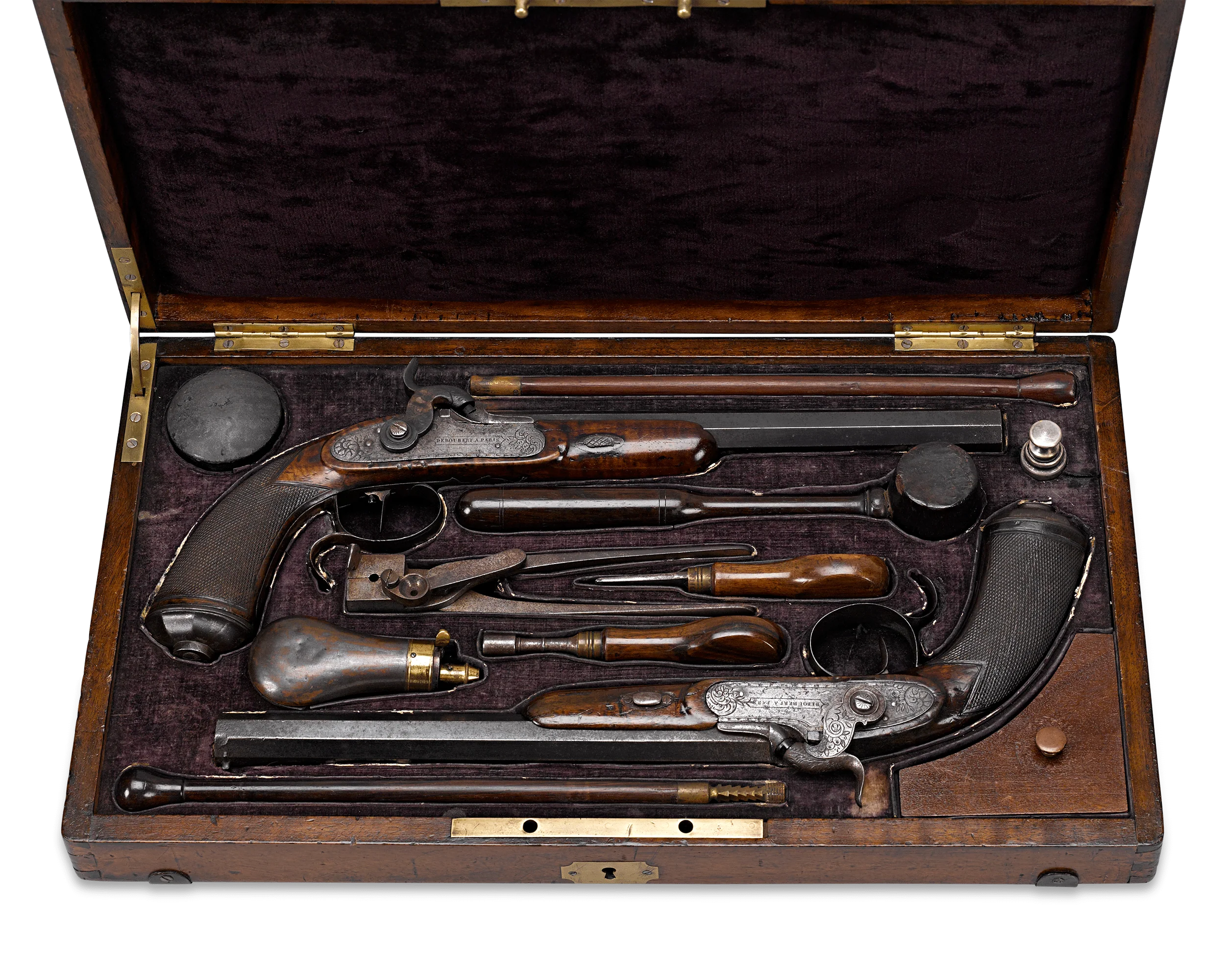
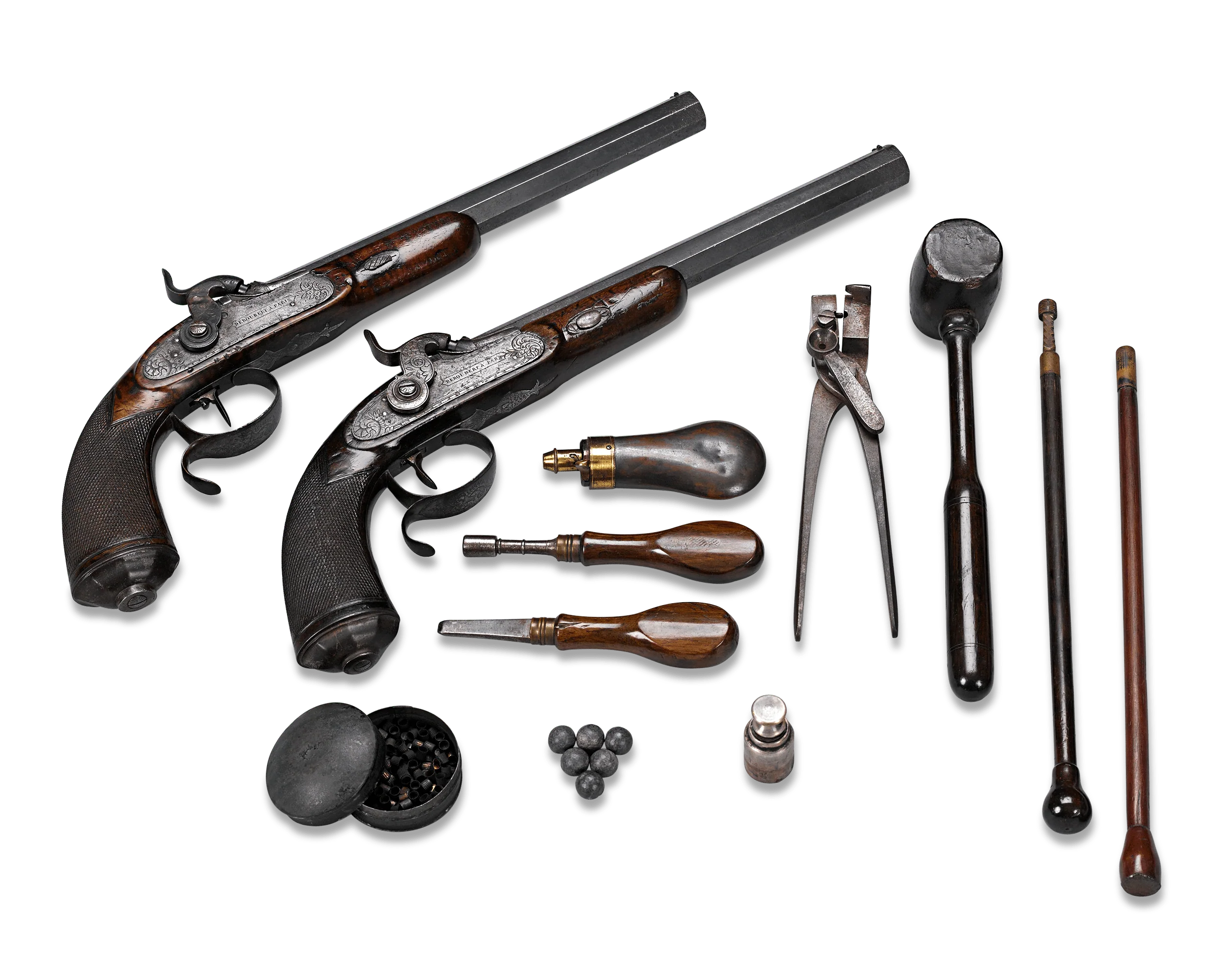
This handsome pair of .45-caliber percussion cap pistols, complete in their original case, was crafted by Deboubert of Paris. The octagonal muzzles are rifled with eight grooves, giving an accurate and lethal edge to these genteel weapons. Positioned in their fitted, velvet-lined case and with their accompanying accessories, these pistols are of exceptional quality and condition. Accouterments housed in the case include a mallet, cap box, ball box, cleaning rods, screw drive/nipple wrench, flask and bullet mold. The mechanism on each pistol is engraved “DEBOUBERT A PARIS.”
In the 1770s, gunsmiths, chiefly in England and France, began to produce purpose-built dueling pistols. These were usually made as "cased pairs" with two identical pistols in a box with powder flasks, bullet molds and other accessories. Many pistols were made with the flintlock mechanism, but this system had some deficiencies, including a vulnerability to weather and a significant delay between the trigger pull and actual firing of the gun. By 1815, gunsmiths were switching to the percussion-cap system, which proved to be much more reliable and less prone to misfire.
Dueling was a privilege of the upper class. Gentlemen were expected to defend their honor and duels were conducted with exquisite politeness. Dueling developed in southern France during the Renaissance and flourished in Europe and North America in the 18th century. In the mid-1700s, the traditional dueling weapon, the sword, fell out of fashion in favor of the pistol. There were detailed guidelines for the conducting of duels, the most notable being the Rules and Articles of War, which governed not only how countries would interact when in conflict, but also an officer's behavior. Not behaving as a gentleman meant a loss of social standing.
Circa 1830
Pistols: 16” length
Case: 18 7/8” wide x 10 1/2” deep x 3 1/8” high
In the 1770s, gunsmiths, chiefly in England and France, began to produce purpose-built dueling pistols. These were usually made as "cased pairs" with two identical pistols in a box with powder flasks, bullet molds and other accessories. Many pistols were made with the flintlock mechanism, but this system had some deficiencies, including a vulnerability to weather and a significant delay between the trigger pull and actual firing of the gun. By 1815, gunsmiths were switching to the percussion-cap system, which proved to be much more reliable and less prone to misfire.
Dueling was a privilege of the upper class. Gentlemen were expected to defend their honor and duels were conducted with exquisite politeness. Dueling developed in southern France during the Renaissance and flourished in Europe and North America in the 18th century. In the mid-1700s, the traditional dueling weapon, the sword, fell out of fashion in favor of the pistol. There were detailed guidelines for the conducting of duels, the most notable being the Rules and Articles of War, which governed not only how countries would interact when in conflict, but also an officer's behavior. Not behaving as a gentleman meant a loss of social standing.
Circa 1830
Pistols: 16” length
Case: 18 7/8” wide x 10 1/2” deep x 3 1/8” high
$13,947.50
Original: $39,850.00
-65%French Dueling Pistols by Deboubert—
$39,850.00
$13,947.50More Images


French Dueling Pistols by Deboubert
This handsome pair of .45-caliber percussion cap pistols, complete in their original case, was crafted by Deboubert of Paris. The octagonal muzzles are rifled with eight grooves, giving an accurate and lethal edge to these genteel weapons. Positioned in their fitted, velvet-lined case and with their accompanying accessories, these pistols are of exceptional quality and condition. Accouterments housed in the case include a mallet, cap box, ball box, cleaning rods, screw drive/nipple wrench, flask and bullet mold. The mechanism on each pistol is engraved “DEBOUBERT A PARIS.”
In the 1770s, gunsmiths, chiefly in England and France, began to produce purpose-built dueling pistols. These were usually made as "cased pairs" with two identical pistols in a box with powder flasks, bullet molds and other accessories. Many pistols were made with the flintlock mechanism, but this system had some deficiencies, including a vulnerability to weather and a significant delay between the trigger pull and actual firing of the gun. By 1815, gunsmiths were switching to the percussion-cap system, which proved to be much more reliable and less prone to misfire.
Dueling was a privilege of the upper class. Gentlemen were expected to defend their honor and duels were conducted with exquisite politeness. Dueling developed in southern France during the Renaissance and flourished in Europe and North America in the 18th century. In the mid-1700s, the traditional dueling weapon, the sword, fell out of fashion in favor of the pistol. There were detailed guidelines for the conducting of duels, the most notable being the Rules and Articles of War, which governed not only how countries would interact when in conflict, but also an officer's behavior. Not behaving as a gentleman meant a loss of social standing.
Circa 1830
Pistols: 16” length
Case: 18 7/8” wide x 10 1/2” deep x 3 1/8” high
In the 1770s, gunsmiths, chiefly in England and France, began to produce purpose-built dueling pistols. These were usually made as "cased pairs" with two identical pistols in a box with powder flasks, bullet molds and other accessories. Many pistols were made with the flintlock mechanism, but this system had some deficiencies, including a vulnerability to weather and a significant delay between the trigger pull and actual firing of the gun. By 1815, gunsmiths were switching to the percussion-cap system, which proved to be much more reliable and less prone to misfire.
Dueling was a privilege of the upper class. Gentlemen were expected to defend their honor and duels were conducted with exquisite politeness. Dueling developed in southern France during the Renaissance and flourished in Europe and North America in the 18th century. In the mid-1700s, the traditional dueling weapon, the sword, fell out of fashion in favor of the pistol. There were detailed guidelines for the conducting of duels, the most notable being the Rules and Articles of War, which governed not only how countries would interact when in conflict, but also an officer's behavior. Not behaving as a gentleman meant a loss of social standing.
Circa 1830
Pistols: 16” length
Case: 18 7/8” wide x 10 1/2” deep x 3 1/8” high
Product Information
Product Information
Shipping & Returns
Shipping & Returns
Description
This handsome pair of .45-caliber percussion cap pistols, complete in their original case, was crafted by Deboubert of Paris. The octagonal muzzles are rifled with eight grooves, giving an accurate and lethal edge to these genteel weapons. Positioned in their fitted, velvet-lined case and with their accompanying accessories, these pistols are of exceptional quality and condition. Accouterments housed in the case include a mallet, cap box, ball box, cleaning rods, screw drive/nipple wrench, flask and bullet mold. The mechanism on each pistol is engraved “DEBOUBERT A PARIS.”
In the 1770s, gunsmiths, chiefly in England and France, began to produce purpose-built dueling pistols. These were usually made as "cased pairs" with two identical pistols in a box with powder flasks, bullet molds and other accessories. Many pistols were made with the flintlock mechanism, but this system had some deficiencies, including a vulnerability to weather and a significant delay between the trigger pull and actual firing of the gun. By 1815, gunsmiths were switching to the percussion-cap system, which proved to be much more reliable and less prone to misfire.
Dueling was a privilege of the upper class. Gentlemen were expected to defend their honor and duels were conducted with exquisite politeness. Dueling developed in southern France during the Renaissance and flourished in Europe and North America in the 18th century. In the mid-1700s, the traditional dueling weapon, the sword, fell out of fashion in favor of the pistol. There were detailed guidelines for the conducting of duels, the most notable being the Rules and Articles of War, which governed not only how countries would interact when in conflict, but also an officer's behavior. Not behaving as a gentleman meant a loss of social standing.
Circa 1830
Pistols: 16” length
Case: 18 7/8” wide x 10 1/2” deep x 3 1/8” high
In the 1770s, gunsmiths, chiefly in England and France, began to produce purpose-built dueling pistols. These were usually made as "cased pairs" with two identical pistols in a box with powder flasks, bullet molds and other accessories. Many pistols were made with the flintlock mechanism, but this system had some deficiencies, including a vulnerability to weather and a significant delay between the trigger pull and actual firing of the gun. By 1815, gunsmiths were switching to the percussion-cap system, which proved to be much more reliable and less prone to misfire.
Dueling was a privilege of the upper class. Gentlemen were expected to defend their honor and duels were conducted with exquisite politeness. Dueling developed in southern France during the Renaissance and flourished in Europe and North America in the 18th century. In the mid-1700s, the traditional dueling weapon, the sword, fell out of fashion in favor of the pistol. There were detailed guidelines for the conducting of duels, the most notable being the Rules and Articles of War, which governed not only how countries would interact when in conflict, but also an officer's behavior. Not behaving as a gentleman meant a loss of social standing.
Circa 1830
Pistols: 16” length
Case: 18 7/8” wide x 10 1/2” deep x 3 1/8” high