✨ New Arrivals Just Dropped!Explore

Exhibition Model of Expanding Table by Samuel Hawkins
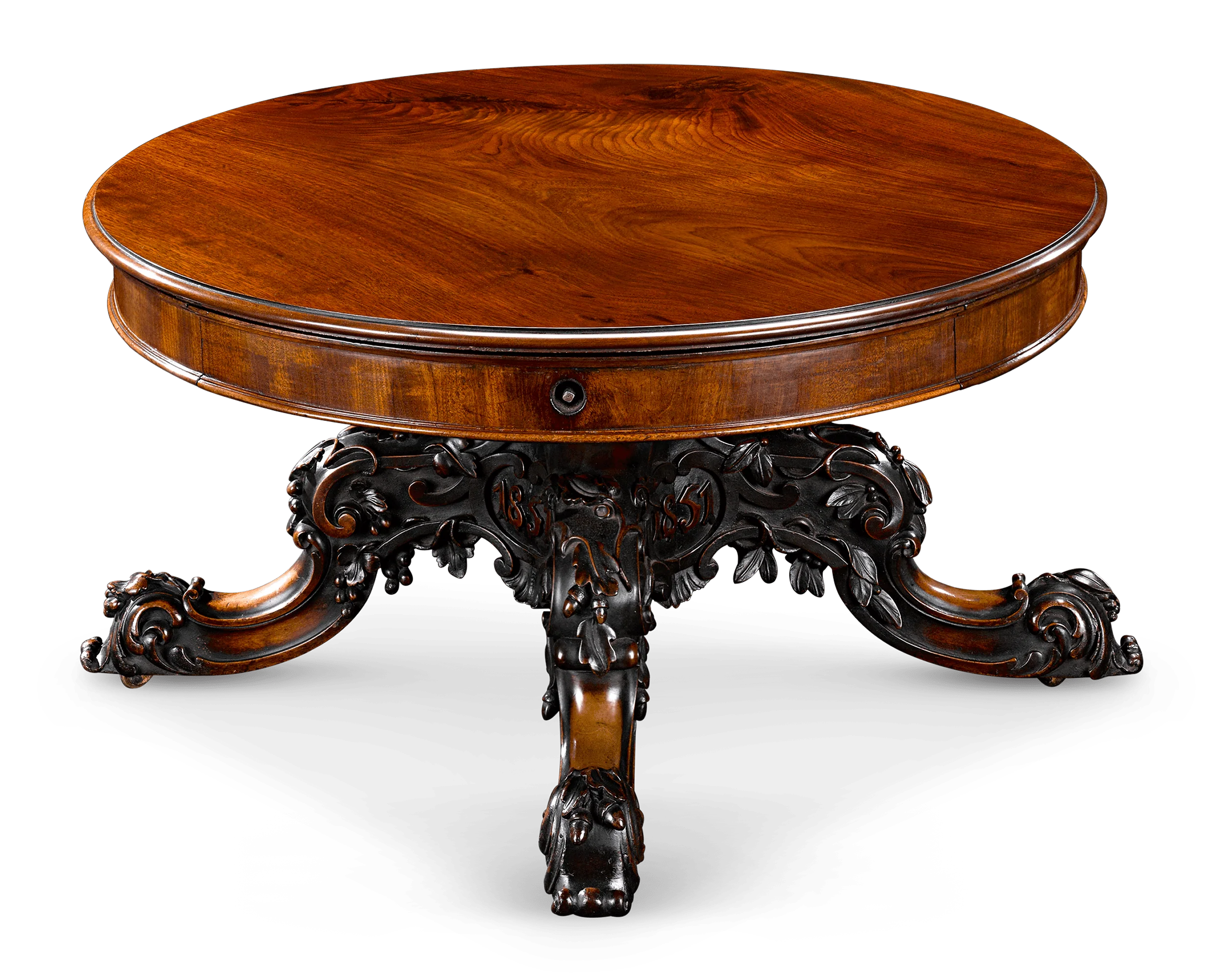
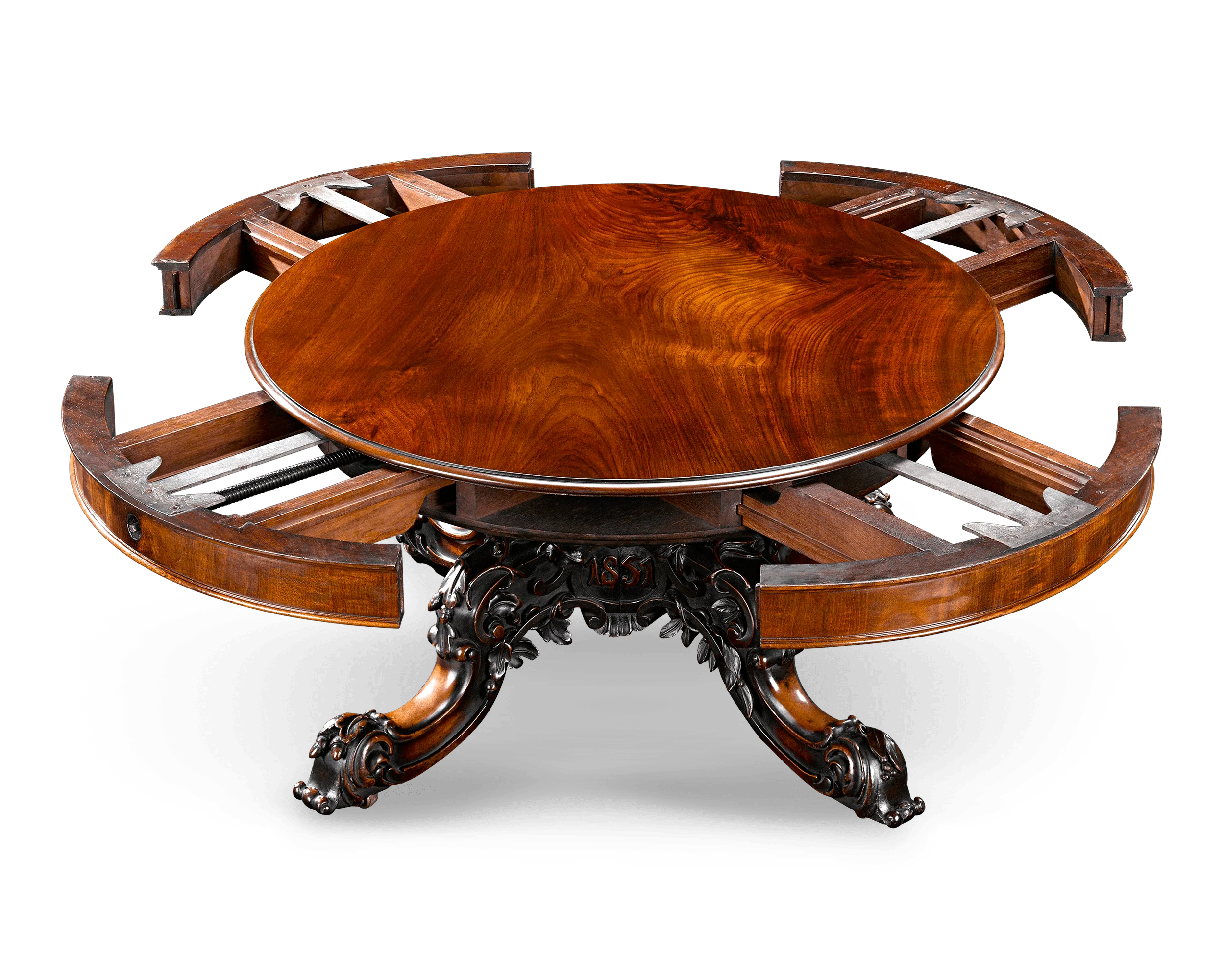
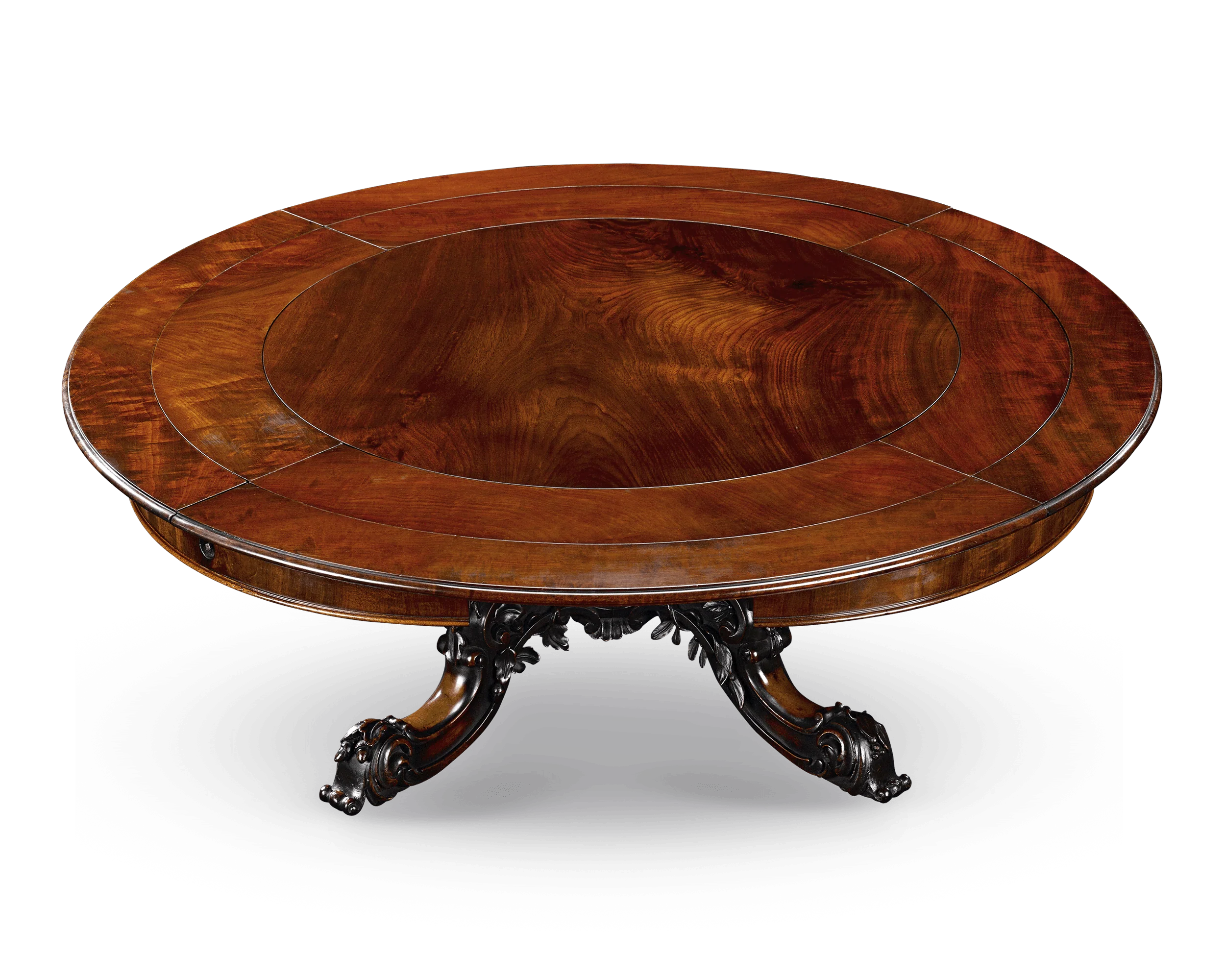
A masterpiece of both cabinetmaking and mechanical engineering, this one-of-a-kind expanding table was crafted by the renowned cabinetmaker Samuel Hawkins of London for the Great Exhibition of 1851. Diminutive in size, the fascinating table was designed as a model to demonstrate Hawkins’ innovative patent screw movement to visitors of the Exhibition – six million people in total over five months. It was exhibited again a century later at the Victoria & Albert Museum during the Festival of Britain, an event intended “to symbolise two main qualities of the national character: realism and strength on the one hand, and, on the other, independence and imagination” (Catalogue of the Exhibition, 1951, p.117). To this day, the miniature masterpiece demonstrates the quest of English furniture makers to combine technical innovation with superb craftsmanship.
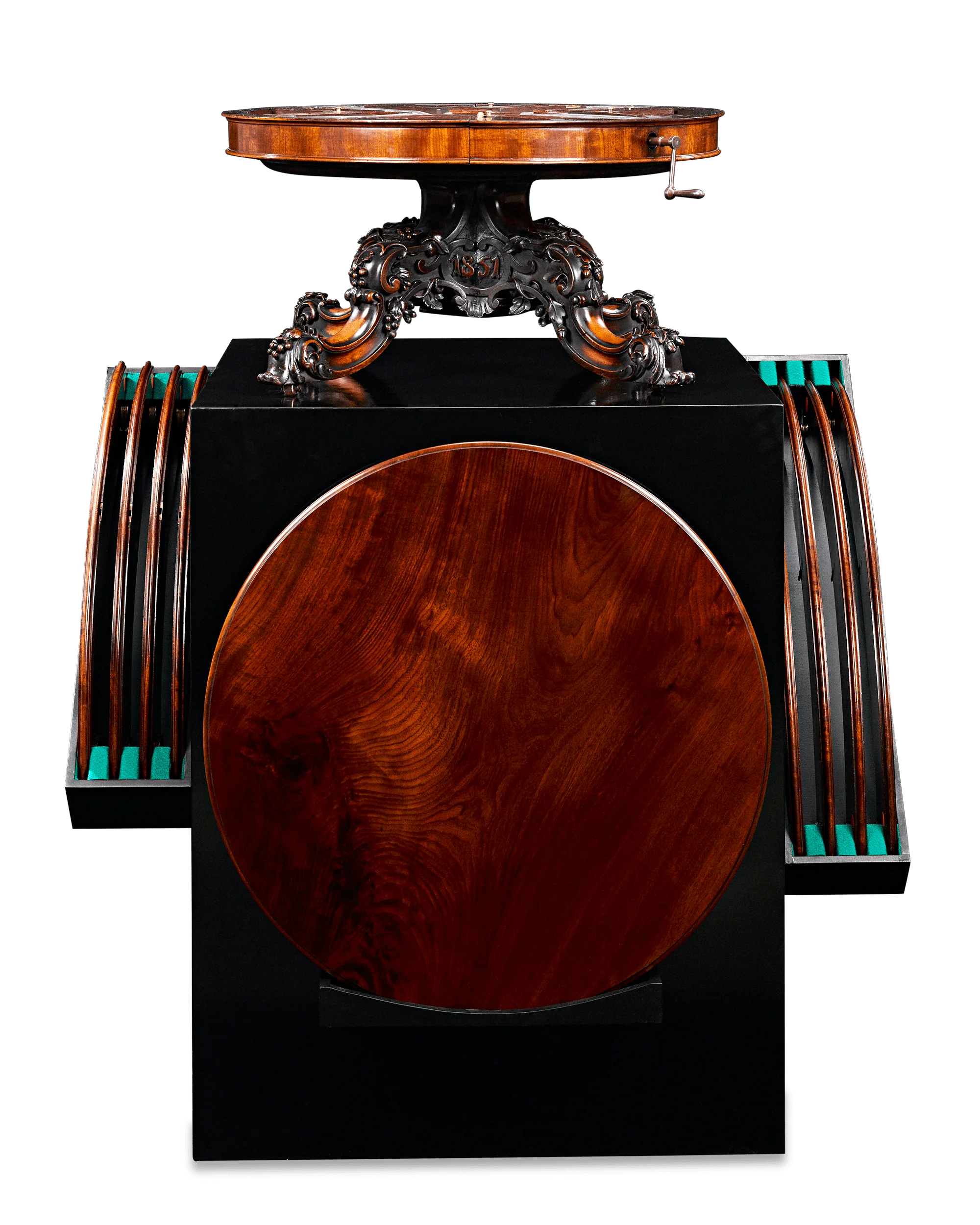
Displaying exceptional ingenuity, Hawkins’ wind-out screw mechanism allowed one to extend the table’s base to accommodate concentric leaves with the simple crank of a handle. It is based on the inventive expanding table originally designed by Robert Jupe in 1835, which used a swivel mechanism to separate sections of the tabletop and allow for segmented leaves to be inserted. Hawkins’ tabletop, on the other hand, extends outwards directly from the center in order to accommodate additional leaves around its diameter. This unique design allowed the mechanism to also smoothly operate on rectangular tables, which could be wound out from the middle to allow for more table space.
Hawkins was not alone in his endeavor to combine the technical merits of engineering and mechanics with the most artful pursuit of cabinetmaking. The first half of the 19th century saw a prolific increase in the popularity of applying new ideas to traditional furniture principles, which allowed furniture to serve many purposes. The resulting “patent” furniture was practical and refined, though few were as innovative as Hawkins’ prodigious design.
Carved with the year of the Exhibition on the beautifully designed pedestal base, the table is a testament to the significance of this innovation. The model is mentioned in detail in the catalog of the Great Exhibition of 1851, the first international exhibition of industry, manufacturing, and science. Held at London’s dazzling Crystal Palace, its visitors were treated to exhibits from around the globe, including feats of engineering, innovations in industry, and marvels of design. Queen Victoria herself was a frequent visitor, along with her husband, Prince Albert, and others including Charlotte Brontë, Lewis Carroll, Charles Darwin, Alfred Tennyson and Charles Dickens.
Pieces such as this that were made specifically for this seminal exhibition are among the most valuable to be found. Before the age of modern advertising, international exhibitions were the sole opportunity for craftsmen and inventors to market their wares to a mass audience. Thus, each piece was masterfully designed and painstakingly crafted down to the smallest detail, in the hopes that it would make a lasting impression on critics and attendees alike. Without question, this expanding table displays the finest craftsmanship and artistry, and is an unparalleled specimen of English ingenuity and original design.
The table's mechanism is illustrated and described in great detail in the Official Descriptive & Illustrated Catalogue of the Great Exhibition of 1851.
Circa 1851
13” high x 24” diameter
Displaying exceptional ingenuity, Hawkins’ wind-out screw mechanism allowed one to extend the table’s base to accommodate concentric leaves with the simple crank of a handle. It is based on the inventive expanding table originally designed by Robert Jupe in 1835, which used a swivel mechanism to separate sections of the tabletop and allow for segmented leaves to be inserted. Hawkins’ tabletop, on the other hand, extends outwards directly from the center in order to accommodate additional leaves around its diameter. This unique design allowed the mechanism to also smoothly operate on rectangular tables, which could be wound out from the middle to allow for more table space.
Hawkins was not alone in his endeavor to combine the technical merits of engineering and mechanics with the most artful pursuit of cabinetmaking. The first half of the 19th century saw a prolific increase in the popularity of applying new ideas to traditional furniture principles, which allowed furniture to serve many purposes. The resulting “patent” furniture was practical and refined, though few were as innovative as Hawkins’ prodigious design.
Carved with the year of the Exhibition on the beautifully designed pedestal base, the table is a testament to the significance of this innovation. The model is mentioned in detail in the catalog of the Great Exhibition of 1851, the first international exhibition of industry, manufacturing, and science. Held at London’s dazzling Crystal Palace, its visitors were treated to exhibits from around the globe, including feats of engineering, innovations in industry, and marvels of design. Queen Victoria herself was a frequent visitor, along with her husband, Prince Albert, and others including Charlotte Brontë, Lewis Carroll, Charles Darwin, Alfred Tennyson and Charles Dickens.
Pieces such as this that were made specifically for this seminal exhibition are among the most valuable to be found. Before the age of modern advertising, international exhibitions were the sole opportunity for craftsmen and inventors to market their wares to a mass audience. Thus, each piece was masterfully designed and painstakingly crafted down to the smallest detail, in the hopes that it would make a lasting impression on critics and attendees alike. Without question, this expanding table displays the finest craftsmanship and artistry, and is an unparalleled specimen of English ingenuity and original design.
The table's mechanism is illustrated and described in great detail in the Official Descriptive & Illustrated Catalogue of the Great Exhibition of 1851.
Circa 1851
13” high x 24” diameter
$27,475.00
Original: $78,500.00
-65%Exhibition Model of Expanding Table by Samuel Hawkins—
$78,500.00
$27,475.00More Images



Exhibition Model of Expanding Table by Samuel Hawkins
A masterpiece of both cabinetmaking and mechanical engineering, this one-of-a-kind expanding table was crafted by the renowned cabinetmaker Samuel Hawkins of London for the Great Exhibition of 1851. Diminutive in size, the fascinating table was designed as a model to demonstrate Hawkins’ innovative patent screw movement to visitors of the Exhibition – six million people in total over five months. It was exhibited again a century later at the Victoria & Albert Museum during the Festival of Britain, an event intended “to symbolise two main qualities of the national character: realism and strength on the one hand, and, on the other, independence and imagination” (Catalogue of the Exhibition, 1951, p.117). To this day, the miniature masterpiece demonstrates the quest of English furniture makers to combine technical innovation with superb craftsmanship.
Displaying exceptional ingenuity, Hawkins’ wind-out screw mechanism allowed one to extend the table’s base to accommodate concentric leaves with the simple crank of a handle. It is based on the inventive expanding table originally designed by Robert Jupe in 1835, which used a swivel mechanism to separate sections of the tabletop and allow for segmented leaves to be inserted. Hawkins’ tabletop, on the other hand, extends outwards directly from the center in order to accommodate additional leaves around its diameter. This unique design allowed the mechanism to also smoothly operate on rectangular tables, which could be wound out from the middle to allow for more table space.
Hawkins was not alone in his endeavor to combine the technical merits of engineering and mechanics with the most artful pursuit of cabinetmaking. The first half of the 19th century saw a prolific increase in the popularity of applying new ideas to traditional furniture principles, which allowed furniture to serve many purposes. The resulting “patent” furniture was practical and refined, though few were as innovative as Hawkins’ prodigious design.
Carved with the year of the Exhibition on the beautifully designed pedestal base, the table is a testament to the significance of this innovation. The model is mentioned in detail in the catalog of the Great Exhibition of 1851, the first international exhibition of industry, manufacturing, and science. Held at London’s dazzling Crystal Palace, its visitors were treated to exhibits from around the globe, including feats of engineering, innovations in industry, and marvels of design. Queen Victoria herself was a frequent visitor, along with her husband, Prince Albert, and others including Charlotte Brontë, Lewis Carroll, Charles Darwin, Alfred Tennyson and Charles Dickens.
Pieces such as this that were made specifically for this seminal exhibition are among the most valuable to be found. Before the age of modern advertising, international exhibitions were the sole opportunity for craftsmen and inventors to market their wares to a mass audience. Thus, each piece was masterfully designed and painstakingly crafted down to the smallest detail, in the hopes that it would make a lasting impression on critics and attendees alike. Without question, this expanding table displays the finest craftsmanship and artistry, and is an unparalleled specimen of English ingenuity and original design.
The table's mechanism is illustrated and described in great detail in the Official Descriptive & Illustrated Catalogue of the Great Exhibition of 1851.
Circa 1851
13” high x 24” diameter
Displaying exceptional ingenuity, Hawkins’ wind-out screw mechanism allowed one to extend the table’s base to accommodate concentric leaves with the simple crank of a handle. It is based on the inventive expanding table originally designed by Robert Jupe in 1835, which used a swivel mechanism to separate sections of the tabletop and allow for segmented leaves to be inserted. Hawkins’ tabletop, on the other hand, extends outwards directly from the center in order to accommodate additional leaves around its diameter. This unique design allowed the mechanism to also smoothly operate on rectangular tables, which could be wound out from the middle to allow for more table space.
Hawkins was not alone in his endeavor to combine the technical merits of engineering and mechanics with the most artful pursuit of cabinetmaking. The first half of the 19th century saw a prolific increase in the popularity of applying new ideas to traditional furniture principles, which allowed furniture to serve many purposes. The resulting “patent” furniture was practical and refined, though few were as innovative as Hawkins’ prodigious design.
Carved with the year of the Exhibition on the beautifully designed pedestal base, the table is a testament to the significance of this innovation. The model is mentioned in detail in the catalog of the Great Exhibition of 1851, the first international exhibition of industry, manufacturing, and science. Held at London’s dazzling Crystal Palace, its visitors were treated to exhibits from around the globe, including feats of engineering, innovations in industry, and marvels of design. Queen Victoria herself was a frequent visitor, along with her husband, Prince Albert, and others including Charlotte Brontë, Lewis Carroll, Charles Darwin, Alfred Tennyson and Charles Dickens.
Pieces such as this that were made specifically for this seminal exhibition are among the most valuable to be found. Before the age of modern advertising, international exhibitions were the sole opportunity for craftsmen and inventors to market their wares to a mass audience. Thus, each piece was masterfully designed and painstakingly crafted down to the smallest detail, in the hopes that it would make a lasting impression on critics and attendees alike. Without question, this expanding table displays the finest craftsmanship and artistry, and is an unparalleled specimen of English ingenuity and original design.
The table's mechanism is illustrated and described in great detail in the Official Descriptive & Illustrated Catalogue of the Great Exhibition of 1851.
Circa 1851
13” high x 24” diameter
Product Information
Product Information
Shipping & Returns
Shipping & Returns
Description
A masterpiece of both cabinetmaking and mechanical engineering, this one-of-a-kind expanding table was crafted by the renowned cabinetmaker Samuel Hawkins of London for the Great Exhibition of 1851. Diminutive in size, the fascinating table was designed as a model to demonstrate Hawkins’ innovative patent screw movement to visitors of the Exhibition – six million people in total over five months. It was exhibited again a century later at the Victoria & Albert Museum during the Festival of Britain, an event intended “to symbolise two main qualities of the national character: realism and strength on the one hand, and, on the other, independence and imagination” (Catalogue of the Exhibition, 1951, p.117). To this day, the miniature masterpiece demonstrates the quest of English furniture makers to combine technical innovation with superb craftsmanship.
Displaying exceptional ingenuity, Hawkins’ wind-out screw mechanism allowed one to extend the table’s base to accommodate concentric leaves with the simple crank of a handle. It is based on the inventive expanding table originally designed by Robert Jupe in 1835, which used a swivel mechanism to separate sections of the tabletop and allow for segmented leaves to be inserted. Hawkins’ tabletop, on the other hand, extends outwards directly from the center in order to accommodate additional leaves around its diameter. This unique design allowed the mechanism to also smoothly operate on rectangular tables, which could be wound out from the middle to allow for more table space.
Hawkins was not alone in his endeavor to combine the technical merits of engineering and mechanics with the most artful pursuit of cabinetmaking. The first half of the 19th century saw a prolific increase in the popularity of applying new ideas to traditional furniture principles, which allowed furniture to serve many purposes. The resulting “patent” furniture was practical and refined, though few were as innovative as Hawkins’ prodigious design.
Carved with the year of the Exhibition on the beautifully designed pedestal base, the table is a testament to the significance of this innovation. The model is mentioned in detail in the catalog of the Great Exhibition of 1851, the first international exhibition of industry, manufacturing, and science. Held at London’s dazzling Crystal Palace, its visitors were treated to exhibits from around the globe, including feats of engineering, innovations in industry, and marvels of design. Queen Victoria herself was a frequent visitor, along with her husband, Prince Albert, and others including Charlotte Brontë, Lewis Carroll, Charles Darwin, Alfred Tennyson and Charles Dickens.
Pieces such as this that were made specifically for this seminal exhibition are among the most valuable to be found. Before the age of modern advertising, international exhibitions were the sole opportunity for craftsmen and inventors to market their wares to a mass audience. Thus, each piece was masterfully designed and painstakingly crafted down to the smallest detail, in the hopes that it would make a lasting impression on critics and attendees alike. Without question, this expanding table displays the finest craftsmanship and artistry, and is an unparalleled specimen of English ingenuity and original design.
The table's mechanism is illustrated and described in great detail in the Official Descriptive & Illustrated Catalogue of the Great Exhibition of 1851.
Circa 1851
13” high x 24” diameter
Displaying exceptional ingenuity, Hawkins’ wind-out screw mechanism allowed one to extend the table’s base to accommodate concentric leaves with the simple crank of a handle. It is based on the inventive expanding table originally designed by Robert Jupe in 1835, which used a swivel mechanism to separate sections of the tabletop and allow for segmented leaves to be inserted. Hawkins’ tabletop, on the other hand, extends outwards directly from the center in order to accommodate additional leaves around its diameter. This unique design allowed the mechanism to also smoothly operate on rectangular tables, which could be wound out from the middle to allow for more table space.
Hawkins was not alone in his endeavor to combine the technical merits of engineering and mechanics with the most artful pursuit of cabinetmaking. The first half of the 19th century saw a prolific increase in the popularity of applying new ideas to traditional furniture principles, which allowed furniture to serve many purposes. The resulting “patent” furniture was practical and refined, though few were as innovative as Hawkins’ prodigious design.
Carved with the year of the Exhibition on the beautifully designed pedestal base, the table is a testament to the significance of this innovation. The model is mentioned in detail in the catalog of the Great Exhibition of 1851, the first international exhibition of industry, manufacturing, and science. Held at London’s dazzling Crystal Palace, its visitors were treated to exhibits from around the globe, including feats of engineering, innovations in industry, and marvels of design. Queen Victoria herself was a frequent visitor, along with her husband, Prince Albert, and others including Charlotte Brontë, Lewis Carroll, Charles Darwin, Alfred Tennyson and Charles Dickens.
Pieces such as this that were made specifically for this seminal exhibition are among the most valuable to be found. Before the age of modern advertising, international exhibitions were the sole opportunity for craftsmen and inventors to market their wares to a mass audience. Thus, each piece was masterfully designed and painstakingly crafted down to the smallest detail, in the hopes that it would make a lasting impression on critics and attendees alike. Without question, this expanding table displays the finest craftsmanship and artistry, and is an unparalleled specimen of English ingenuity and original design.
The table's mechanism is illustrated and described in great detail in the Official Descriptive & Illustrated Catalogue of the Great Exhibition of 1851.
Circa 1851
13” high x 24” diameter